Weekly Skincare Routine for Clear Skin in 2026: Skin Cycling Made Simple
Weekly skin cycling plan for clear skin in 2026: exfoliate, retinoid, recover, plus safe pairings, fixes, and FAQs.

Weekly Skincare Routine for Clear Skin in 2026 is not about doing more—it’s about doing the right things on the right nights, so your skin stays calm, strong, and breakout-resistant.
Medical note: This article is for general education. If you have severe, painful, or scarring acne, a chronic skin condition, or you’re pregnant/breastfeeding, check in with a dermatologist before starting strong active ingredients.
The 2026 shift: clear skin starts with a calm skin barrier
If you’ve ever said, “My skin is breaking out… so I’ll exfoliate harder,” you’re not alone. But in 2026, we know that overdoing it is one of the fastest ways to get stuck in the breakout–irritation loop.
Your skin barrier is your outer defense layer. When it’s healthy, it keeps water in and irritants out. When it’s stressed, almost anything can sting—cleansers feel tight, actives burn, and you may break out from products that used to be fine.
If you want the “why” in plain English, start here:
- What is the skin barrier?
- Signs of a damaged skin barrier
- How to avoid damaging the skin barrier
- Ceramides for skin barrier health
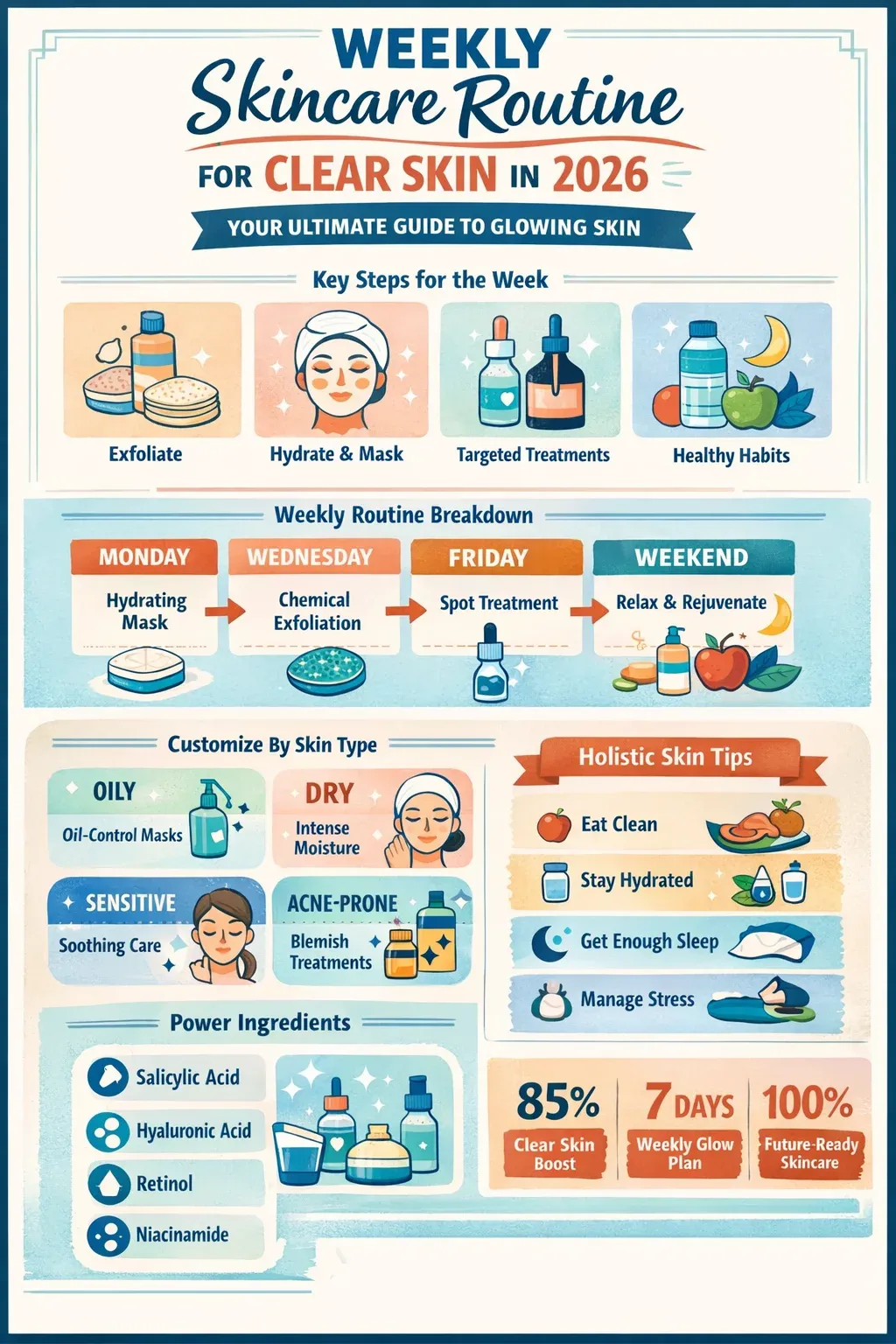
The big idea: a weekly routine should challenge your skin just enough to unclog pores and speed up turnover… then give it time to recover. That’s how you get clear skin without flaking, redness, or mystery bumps.
Key takeaways you can screenshot
- Clear skin comes from consistency + recovery, not daily “power treatments.”
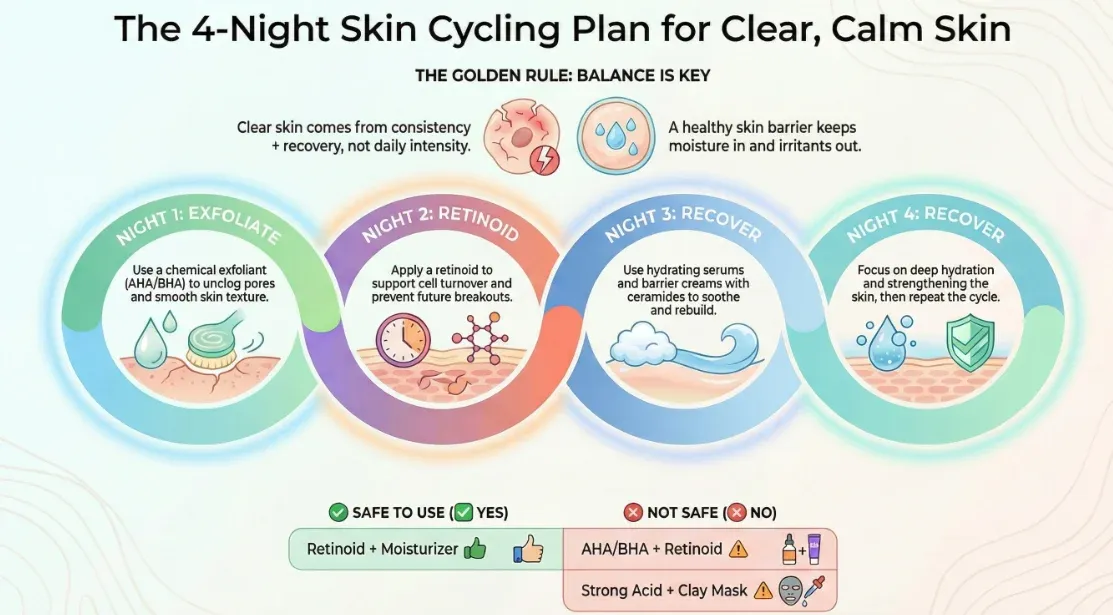
- Build your week around skin cycling: exfoliate → retinoid → recover → recover → repeat.
- “Extra steps” (masks, devices) go on recovery nights, not on your harshest nights.
- If your face feels hot, tight, or shiny in a weird way, pause actives and repair first.
Weekly Skincare Routine for Clear Skin in 2026: the 4-night skin cycling plan
Skin cycling is the simplest schedule that still delivers results. Instead of guessing what to do on Tuesday, you follow a repeatable pattern.
👉 List of recommended products
Affiliate Disclaimer: This post may contain affiliate links, which means I may receive a small commission if you make a purchase through my links, at no extra cost to you. I only recommend products I genuinely believe in and would use myself. Your support helps keep this blog running and allows me to continue creating free content to help you achieve your best skin. Thank you for supporting SkinOptimizer!
Here’s the cycle:
- Night 1: Exfoliate (unclog + smooth)
- Night 2: Retinoid (clear pores + support long-term texture)
- Night 3: Recover (soothe + rebuild barrier)
- Night 4: Recover (hydrate + strengthen)
Then repeat.
The full “what to do” blueprint (no fluff)
| Night | Goal | What you apply (simple order) | Best for | Skip if… |
|---|---|---|---|---|
| 1 — Exfoliate | Clear dead skin + unclog pores | Cleanse → exfoliant → moisturizer | Blackheads, clogged pores, rough texture | Skin is peeling, burning, or very red |
| 2 — Retinoid | Support turnover + prevent clogs | Cleanse → (moisturizer buffer) → retinoid → moisturizer | Acne, texture, early fine lines | You’re already irritated from Night 1 |
| 3 — Recover | Calm + rebuild | Cleanse → hydrating serum → barrier cream | Sensitivity, redness, dryness | You’re tempted to “just add one more active” |
| 4 — Recover | Deep hydration + balance | Cleanse → soothing layer → moisturizer (and optional mask) | Everyone | You’re using a drying clay mask too often |
Two rules that protect your skin barrier:
Rule #1: Don’t stack strong actives on the same night.
Rule #2: Recovery nights are not “empty.” They’re where the magic sticks.
The daily bookends: your AM “shield” and PM “reset” (5 minutes each)
A weekly plan only works if your daily basics are boring and consistent. Think of it like this:
- Morning = protection. You’re building a shield for UV, pollution, and random life.
- Night = reset. You’re removing the day and supporting recovery.
If you want deeper step-by-step guides, these internal pages pair perfectly with the weekly cycle:
Your AM routine (simple, not fancy)
- Cleanse (optional): If you wake up oily, do a gentle cleanse. If you wake up dry, a water rinse can be enough.
- Moisturize: A light moisturizer keeps your barrier stable.
- Sunscreen: This is the step that keeps your hard work from fading.
If your sunscreen pills under makeup, it’s often a layering or timing issue. This is your fix:
Your PM routine (every night, even recovery nights)
- Cleanse: Take off sunscreen and makeup properly. Over-cleansing is a thing, but so is leaving a film behind.
- Do the “night of the cycle” step: exfoliate, retinoid, or recover.
- Moisturize: Always.
Two boring details that make a huge difference
- Expired products can irritate skin. If a “safe” product suddenly stings, check the date and smell. Here’s a quick guide:
How to check if skincare is expired - If your shelf is chaos, your routine becomes chaos. A simple organizer = fewer missed days:
How to organize skincare products in your bathroom
2026 bonus: travel + sustainability without breaking your routine
If you’re traveling a lot (or you like low-waste), “waterless” formulas can be a smart add-on. Just keep the same weekly schedule and patch test anything new:
Night 1: Exfoliation night (your “reset button”)
Exfoliation is where most people either win… or wreck their barrier.
The goal is simple: remove built-up dead skin so pores don’t get clogged. You are not trying to “scrub your pores clean.” You’re helping your skin shed normally.
If you’re worried about over-exfoliating, this guide is worth a quick read:
Choose your exfoliant (AHA vs BHA vs PHA)
BHA (salicylic acid) is oil-soluble. That means it can get inside pores and help with blackheads, whiteheads, and oily T-zones. If your main issue is clogged pores, start here:
AHA (glycolic/lactic acid) works more on the surface. It’s great for rough texture and post-breakout marks, especially if your skin isn’t very oily.
PHA is the gentler cousin. It’s a smart pick if you’re sensitive or you’re new to acids.
How to do exfoliation night (simple steps)
- Cleanse (gentle—no squeaky clean feeling). If you need cleanser ideas, see best cleansers for acne-prone skin.
- Apply your exfoliant (follow label instructions; don’t freestyle).
- Moisturize (yes, even oily skin). If you need help picking one, use how to pick the right moisturizer.
Pro tip: If you’re new, use exfoliation night once per cycle for 2–3 weeks. After that, you can decide if you need more. Most people don’t.
The most common exfoliation mistakes (so you don’t waste a month)
- Using an acid and a scrub in the same week “because it’s not that strong.”
- Doing a clay mask and exfoliating and a spot treatment in one night.
- Treating tightness like a “good sign.” Tightness is usually a warning.
Night 2: Retinoid night (the long-game clear skin move)
Retinoids are the workhorse of clear skin routines because they help prevent clogs before they become breakouts. They can also help with texture and fine lines over time.
If you want a clear overview, start with:
Beginner-friendly retinoid rules
- Start low and slow. Once per cycle for 2–4 weeks.
- Use the “sandwich” if you’re sensitive. Moisturizer → retinoid → moisturizer.
- Retinoids at night. Many can increase sun sensitivity, so SPF in the morning is non-negotiable.
This is also where your sunscreen habits matter. If you need a no-nonsense refresher:
When retinoids feel “too much”
Retinoids can cause dryness early on. That doesn’t mean you failed. It means your skin needs more recovery.
If you’re peeling, burning, or suddenly breaking out in new places:
- Drop to one retinoid night every 5–6 nights
- Add a richer moisturizer
- Prioritize barrier repair (more on that below)
Nights 3 & 4: Recovery nights (the most underrated clear-skin step)
Recovery nights are where your skin barrier rebuilds. This is the step most “weekly routine” articles rush through, and it’s why people quit.
Think of recovery nights as training days for your skin’s resilience. This is where you:
- calm inflammation
- boost hydration
- reduce flaking
- make your next active night feel easier
If your skin is acne-prone and irritated, these are great reads:
What to use on recovery nights
Keep it simple:
- Hydration layer (serum or essence)
- Barrier moisturizer (ceramides, niacinamide, centella/cica)
- Optional: face oil if your skin loves it (but don’t force it). If you’re unsure, see do facial oils cause breakouts?
Where masks fit (without causing chaos)
Masks should support your cycle, not compete with it.
- Hydrating masks: great on Night 4.
- Clay masks: great for oily skin, but keep them targeted (T-zone only) and not too frequent.
If you want a mask deep-dive:
Make it yours: adjust the cycle to your skin type + your life
A routine should fit you—not the other way around. Here’s how to tweak the same 4-night idea for different needs.
Skin Cycling: Get Clear Skin
Fast customization (skin type, goal, and “what to change”)
| If your skin is… | Your Night 1 exfoliant | Your Night 2 retinoid approach | Recovery nights focus | Extra note |
|---|---|---|---|---|
| Oily / acne-prone | BHA (salicylic) | Start slow, build to every cycle | Lightweight hydration + non-comedogenic moisturizer | Spot treat only on non-active nights |
| Dry | PHA or gentle lactic acid | Sandwich method, less often | Ceramides + richer cream | Avoid drying masks |
| Sensitive / reactive | PHA (or skip for 2 weeks) | Very low strength, less often | Cica, ceramides, fragrance-free | Patch test everything |
| Combination | BHA on T-zone only | Standard cycle | Balance hydration | Don’t punish cheeks for a shiny nose |
| Post-acne marks | AHA (surface glow) | Standard cycle | Niacinamide + barrier care | SPF is the real brightening “treatment” |
Seasonality: winter skin is not summer skin
- Winter: add one more recovery night. Swap foaming cleanser for cream cleanser. Focus on barrier.
- Summer: you may tolerate exfoliation better, but don’t increase just because it’s humid. Sweat + sunscreen can mean you need smarter cleansing, not harsher acids.
- Travel: planes dry you out. Travel week = recovery week.
If you want a helpful reminder on hydration vs moisture:
Age changes: teen acne vs adult acne
Teens often need: gentle cleansing, benzoyl peroxide or salicylic acid, and a routine that’s easy to keep. Adults often need: less stripping, more barrier focus, and patience.
Two internal guides that can help:
Level up in 2026: tech + smart habits that actually matter
You don’t need a 12-step routine. But a few modern upgrades can make your weekly plan easier.
At-home devices (where they fit without irritation)
LED therapy is the most realistic “home tech” add-on for clear skin routines. Use it on recovery nights, before serums.
If you’re curious, read:
Lifestyle matters (without becoming overwhelming)
Clear skin doesn’t require perfection. But it does respond to patterns:
- Sleep: when you’re chronically tired, inflammation rises.
- Stress: flare-ups are common (yes, it’s real). See can stress cause skin problems?.
- Hydration: it helps, but it’s not magic. If you’ve wondered, see is drinking water the key to clear skin?.
For two trustworthy, science-based reads on skincare basics and ingredient claims, here are the external resources I trust most:
- American Academy of Dermatology public skincare guidance: https://www.aad.org/public
- FDA cosmetics overview (claims, labeling, and safety): https://www.fda.gov/cosmetics
Ingredient pairing 101 (the “don’t ruin your week” cheat sheet)
Most irritation comes from bad combinations—not from one ingredient used correctly.
Common weekly combos (what’s safe, what’s not)
| Combo | OK together? | Safer way to do it |
|---|---|---|
| AHA/BHA + retinoid (same night) | ❌ No | Put acids on Night 1, retinoid on Night 2 |
| Clay mask + strong acid (same night) | ❌ Usually no | Clay mask on Night 4, acids on Night 1 |
| Retinoid + rich moisturizer | ✅ Yes | Sandwich method if sensitive |
| BHA + spot treatment | ⚠️ Sometimes | Spot treat on recovery nights only |
| Vitamin C (AM) + retinoid (PM) | ✅ Yes | Keep C in the morning, retinoid at night |
Save vs splurge: where your money actually changes results
Skincare is full of shiny promises. Here’s the practical truth: some categories matter more than others.
Where you can usually save
- Cleanser (gentle and basic is fine)
- Moisturizer (especially on recovery nights)
- Clay masks (a simple formula works)
Where it’s worth spending (if you can)
- Leave-on exfoliant (formulation matters)
- Retinoid (strength, stability, and texture matter)
- Sunscreen you’ll actually wear (because you won’t skip it)
If you’re tempted to buy everything, read this first:
Troubleshooting: what to do when your weekly routine goes wrong
This section is the difference between “I tried it once” and “this became my skin baseline.”
Purging vs breakouts (quick reality check)
- Purging: happens where you usually break out, often after starting a retinoid or exfoliant. It should improve over a few weeks.
- Breakout/reaction: new areas, itchy bumps, swelling, or burning that doesn’t calm down. That’s a sign to stop the new product.
The “barrier SOS” plan (5–7 days)
If your skin feels hot, tight, glossy, or stings when you apply water:
- Stop acids and retinoids.
- Cleanse gently once at night.
- Moisturize (ceramides + soothing ingredients).
- SPF in the morning.
- Restart actives slowly when your skin feels normal again.
FAQ: Weekly Skincare Routine for Clear Skin in 2026
1) How long does it take to see results from skin cycling?
Most people notice fewer “random” breakouts and smoother texture in 2–4 weeks. Deep congestion and post-acne marks can take 8–12 weeks. The goal is steady improvement, not overnight perfection.
2) Should weekly treatments happen in the morning or at night?
Night is best for exfoliants and retinoids. In the morning, focus on gentle cleansing, moisturizer, and sunscreen. If you only change one thing, make sunscreen daily.
3) Can I do a clay mask and exfoliation on the same day?
Usually no—especially if you’re using a strong AHA/BHA. If you love clay masks, use them on a recovery night and keep it targeted (T‑zone). Your cheeks will thank you.
4) What if I get a facial, peel, or laser treatment?
Ask your provider for a simple post-treatment plan. As a general rule, pause acids and retinoids for several days before and after stronger treatments (sometimes longer). Treat that week as a recovery week.
5) Is expensive skincare always better for clear skin?
No. You’re paying for texture, packaging, and sometimes better stability. The “worth it” spend is usually leave-on actives (exfoliant, retinoid) and a sunscreen you love. Everything else can be simple and still work.
Final reset: how to know you’re doing it right
If your weekly routine is working, you’ll notice:
- fewer “surprise” pimples
- less redness after actives
- smoother makeup (or no need for it)
- your skin feels more stable, not more fragile
If you want one habit to protect all your progress: wear sunscreen daily and reapply when you’re outside. Clear skin and even tone love consistency.