Most Expensive Skincare Products 2026: Evidence-Based Analysis of Luxury vs. Value
Evidence-based analysis of the most expensive skincare products. Are La Prairie, La Mer, and Augustinus Bader worth the price? Science-backed luxury vs value guide.

The most expensive skincare products in the world — from La Prairie's $1,950 cream to La Mer's $610 moisturizer — raise a fundamental question: are they worth the price? The global luxury skincare market is projected to reach $49.87 billion by 2032, driven by consumers seeking not just results but an experience. However, the relationship between price and efficacy is far from linear. Many expensive products rely on proprietary blends, rare ingredients, and luxury packaging rather than clinically proven active ingredients at effective concentrations.
This evidence-based guide analyzes the most expensive skincare products on the market, breaks down what you are actually paying for, and provides practical guidance on when luxury is worth the investment — and when it is not. For a complete anti-aging strategy, explore our anti-aging ingredients guide and best moisturizers for aging skin.
TL;DR — Most Expensive Skincare Products
- Price ≠ efficacy: A $1,950 cream does not contain 10x more active ingredients than a $195 cream
- What you pay for: Packaging, fragrance, branding, patented complexes — not necessarily better results
- Best luxury investment: Augustinus Bader The Cream ($280) — patented TFC8® technology, strong clinical claims
- Best mid-luxury: SkinCeuticals C E Ferulic ($182) — peer-reviewed clinical data for antioxidant protection
- Best accessible luxury: Tatcha Dewy Skin Cream ($79) — elegant formulation without the haute price tag
- Key rule: SPF 30+, retinoid, and vitamin C outperform any luxury cream regardless of price
The Skin Insider
The luxury skincare industry thrives on what economists call Veblen goods — products where demand increases with price because the high cost itself signals status. A $1,950 jar of La Prairie cream costs approximately $50-80 to formulate, manufacture, and package. The remaining cost is marketing, distribution, retail markup, and brand equity. This does not mean luxury products cannot be effective. It means you should evaluate them based on their ingredient list and clinical data, not their price tag or the weight of the jar. A 2025 review in PMC confirms that peptides and bioactive ingredients — which are found in both luxury and drugstore products — are the key drivers of anti-aging efficacy, not the brand name.
Top 5 Most Expensive Skincare Products (2026)
| Product | Price | Size | Cost/ml | Key Active | Clinical Data |
|---|---|---|---|---|---|
| La Prairie Platinum Rare Cream | $1,950 | 50ml | $39/ml | Platinum peptides | Brand-funded |
| Clé de Peau La Crème | $1,050 | 50ml | $21/ml | Skin-empowering illuminator | Brand-funded |
| La Mer Crème de La Mer | $610 | 60ml | $10.17/ml | Miracle Broth™ | 86% improvement (4 wks, brand) |
| Augustinus Bader The Cream | $280 | 50ml | $5.60/ml | TFC8® | Brand-funded |
| SkinCeuticals C E Ferulic | $182 | 30ml | $6.07/ml | 15% L-ascorbic acid | Peer-reviewed PubMed |
Product Deep Dives
1. La Prairie Platinum Rare Haute-Rejuvenation Cream — $1,950
La Prairie's Platinum Rare Cream is the most expensive regular-production skincare product widely available. The formula centers on platinum peptides, which the brand claims support cellular energy and regeneration. The packaging alone — a weighted glass jar with a metal spatula — is a significant part of the cost. No independent peer-reviewed studies confirm that platinum peptides outperform standard signal peptides at a fraction of the cost.
Verdict: The ultimate luxury experience. If you value the ritual and status, it delivers. If you want results per dollar, a $50 peptide moisturizer will likely perform similarly.
2. Clé de Peau Beauté La Crème — $1,050
Clé de Peau's flagship moisturizer uses the brand's Skin-Empowering Illuminator, a proprietary complex of ingredients including pearl protein, platinum silk, and theanine. The texture is notably elegant and the fragrance refined. However, the active ingredient list at effective concentrations does not justify a 10x premium over well-formulated drugstore alternatives containing similar peptides and humectants.
Verdict: Beautiful texture and packaging. The cost-to-ingredients ratio is among the lowest in skincare.
3. La Mer Crème de La Mer — $610
La Mer's iconic moisturizer is built around Miracle Broth™, a fermented blend of sea kelp, calcium, magnesium, and other minerals. The brand reports that 86% of users showed improvement in more youthful-looking skin after 4 weeks. However, the formula relies primarily on emollients and occlusives (petrolatum, mineral oil, glycerin) rather than active anti-aging ingredients like peptides or retinoids. The fermented broth adds moisturizing benefit but is not a collagen-stimulating active.
Verdict: A rich, effective moisturizer — but priced primarily as a status symbol rather than for its active ingredient profile.
4. Augustinus Bader The Cream — $280
Augustinus Bader The Cream is built around TFC8® (Trigger Factor Complex 8), a patented blend of amino acids, vitamins, and peptides developed by Dr. Augustinus Bader, a stem cell biologist. The cream positions itself as a treatment rather than a moisturizer — the brand claims TFC8® supports cellular renewal by activating the skin's own repair mechanisms. Unlike La Prairie or La Mer, the clinical claims are supported by a stronger scientific framework, though independent peer-reviewed data on TFC8® specifically remains limited. A 2025 review of bioactive peptides in cosmeceuticals confirms that peptide-based formulations can enhance fibroblast proliferation and collagen synthesis, supporting the general category.
Verdict: The most scientifically grounded option among ultra-luxe creams. A reasonable luxury investment if the price fits your budget.
5. SkinCeuticals C E Ferulic — $182
SkinCeuticals C E Ferulic is the most clinically studied antioxidant serum on the market, with peer-reviewed data published in PubMed supporting its efficacy. Unlike the luxury creams above, the high price is justified by the patented stabilization technology that keeps 15% L-ascorbic acid, 1% vitamin E, and 0.5% ferulic acid stable and effective at the optimal pH. This is the one product on this list where the price correlates directly with formulation science rather than marketing.
Verdict: The best evidence-based investment on this list. Peer-reviewed data, patented delivery, proven efficacy.
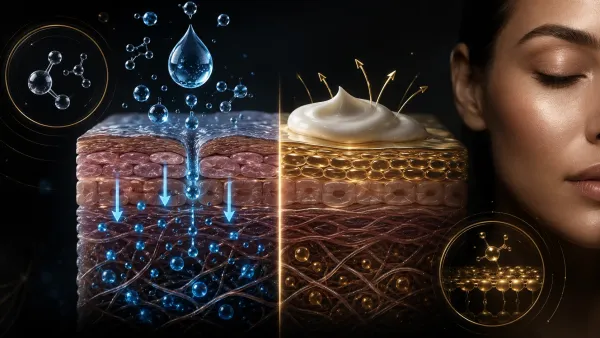
Luxury vs. Value — Visual Guide
What You Are Actually Paying For
| Cost Component | Drugstore | Premium | Ultra-Luxe |
|---|---|---|---|
| Formulation | 40-50% | 25-35% | 10-15% |
| Packaging | 10-15% | 20-30% | 25-40% |
| Marketing | 15-20% | 20-25% | 25-35% |
| Retail margin | 25-30% | 20-25% | 15-20% |
Smart Luxury Shopping Tips
- Read the INCI: Check that proven actives appear in the top half of the ingredient list, not just as trace ingredients after fragrance
- Compare cost/ml: Luxury products sold in smaller jars often cost 3-5x more per ml than standard sizes. Do the math
- Look for peer-reviewed data: Brand-funded clinical trials are useful but not conclusive. PubMed-indexed studies are more reliable
- Splurge on serums, save on cleansers: A cleanser contacts skin for 60 seconds. A serum stays on for hours. The serum is where active ingredient quality matters
- Ask for samples: Most luxury counters offer samples. Test for at least 7 days before committing to a full-size purchase
- Check refill programs: Some premium brands (Tatcha, Augustinus Bader) offer refill options that save 15-25% on the jar cost
For a complete anti-aging strategy that delivers results regardless of budget, explore our retinol guide, vitamin C guide, and anti-aging ingredients guide.
The Optimizer's Edge
The most expensive skincare product is not La Prairie or La Mer — it is the product you buy, use twice, and abandon in your bathroom cabinet. The true cost of any skincare product is not the price per jar but the price per use. If a $1,950 cream lasts 6 months, that is $10.83 per day. If a $50 drugstore cream also lasts 6 months, that is $0.28 per day. The question is not whether luxury creams can work — many are well-formulated. The question is whether they work 38x better than the drugstore alternative. The evidence says no. Spend your budget on proven essentials: SPF 30+, a retinoid, and vitamin C. Then, if your budget allows, add a luxury cream for the experience — not because your skin needs it to be healthy.
Your Clear Skin Checklist
- Step 1: Build your core routine with evidence-based essentials — SPF 30+, retinoid, vitamin C. These deliver 90% of results regardless of brand.
- Step 2: If you want to add luxury, choose products with peer-reviewed data (SkinCeuticals) or patented technology (Augustinus Bader) rather than purely marketing-driven brands.
- Step 3: Compare cost per ml, read the ingredient list, and always request samples before committing to a full-size luxury purchase.
Frequently Asked Questions About Expensive Skincare
What is the most expensive face cream in the world?
Are expensive skincare products worth the money?
Why are luxury skincare products so expensive?
What ingredients make skincare products expensive?
Which is a better investment: La Mer or Augustinus Bader?
This article is for informational purposes only and does not replace professional dermatological advice. Prices and product formulations mentioned are based on publicly available information as of 2026. Individual results vary.