Unlocking Radiance: The Transformative Benefits of Laser Skin Resurfacing
Discover the transformative benefits of laser skin resurfacing for a radiant complexion and youthful glow!

In this guide

Laser skin resurfacing may soften fine lines, improve uneven texture and make some acne scars less noticeable. The benefit depends on the concern, the device and settings, your skin history, and how you heal—not simply the treatment's brand name.
Ablative treatment removes tissue; nonablative treatment heats targeted tissue without removing the surface in the same way. Both can be fractional. More intensive treatment generally asks more of your recovery, and neither guarantees clear skin or a face-lift effect.
Start with a medical consultation and one specific goal. Ask what improvement is realistic, what could worsen, and when you can safely return to your normal routine.
- Choose by concern: shallow texture, brown marks and persistent redness are not interchangeable targets.
- Decode the description: fractional describes a treatment pattern, not a promise of light treatment.
- Budget for recovery: skin healing, looking presentable and final results run on different clocks.
- Discuss pigment risk: darker skin, melasma and past dark marks need individualized assessment.
The benefits of laser skin resurfacing are easier to judge when you replace “better skin” with a specific change. A smoother cheek, less noticeable scar edge and less visible sunspot each need a different conversation.
Our approach is to separate the possible benefit from the price of achieving it. That price includes recovery time, follow-up care, uncertainty and the possibility that another treatment is a better fit.
Benefits of laser skin resurfacing: match the treatment to the concern
Mayo Clinic's resurfacing overview identifies fine wrinkles, sun-related changes, uneven texture and some acne scars as common targets. These are possible improvements, not a guarantee that every mark or line will respond.
Make your goal observable. “I want the shallow scars on my cheeks to cast less shadow” gives a clinician more to assess than “I want glass skin.” Keep one priority at the top of your consultation notes.
| Your main concern | Useful question | Important limit |
|---|---|---|
| Fine surface lines | Could resurfacing soften these lines? | Expression, volume loss and loose skin need separate assessment. |
| Uneven acne-scar texture | Which scar types would this approach address? | A single device may not suit every scar. |
| Brown spots or patches | What is the diagnosis before treating pigment? | Melasma is not simply an age spot. |
| Red marks or visible vessels | Is resurfacing the right category at all? | A redness-targeting approach may be different. |
Texture and acne scars: improvement, not erasure
The American Academy of Dermatology's scar guidance emphasizes that lasers can reduce a scar's visibility but cannot remove it completely. Some treatment plans combine approaches rather than relying on laser alone.
Ask the clinician to show which scars they expect to improve and which they expect to remain. Our acne-scar treatment overview can help you understand the vocabulary before that conversation.
Flat marks and indented scars also need to be separated. If color is your main concern, read about post-acne redness so you can describe what you see without assuming it is permanent scar tissue.
Laser skin resurfacing benefits for lines and sun damage
Resurfacing may soften surface lines, but it should not be sold as a replacement for surgery when substantial loose skin is the concern. Ask whether the proposed result matches the specific feature that bothers you most.
- Name the area: around the mouth is more useful than “anti-aging.”
- Name the change: softer texture is different from lifting a jawline.
- Name the boundary: say how much visible recovery you can accommodate.
Do not judge a result from a photo with different lighting, expression or makeup. Ask to see consistent photographs of people treated for a similar concern, while remembering that another person's outcome does not predict yours.
Ablative, nonablative and fractional describe different things
Two questions help decode the terminology: does the treatment remove tissue, and does it treat the surface continuously or in a pattern? A clinic should be able to explain both without relying on a branded treatment name.
Ablative resurfacing removes tissue and creates a wound that needs care. Nonablative resurfacing targets tissue with heat without removing the surface in the same manner; less disruption does not mean no risk or no downtime.
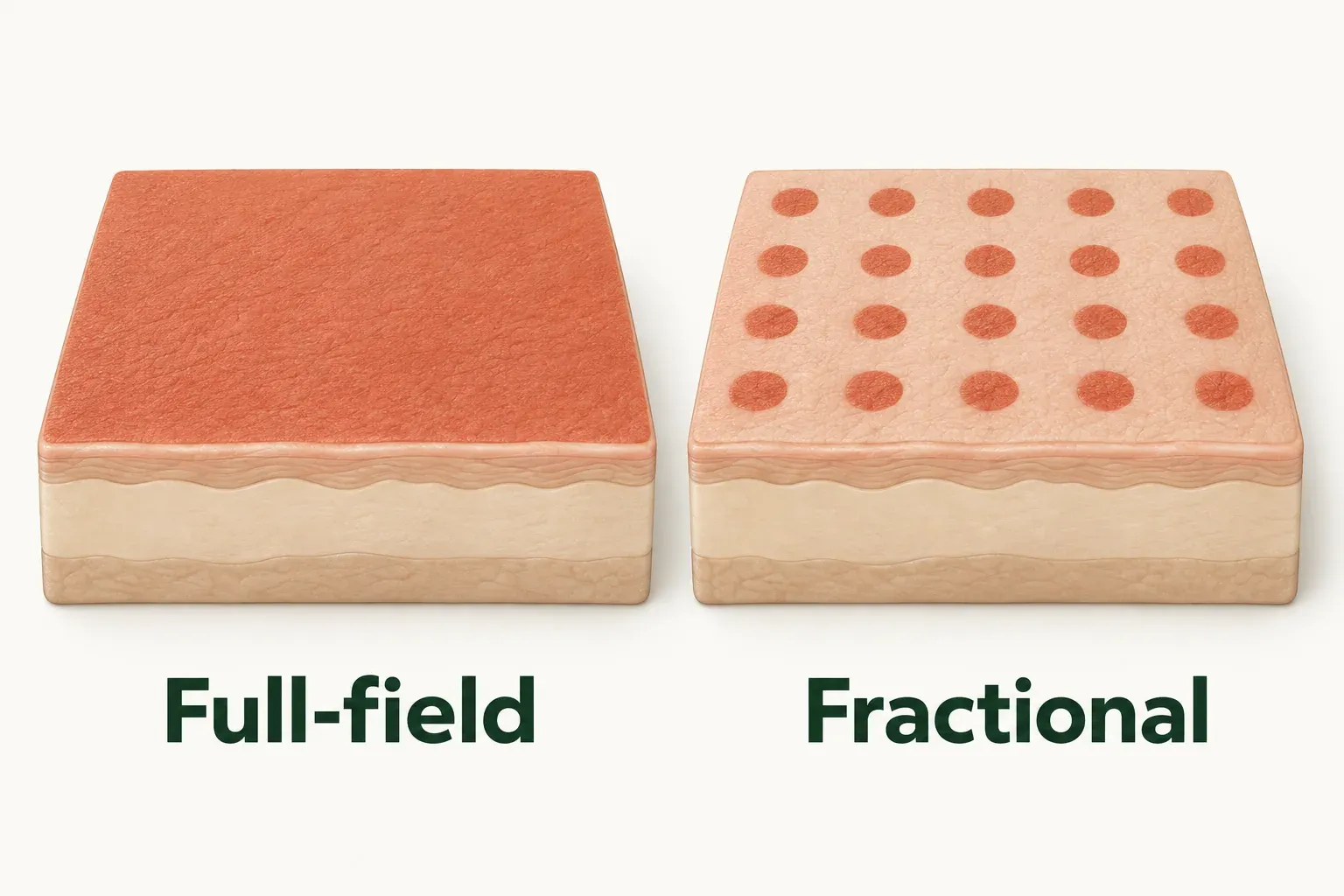
DermNet explains fractional treatment as a pattern of small treatment zones separated by tissue that helps healing. Fractional treatment can be ablative or nonablative, so “fractional” alone does not tell you how recovery will feel.
| Term on the quote | What it describes | Ask the clinic |
|---|---|---|
| Ablative | Tissue removal | What wound care and recovery will this require? |
| Nonablative | Heating without the same surface removal | How many sessions and what visible reaction are likely? |
| Fractional | Separated treatment zones | Is this ablative or nonablative, and how intensive? |
| Full-field | Continuous treatment across the selected area | Why does this coverage suit my goal and history? |
CO2 and erbium refer to laser technologies; the device, mode and settings still matter. IPL uses broad-spectrum light and is not a laser, even when it appears alongside lasers in a clinic's menu.
MedlinePlus explains that different lasers have different uses. For more terminology, use our fractional laser guide, then ask your clinician to translate your actual quote into plain language.
Skin history can change whether the benefit is worth the risk
Two people with similar-looking texture may need different plans. Skin tone, previous pigment changes, active skin disease, medications and healing history all belong in the consultation—not in a brief sales form after payment.
Resurfacing can cause darker or lighter patches, infection, scarring and prolonged inflammation. Mayo Clinic notes a greater risk of long-term color changes in brown or Black skin; seek a clinician experienced with your skin tone rather than accepting a blanket safety promise.
Our guide to dark spots on darker skin explains why avoiding new irritation matters. Bring photographs of previous reactions if you have them, particularly marks that appeared after acne, burns or another procedure.
- Cold sores, current infection, active breakouts or a recent skin flare.
- Past raised scars, slow wound healing or lasting pigment changes.
- All medicines and supplements, including current or previous isotretinoin.
- Recent tanning, sunburn, pregnancy, breastfeeding or immune-system conditions.
Do not stop a prescribed medicine because of a generic pre-laser checklist. The treating clinician and prescriber should decide whether treatment or medication timing needs to change.
Melasma needs its own plan
The AAD's melasma guidance describes a tailored plan built around sun protection and medication, sometimes with an added procedure. A laser package should not replace diagnosis or be presented as a permanent cure.
Ask what happens if pigment worsens, returns or does not respond. For someone with recurring facial patches, that answer may be more important than the advertised number of sessions.
If painful breakouts are still developing, discuss those first. Our cystic-acne guide provides background, but laser resurfacing should not be mistaken for a universal active-acne treatment.
Plan three recovery clocks, not one downtime number
“Back to normal” can mean skin has closed, you feel comfortable being seen, or you can judge the final result. Ask which definition a clinic is using when it advertises a recovery window.
Cleveland Clinic's recovery guidance describes redness, tenderness, peeling and wound-care needs that vary with treatment. Visible pinkness can continue after early healing; a short appointment does not imply a short recovery.
| Recovery clock | What you need to know | Planning decision |
|---|---|---|
| Skin healing | When are washing, makeup and skincare safe? | Get written product and wound-care instructions. |
| Social and work recovery | How visible could redness, swelling or peeling be? | Allow flexibility for meetings, work and travel. |
| Result assessment | When will comparison photos be meaningful? | Book the review before deciding on more treatment. |
For an important event, do not build your calendar around the fastest recovery you saw online. Tell the clinician the event date and ask whether postponing treatment is the more sensible choice.
A desk job at home and outdoor physical work create different practical problems. Explain sun exposure, heat, protective equipment and whether you can follow the aftercare plan during a normal shift.
Before treatment: leave with a written plan
Ask for instructions early enough to arrange time away, transport if needed and follow-up contact. Make sure you know who will answer a concern outside ordinary office hours.
- Skin preparation: which products to pause, and exactly when.
- Comfort and transport: what anesthesia is planned and whether you need an escort.
- Aftercare: which cleanser, dressing or ointment the clinician wants you to use.
- Review: when your healing will be checked and how to send a concern.
Do not add extra exfoliation to “prepare” the skin yourself. A salicylic-acid acne routine may have a role on intact skin, but it is not permission to use acid on recently resurfaced skin.
After treatment: follow the procedure-specific instructions
Gentle care does not mean choosing any product labeled gentle. Ask when to wash, what to apply, and when to restart sunscreen, makeup or active ingredients for your particular treatment.
Protect healing skin from sun exposure and use the clinician's instructions for physical coverage and sunscreen timing. Once routine sun protection is appropriate, avoid the common sunscreen mistakes that undermine it.
Do not pick peeling skin or add a scrub to speed the process. More products can also make it harder to identify what caused a new reaction, so keep the approved aftercare list easy to follow.
Ask for specific warning signs before leaving. Worsening pain, spreading redness, fever, unexpected blisters or discharge deserve prompt clinical advice; vision changes or severe symptoms need urgent medical assessment rather than an online reassurance check.
Is laser resurfacing worth it for your goal?
Our editorial test is whether the expected improvement matters enough to you to justify the complete plan. You do not need to treat normal pores, lines or scars just because a device can target them.
Consider a reader whose main concern is a subtle cheek texture change but who cannot take visible downtime. The next step is asking about lower-intensity options or postponement—not accepting a stronger treatment and hoping to heal unusually quickly.
Now consider someone bothered by several different scar shapes. The useful question is whether a combined, staged plan would address those differences, not whether the clinic can promise one dramatic resurfacing session.
- Session cost: which area, device and clinician are included?
- Course cost: what if more than one session is recommended?
- Recovery cost: will you need time off, transport or childcare?
- Follow-up cost: are review appointments and complication assessments included?
Request the answer in writing so you can compare like with like. Avoid making a same-day package decision before understanding refund terms, scheduling limits and what happens if you are unsuitable on the treatment day.
Compare alternatives without assuming one winner
Ask how the proposed laser compares with a peel, microneedling, topical care or no procedure for your actual concern. Different mechanisms should not be ranked by a single “stronger is better” scale.
Our chemical-peel guide for acne scars and microneedling decision guide can help you prepare that comparison. Neither is a substitute for assessing scar depth, pigment risk and active skin conditions.
A sensible plan also has a stopping point. Agree when to review the outcome, what would count as worthwhile improvement, and what would make you stop rather than buy another session automatically.
This video was included in the original article and is retained as supplementary material. Use the individualized risk and recovery questions in this guide when discussing any treatment shown.
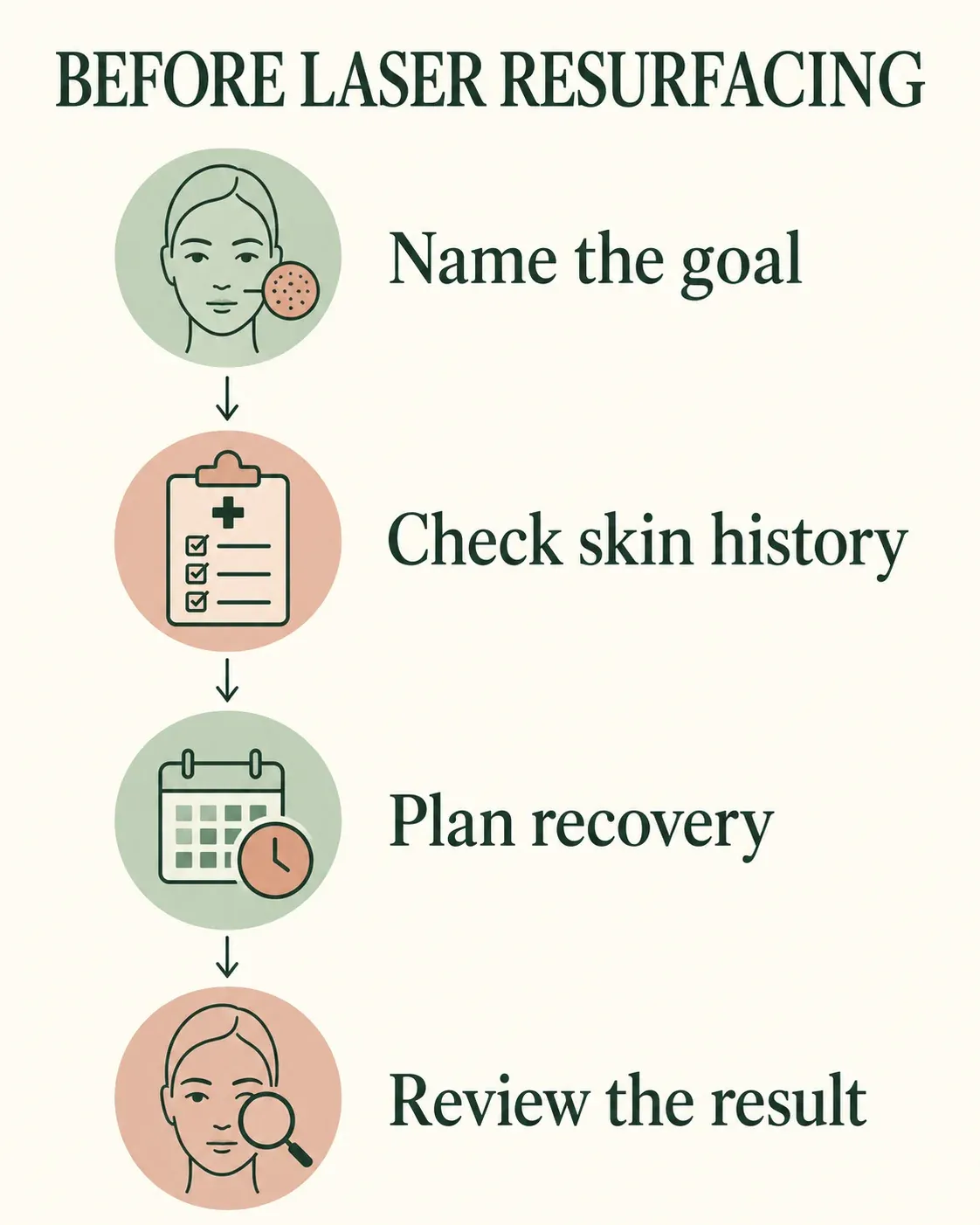
- Define one priority. Describe the mark, line or texture change that matters most to you.
- Confirm the plan. Know the device category, treatment area, likely sessions and limits.
- Disclose your history. Include medicines, cold sores, pigment changes and past healing problems.
- Protect recovery time. Get product instructions, return-to-work advice and a contact number.
- Set a review point. Compare consistent photos before deciding whether more treatment is worthwhile.
Bottom line: buy a clear plan, not a promise of radiance
Laser resurfacing can be worth considering when a defined concern, realistic benefit and manageable recovery line up. If any of those remain vague, another consultation—or waiting—is a valid next step.
The best question is not “Which laser is best?” It is “Why is this plan suitable for my skin, my goal and my ability to recover?”
Frequently Asked Questions About Laser Skin Resurfacing
Questions were informed by reviewed community discussions about laser downtime and work and melasma and recovery uncertainty. These identify reader questions, not evidence of safety or effectiveness; the medical references above support the answers.
Can I get worthwhile results without weeks of downtime?
Some less intensive approaches involve shorter visible recovery, but they may offer subtler changes or need more sessions. Ask for a realistic range for the exact treatment, including redness and work restrictions, rather than a best-case estimate.
Is one laser resurfacing session enough?
Sometimes one treatment is the initial plan; other approaches use a series. Your concern, settings and response determine the schedule, so agree on a review point before committing to additional sessions.
Can darker skin or melasma be treated with lasers?
Some people may be candidates, but pigment risk and the diagnosis need careful assessment. Choose a clinician experienced with your skin tone; melasma often needs ongoing sun protection and medical treatment rather than a stand-alone laser solution.
When can I wear makeup or restart retinol?
Use the treating clinician's instructions for your procedure and healing stage. There is no safe universal restart day for all lasers, and visible improvement does not by itself mean the surface is ready for makeup or active ingredients.
Is laser resurfacing better than microneedling or a chemical peel?
Not universally. The best comparison considers the diagnosis, intended depth of change, pigment and healing risks, cost and recovery; ask why the proposed method fits your concern better than the alternatives, including doing nothing.
This article is for informational purposes only and does not replace professional dermatological advice.