Understanding Chemical Peels: What to Expect for Your Skin's Transformation
Explore what to expect from chemical peels, including benefits, preparation, and recovery tips for glowing skin!

In this guide

Chemical peels create a controlled skin injury, so what to expect depends on the treatment depth, your skin and the clinician's plan. A light peel may bring mild irritation and fine flaking; deeper treatment needs more involved wound care and recovery.
Ask for the exact peel name, expected depth and written aftercare before booking. Do not judge success by how much skin sheds or restart strong skincare just because seven days have passed.
Use this guide to plan the appointment and ask better questions, not to choose an acid concentration or treat a complication yourself. Your treating clinician's instructions take priority.
- Depth comes first: a superficial facial and a deep peel are not interchangeable appointments.
- Recovery has several endpoints: healed skin, comfortable makeup and your final appearance may arrive at different times.
- Protect the healing surface: follow the prescribed care plan and leave flakes or crusts alone.
- Know whom to call: unexpected or worsening symptoms need assessment, not an internet diagnosis.
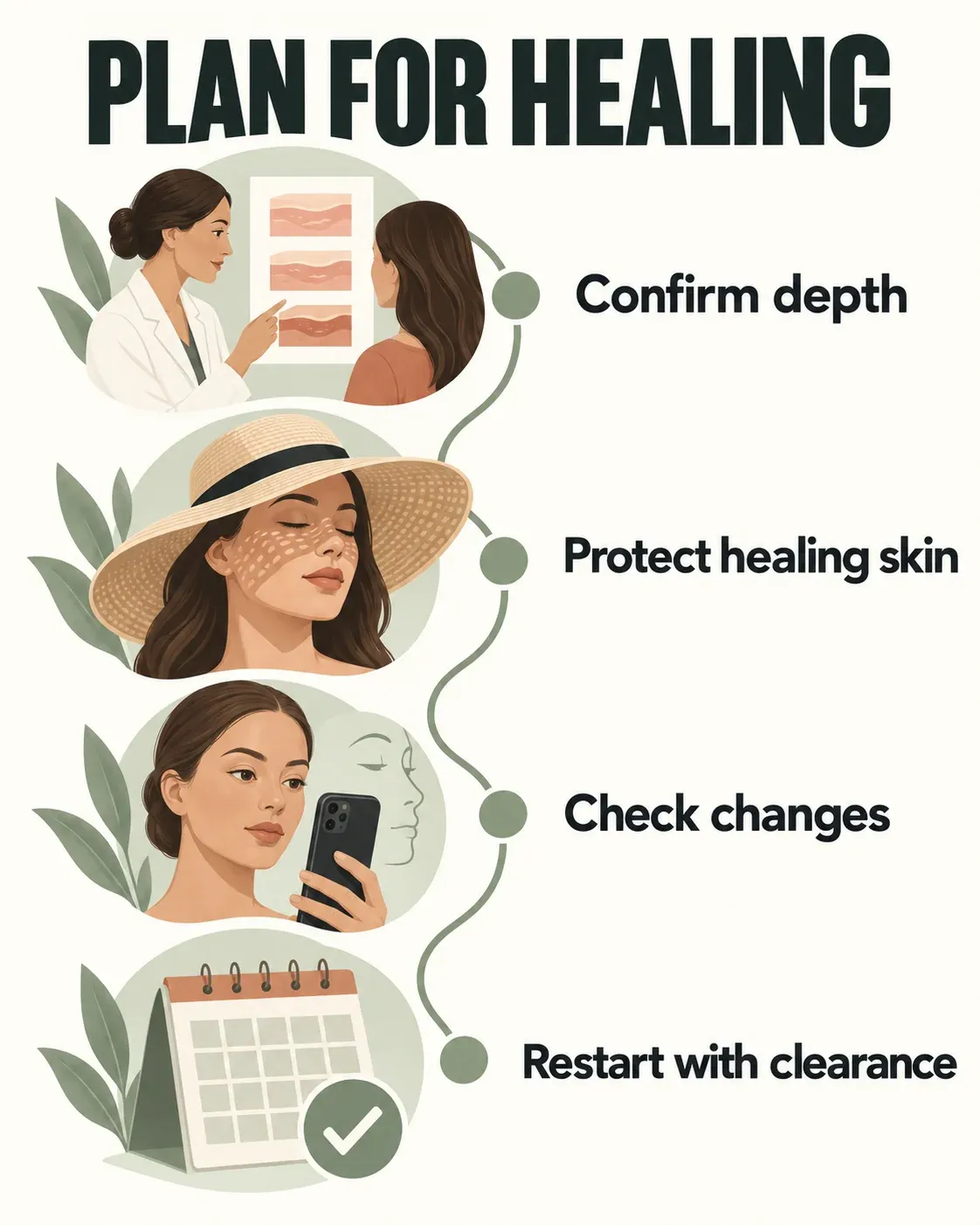
SkinOptimizer is an editorial skincare resource, not a medical practice. We checked dermatology and medical-center guidance for this update and distinguish clinical information from our practical planning suggestions.
The illustrations explain decisions; they are not patient photographs, treatment results or clinical evidence. No treatment or product was tested for this guide.
Chemical peels sound like one treatment, but the name covers very different experiences. The useful question is not simply whether a peel is “strong.” It is whether the proposed procedure suits your concern and the recovery you can realistically manage.
For example, being able to answer emails at home is different from working outdoors or wearing stage makeup. Tell the clinic what your actual week involves instead of asking only when you can “return to normal.”
Ask for three separate estimates: when the surface should heal, when your usual activities can resume and when the result can be assessed. One advertised downtime number cannot answer all three questions.
Chemical peels: what to expect by depth
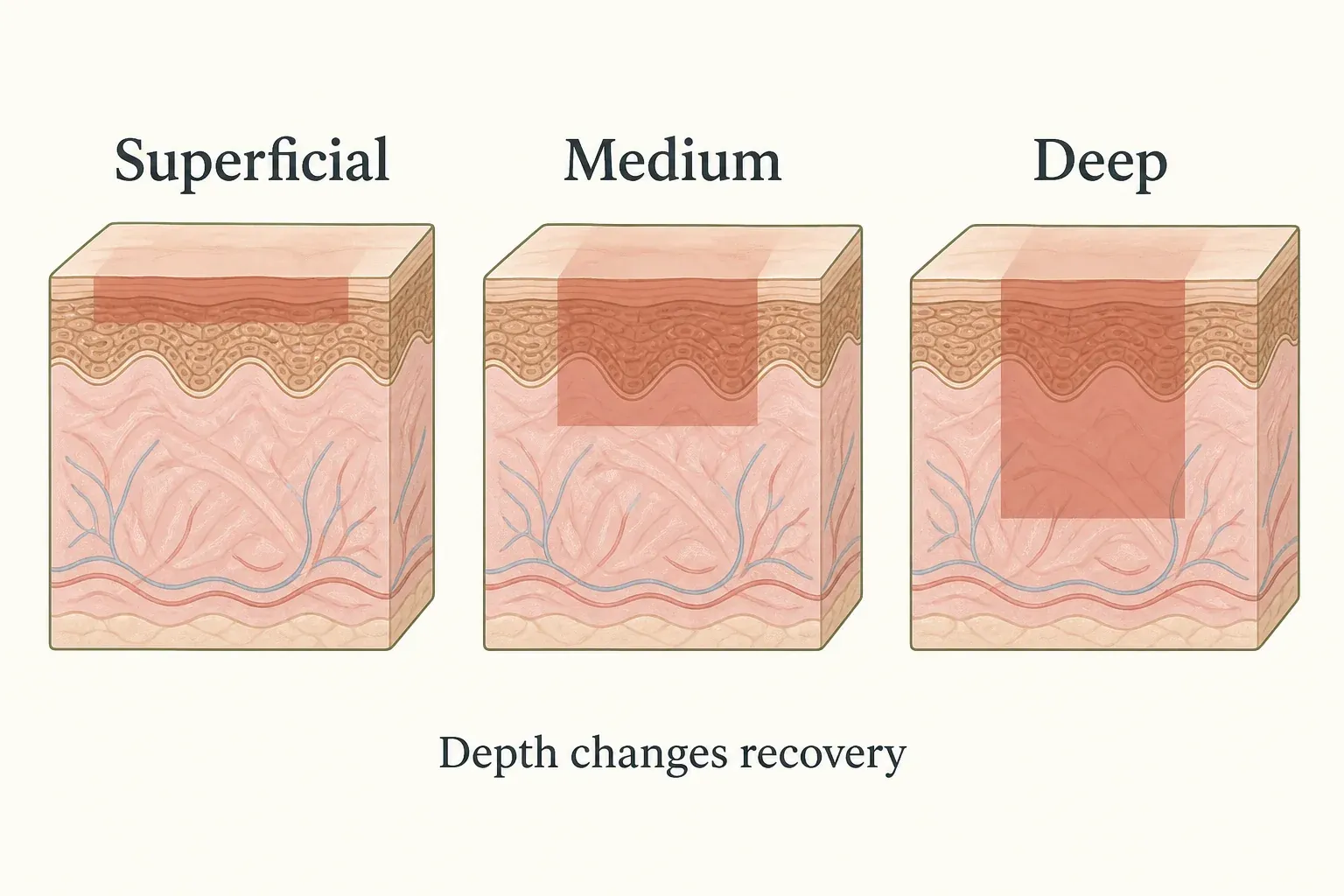
A superficial peel targets the epidermis, while medium and deep procedures extend farther into the skin. The Cleveland Clinic overview distinguishes these categories and explains why deeper scars or sagging may require a different approach.
Do not choose from a menu by matching “oily,” “dry” or “dark” skin to an acid name. The consultation should also account for your treatment goal, previous reactions, pigment history and current skin condition.
The following healing ranges come from the American Academy of Dermatology's patient guidance. They are planning ranges, not a promise that your skin will look settled on the last day.
| Depth | Typical healing range | Planning implication |
|---|---|---|
| Superficial / light | About 1–7 days | Ask about visible flaking and work requirements even if marketed as a lunchtime peel. |
| Medium | About 7–14 days | Allow for wound care, follow-up and a face that may remain red after healing. |
| Deep | About 14–21 days | Arrange substantial recovery support and the surgical team's follow-up plan. |
For a practical comparison, write down the concern that bothers you most. “Brown marks left by pimples” is more useful than “bad skin,” and it helps separate pigment from a depressed scar.
Our guide to chemical peels for acne scars explores that distinction. Keep expectations specific: improving one feature does not mean a peel can erase every mark, line or pore.
Why a deep chemical peel is a different decision
Deep phenol peels have risks beyond the skin, including effects on the heart, kidneys and liver, as described by Mayo Clinic. They require specialized assessment and monitoring, not a casual upgrade from a light facial.
If a consultation skips that distinction, pause before committing. Ask who performs the procedure, where it takes place, what monitoring is used and who handles problems after hours.
Before booking: turn your goal into a written plan
The AAD preparation checklist emphasizes discussing medicines, prior cosmetic procedures and relevant medical history. Bring an actual list or photographs of labels rather than relying on memory.
Disclose current or recent isotretinoin use, cold sores, pregnancy, unusual scarring and previous dark or light patches after irritation. The clinician should decide whether treatment is appropriate and whether any preparation is needed.
- Name the goal: which one concern will you use to judge improvement?
- Explain the schedule: include outdoor work, exercise, travel, caregiving and important events.
- Bring the routine: prescriptions, retinol, exfoliants and recent procedures all belong on the list.
- Request written instructions: include product names, contact details and follow-up arrangements.
Do not independently stop prescribed aspirin, anticoagulants or any other medicine because a beauty article says to. The prescriber and treating clinician need to coordinate medication decisions for your situation.
Some treatment plans include prescribed preparation products; others require pauses. That is why a universal “stop everything for seven days” rule is unreliable. Our chemical peel preparation guide helps organize that conversation.
For darker skin, ask about the clinician's experience with your skin tone and post-inflammatory pigment changes. A suitable plan should not rely on a generic skin-type chart or promise that any peel is risk-free.
Keep a simple note of how past irritation healed: did a spot stay brown, become lighter or leave a raised scar? This history is more informative than choosing a procedure because someone with a similar complexion liked it online.
During the appointment: sensations, steps and questions
Expect a review of the plan, skin cleansing and protection of sensitive areas before application. The appointment should also leave time to discuss aftercare; do not treat the time spent applying the peel as the entire visit.
Application and removal vary by formulation. Mayo Clinic describes neutralization or washing for some light peels, but different handling for TCA and deep peels. Do not assume every solution must be removed on the same schedule.
Warmth or stinging may occur, and deeper procedures may involve pain control or sedation. Speak up promptly if discomfort feels severe or unexpected; enduring more pain is not a way to obtain a better result.
- Confirm the plan aloud. Ask which areas will be treated and whether anything has changed since consultation.
- Agree on communication. Tell the practitioner how you will signal discomfort and ask what they expect you to feel.
- Clarify the first wash. Leave with the exact instructions for your formulation, not advice from another person's peel.
- Check transport. If sedation is planned, follow the team's escort and driving restrictions.
Before leaving, repeat the immediate instructions back in your own words. For example: “I use this prescribed product tonight, avoid these other products, and call this number if that symptom appears.” Ask the team to correct anything you misunderstood.
Aftercare: follow healing, not a countdown
Keep the clinic's instructions where you will use them, such as beside your approved care products. Separate the products you have been told to pause so an automatic evening routine does not undo the plan.
According to DermNet's chemical peel guidance, picking can delay healing and cause scarring. It also describes acne, pigment changes and infections among possible complications; new bumps are not automatically proof that skin is “purging.”
Ask the clinic which cleanser, moisturizer or ointment to use and when. A routine that suits intact dry skin is not necessarily appropriate for a healing treatment site.
| Situation | Practical decision | Avoid assuming |
|---|---|---|
| Instructions name a specific ointment | Use the prescribed plan; ask before substituting. | A favorite serum is an equivalent replacement. |
| Flakes or crusts are visible | Leave them alone and follow the care instructions. | Scrubbing speeds up recovery. |
| You want to resume makeup or retinoids | Request clearance for your peel and healing state. | A calendar date guarantees readiness. |
| Your plan includes outdoor work | Discuss workable protection or reschedule treatment. | One sunscreen application solves the whole problem. |
Sun protection is part of the treatment plan, not an optional finishing touch. Ask how to protect the area during early healing and when the clinician wants sunscreen applied, particularly if the surface is not intact.
After clearance for normal sunscreen use, our sunscreen reapplication guide can help with everyday habits. It does not replace post-procedure instructions about wound care, sun avoidance or protective clothing.
Do not schedule your first peel immediately before an event based on somebody else's photos. If looking predictable matters more than treating a concern this month, moving the procedure is a reasonable choice.
Prepare two lists: “approved now” and “ask before restarting.” Put retinoids, exfoliating acids, scrubs, devices and additional procedures on the second list unless your clinician has specifically cleared them.
That simple separation is more useful than buying a large recovery kit. It also gives you a clear question to bring to follow-up.
Document changes without turning them into a diagnosis
If the clinic requests photographs, use similar lighting and angles and record when a change began. Include symptoms and products used; a filtered close-up alone cannot tell the clinician how the skin feels or whether things are worsening.
Keep the notes short: “More tender since yesterday; used only the prescribed ointment; no new products.” Do not label the problem an infection or normal shedding yourself, and do not delay contacting the clinic while collecting pictures.
Learning about barrier irritation symptoms can improve routine awareness later. Fresh post-peel symptoms need procedure-specific assessment rather than a generic barrier-reset routine.
Expected changes versus reasons to contact the clinic
Some redness, tightness or shedding may fit the expected course, but “normal” depends on depth and timing. Ask the treating team what changes should prompt a call; the absence of dramatic redness does not prove everything is fine.
The AAD advises contacting the dermatologist about burning, itching or swelling after a peel. Use your clinical contact plan early when symptoms are unexpected, worsening or different from the explanation you received.
| What you notice | Next action | What not to do |
|---|---|---|
| Fine flaking that matches the expected course | Continue the instructed care and follow-up. | Pull at skin to make shedding more even. |
| Increasing pain, spreading redness, discharge or new clustered blisters | Seek prompt clinical assessment. | Dismiss it as purging or add acids. |
| Unexpected darkening, light patches or slow healing | Contact the treating clinician for review. | Start a bleaching treatment yourself. |
| Breathing difficulty, fainting or severe eye symptoms | Seek emergency medical care. | Wait for a routine follow-up appointment. |
This table is a safety-oriented contact guide, not a diagnostic tool. If you cannot reach the treating service and symptoms are serious or worsening, seek urgent care rather than waiting for the clinic to reopen.
The FDA warns against chemical peel products without professional supervision because they can cause serious skin injury. An online listing or a familiar acid name does not make a high-strength peel safe.
Do not copy another person's concentrations, number of layers or timing. More visible peeling is not a sensible self-treatment goal.
Results: decide what would make treatment worthwhile
Choose a concrete outcome before paying for a series. “Less noticeable surface discoloration” is assessable; “perfect skin” leaves you comparing an actual face with advertising.
Ask what the clinician expects to improve, what is unlikely to change and when they would reassess the plan. Also ask what happens if irritation or pigment changes make continuing inappropriate.
- Define the target: one main concern, rather than every feature of your skin.
- Set a review point: agree when you will assess the result after healing.
- Price the full plan: include visits, prescribed care and time away from work.
- Keep an exit option: ask whether you can reassess before paying for more sessions.
A proposed package should not make you feel obliged to repeat a treatment your skin has not recovered from. Compare the total commitment with a slower routine-based approach or doing nothing for now.
For discussion with a clinician, acne scar treatment options and our laser resurfacing guide explain different decision paths. They are background reading, not a recommendation to combine procedures.
For ongoing uneven tone, hyperpigmentation routine planning may be useful after recovery and clearance. Avoid adding treatments during healing just because the final result is not visible yet.
- Confirm the treatment. Record the peel name, intended depth and the concern it is meant to address.
- Plan the real week. Include work conditions, transport, appointments and help at home.
- Separate your products. Keep the approved care plan distinct from products awaiting restart clearance.
- Save the contact route. Know whom to call during office hours and what to do after hours.
- Review before repeating. Discuss healing and progress before committing to another session.
Make the next step a consultation, not a stronger peel
The most useful appointment is one you leave understanding. You should know what is planned, what recovery involves and which changes need attention.
If the explanation is vague, request clarification before proceeding. A thoughtful delay is preferable to booking treatment around an outcome or recovery deadline no one can responsibly promise.
Question selection below was informed by cached discussions about little visible peeling and appointment experiences and makeup. Community posts identify questions, not evidence; medical sources above support the answers.
Frequently Asked Questions About Chemical Peels
Does little visible peeling mean the treatment failed?
Not necessarily. Superficial treatments can produce subtle changes, and the amount of shedding alone does not establish the result.
Ask your clinician when to assess improvement; do not repeat the treatment or add exfoliation to force more peeling.
Should a chemical peel hurt?
Stinging or warmth can occur, and deeper procedures may need pain control. Severe or unexpected discomfort should be reported immediately.
Pain is not a useful measure of how well the treatment will work.
When can I wear makeup after a chemical peel?
The timing depends on depth and healing. Some light peels allow makeup quickly, while deeper procedures require a longer pause.
Get instructions for your exact treatment and do not cover open, irritated or unhealed skin simply because an event is approaching.
Is darker skin after a peel always normal?
No. Some changes may be part of healing, but new pigmentation can also be a complication.
Ask the treating clinician to assess unexpected darkening or lighter patches. Do not start acids or pigment treatments on your own while the area is healing.
How soon can I have another chemical peel?
There is no single safe interval for every peel. Timing depends on the procedure, your response and the clinician's assessment.
Repeat treatments require a specific plan; a deep peel is not a routine recurring facial. Wait for clearance instead of copying someone else's schedule.
This article is for informational purposes only and does not replace professional dermatological advice.