Coconut Oil for Skin: Benefits, Risks and Safer Use
Coconut oil for skin can seal in moisture, but it may clog acne-prone areas. Learn where it fits, where to skip it, and how to patch test safely.

In this guide
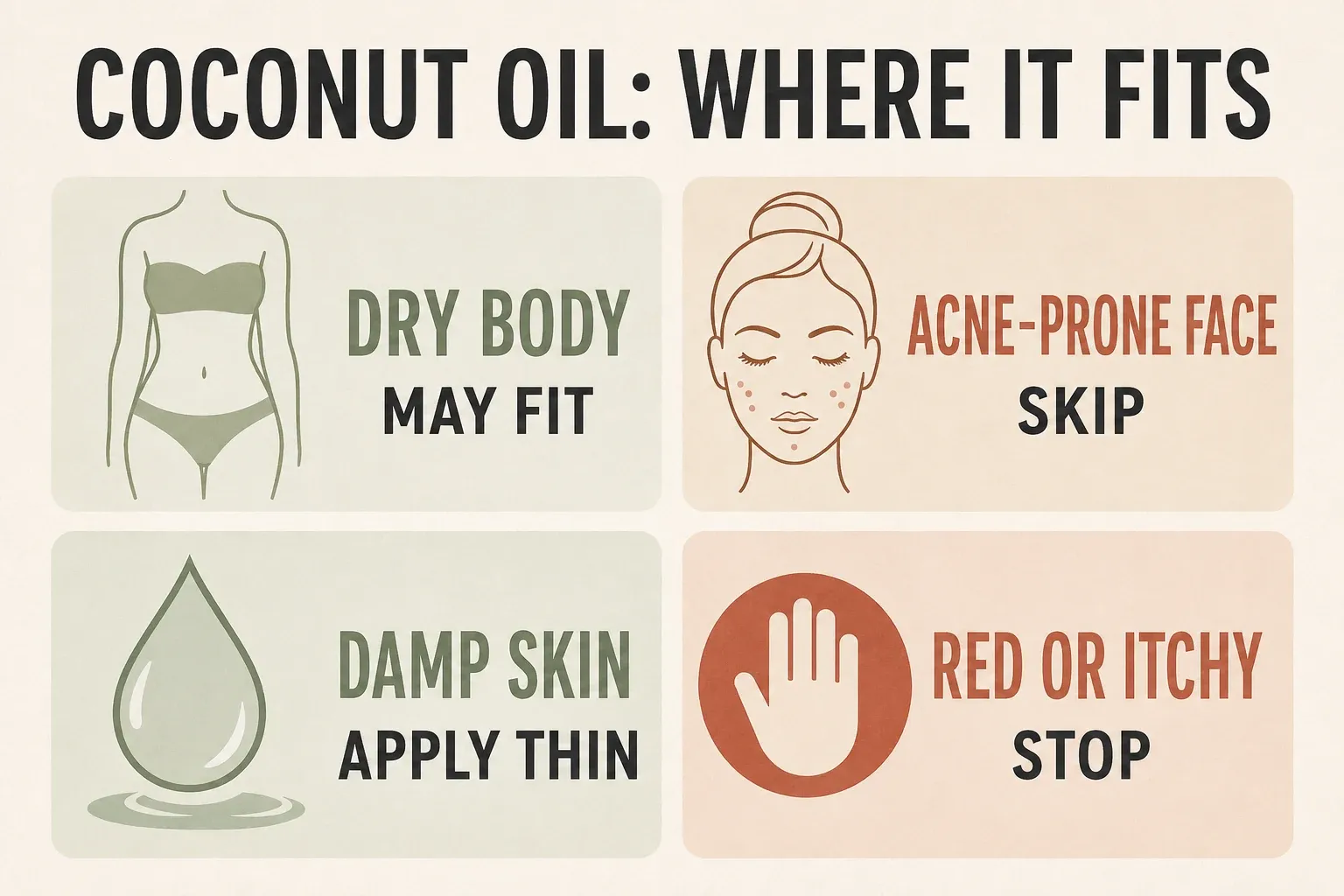
Coconut oil can work as a rich seal for dry, intact body skin, especially when a very thin layer is applied over damp skin or a fragrance-free cream. It is not a universal face moisturizer.
If you are acne-prone, get clogged pores easily, or develop bumps around the hairline, skip raw coconut oil on those areas. Choose an oil-free, non-comedogenic moisturizer first and patch test any new product before wider use.
- Best fit: rough elbows, hands, legs, feet, and other dry body areas that tolerate oils.
- Main limit: a heavy oil can feel greasy and may worsen congestion on acne-prone facial, chest, back, or hairline skin.
- Best method: use less than you think, apply over damp skin, and stop if itching, redness, or new bumps appear.
- Evidence boundary: small clinical studies support moisturizing roles in defined dry-skin or atopic-dermatitis settings; they do not prove that coconut oil treats acne, scars, wrinkles, or infections.
Jump to the choice, the safest application method, or lighter alternatives.
SkinOptimizer is an editorial skincare resource, not a medical provider. We compare ingredient evidence, routine logic, safety guidance, and practical use cases without claiming that a kitchen ingredient replaces a tested treatment or a dermatologist.
Coconut oil for skin is a simple idea with a complicated reputation. It can make rough body skin feel softer, yet the same rich film can be a poor match for a face that clogs easily.
The useful question is not whether coconut oil is “good” or “bad.” The better question is whether it fits your body area, skin state, and intended job.
This guide separates moisturizing evidence from online claims about acne, scars, wounds, wrinkles, and “detoxing.” It also gives you a low-risk way to test tolerance without turning your whole routine into an experiment.
Is Coconut Oil Good for Your Skin?
For dry body skin, coconut oil may be a reasonable occlusive layer. For acne-prone facial skin, the downside often outweighs the benefit because a heavy, slow-spreading film can trap residue and make congestion harder to interpret.
There is no reliable universal “comedogenic score” that predicts every person’s response. Formula, amount, body area, climate, cleansing, and your own follicular tendency all matter.
| Skin situation | Best first choice | Watch for |
|---|---|---|
| Dry legs, elbows, hands, or feet | A thin layer over damp skin or cream | Greasy feel, friction, or clothing transfer |
| Acne-prone face, chest, or back | Oil-free, non-comedogenic moisturizer | Whiteheads, closed bumps, or inflamed spots |
| Dry facial patch without acne history | Patch test first; use only on the small area | Milia, itching, or new texture |
| Active eczema, cracked skin, or infection concern | Use the care plan recommended by a clinician | Oozing, crusting, pain, warmth, or spreading redness |
| Hair oil touching forehead or neck | Keep residue off skin and wash fabrics | Hairline and upper-forehead breakouts |
The NICE acne guideline advises people with acne to avoid oil-based and comedogenic skin-care preparations. That is a more useful default than assuming “natural” automatically means face-friendly.
If your current problem is dryness caused by acne actives, start with a moisturizer labeled oil-free or non-comedogenic. The American Academy of Dermatology recommends applying moisturizer after washing so it can help retain water.
What Coconut Oil Actually Does on Skin
Coconut oil contains a high proportion of saturated fatty acids, including lauric acid. On the surface of skin, the practical effect is mainly emollient and occlusive: it smooths spaces between dry skin cells and reduces evaporation.
That can improve softness and comfort. It does not mean the oil hydrates like a humectant, rebuilds every part of the barrier, or delivers the balanced mix of ingredients found in a well-formulated moisturizer.
| Claim | What the evidence supports | Practical interpretation |
|---|---|---|
| “It moisturizes.” | Reasonable for reducing water loss and softening dry skin | Apply over damp skin or a cream, not to bone-dry skin alone |
| “It treats eczema.” | Some controlled trials found benefits in defined atopic-dermatitis groups | Promising adjunct, not a universal replacement for prescribed care |
| “Lauric acid kills acne bacteria.” | Lab findings do not prove raw oil treats acne on a human face | Do not replace evidence-based acne care with coconut oil |
| “It fades scars and wrinkles.” | No strong human evidence for structural scar or wrinkle correction | Temporary softness can make dry lines look less obvious |
| “It works as sunscreen.” | It is not a reliable broad-spectrum sunscreen | Use a tested SPF 30+ product instead |
A randomized trial in children with mild-to-moderate atopic dermatitis found that topical virgin coconut oil improved severity scores, water loss, and skin capacitance more than mineral oil over eight weeks. Read the published trial abstract on PubMed.
An earlier controlled study also compared virgin coconut and olive oils in adults with atopic dermatitis. These studies are useful, but they tested specific groups and protocols rather than every jar, skin condition, or facial routine.
They do not justify applying raw coconut oil to an infected wound, using it as an acne treatment, or stopping prescribed eczema care. If dermatitis is persistent or severe, a clinician can help identify triggers and choose an appropriate emollient or medication plan.
Coconut Oil on the Face: Why Results Conflict
Online experiences conflict because people are testing different things. One person uses a trace amount for makeup removal and washes it off, while another leaves a thick layer over moisturizer every night.
Skin also changes with season, hormones, medications, irritation, and product combinations. A good result on the legs tells you little about how the same oil will behave on the forehead or around the eyes.
Occlusion can make dry surface lines look smoother within hours. Congestion may take longer to appear, so judge comfort and pore behavior over several days rather than one morning.
If you have oily or acne-prone skin, a lighter route is usually easier to troubleshoot. Start with our daily routine for oily skin or compare options in the face-oil guide by skin type.
If your skin is dry but not acne-prone, the dry-skin routine explains how humectants, creams, and optional occlusives fit together. Coconut oil should be the optional seal, not the entire hydration strategy.
How to Use Coconut Oil on Skin More Safely
Use the smallest amount that leaves skin comfortable rather than shiny. For one lower leg, warm a small dab between your palms and spread it over skin that is still slightly damp.
If you already use a fragrance-free body cream, apply that first. Add coconut oil only to the roughest areas when the cream alone is not enough.

Avoid mixing coconut oil with essential oils, lemon juice, baking soda, coffee grounds, coarse sugar, or salt for facial use. These combinations add irritation risk without solving the core problem better than a simple, tested product.
For more context on fragrance concentrates, read our essential-oil safety guide. If you want a gentle mask, the DIY face-mask guide explains why simpler formulas and careful testing matter.
How to Patch Test and Monitor Pores
A classic irritation patch test cannot guarantee that an oil will never clog pores. You need two observations: a small-area tolerance check and a short, controlled pore-behavior test on the actual type of area you plan to use.
Start on the inner forearm with a tiny amount once daily for several days. Stop if you see itching, persistent redness, swelling, blistering, or a spreading rash.
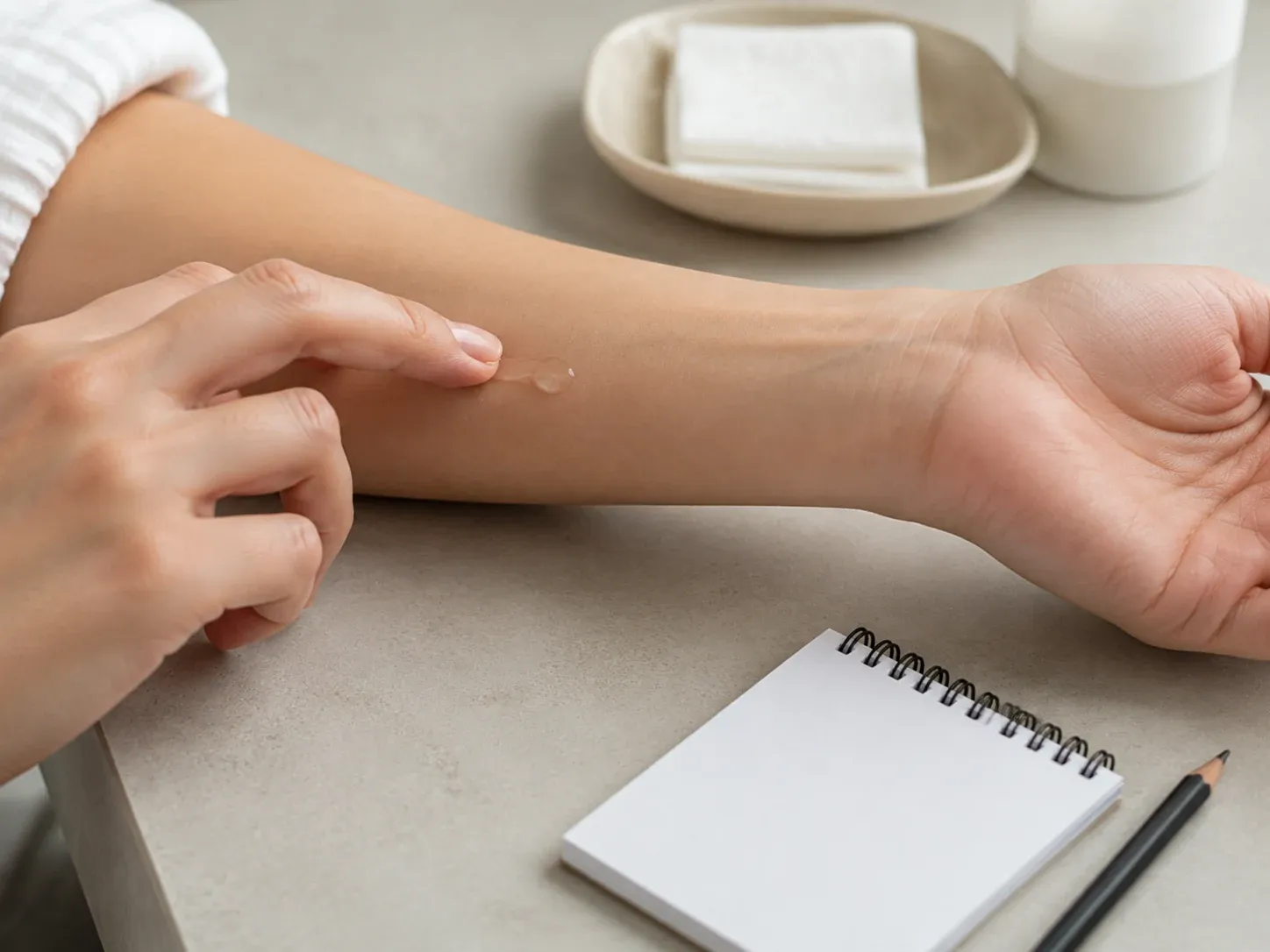
If the inner-arm test stays calm and you still want facial use, choose one small dry area that is not actively breaking out. Do not change other products during the test, and do not test on the whole face.
Watch for delayed closed bumps, whiteheads, increased rough texture, or a repeating pattern in the exact application area. If any appear, stop and return to your previous routine.
People with a history of contact allergy, eczema flares, or unexplained facial rashes may need more than a home test. A dermatologist can decide whether formal patch testing or a different diagnosis is appropriate.
Hairline Breakouts and Coconut-Derived Ingredients
Sometimes the face is not the original application site. Hair oils, conditioners, and styling products can migrate to the forehead, temples, neck, pillowcase, headband, or hat.
The American Academy of Dermatology explains acne cosmetica and recommends checking for oil-free or non-comedogenic hair products when oily residue is causing hairline breakouts.
If bumps cluster at the hairline, stop the suspected product and clean the fabrics and accessories that touch that area. Do not assume the coconut-derived name alone proves the cause, because finished formulas behave differently from raw oil.
Cocamidopropyl betaine, caprylic/capric triglyceride, and coconut alkanes are not interchangeable with virgin coconut oil. Judge the complete product, its use level, and your reaction rather than treating every coconut-derived ingredient as identical.
Better Alternatives by Skin Goal
The best alternative depends on the job you wanted coconut oil to do. For dehydration, add water-binding ingredients; for barrier comfort, use a balanced cream; for a final seal, choose an occlusive you tolerate.
| Your goal | Usually easier to use | Why |
|---|---|---|
| Hydrate a dry face | Fragrance-free glycerin or hyaluronic-acid moisturizer | Adds humectants plus an emollient base in one tested formula |
| Seal a small flaky patch | Plain petrolatum, if tolerated | Simple, stable, and easy to apply only where needed |
| Use a lightweight facial oil | Squalane | Lighter sensory profile and easier layering for many routines |
| Remove makeup or sunscreen | Rinse-off cleansing oil or balm | Designed to emulsify and wash away more predictably |
| Support a damaged barrier | Ceramide-containing moisturizer | Provides a broader barrier-lipid strategy than one raw oil |
For barrier-focused products and routine order, use our skin-barrier explainer and damaged-barrier signs guide. If redness is the main issue, follow the calmer sequence in our redness-aware routine.
For body dryness, coconut oil remains a reasonable option when it feels comfortable and does not cause follicular bumps. It does not need to win against every alternative to have a useful, limited role.
Common Mistakes to Avoid
The first mistake is applying oil to completely dry skin and expecting it to create hydration. Put water and a suitable moisturizer into the routine before deciding whether you need an extra seal.
The second mistake is assuming antibacterial lab findings equal an acne treatment. Raw coconut oil has not replaced the better-supported options in evidence-based acne care.
The third mistake is using thick layers around the eyes because the area feels dry. Heavy products can contribute to tiny bumps in people who are susceptible, and eye-area irritation deserves a gentler approach.
The fourth mistake is scrubbing flaky skin with coconut oil and abrasive particles. Friction can worsen an already uncomfortable barrier, especially when the skin stings with water or ordinary moisturizer.
The fifth mistake is changing several products at once. A one-variable test makes it far easier to decide whether coconut oil helped, did nothing, or created a problem.
Frequently Asked Questions About Coconut Oil for Skin
Community discussions helped identify these questions; they are question-discovery sources, not medical evidence: facial tolerance, face-versus-body use, and moisturizer questions. Answers below use the evidence and safety guidance cited in this article.
Can coconut oil replace moisturizer?
Usually not by itself. Coconut oil mainly softens and seals, while a complete moisturizer may also supply humectants, water, emulsifiers, and a more balanced mix of barrier-supporting ingredients.
If you tolerate it, use a thin layer over damp body skin or over a fragrance-free cream. Stop if the area becomes greasy, itchy, red, or bumpy.
Is brief oil cleansing different from leaving coconut oil on overnight?
Yes. A brief first cleanse is washed away, while an overnight layer remains occlusive for hours and gives you a longer exposure.
A rinse-off cleansing oil is usually more predictable because it contains emulsifiers. If you use coconut oil to loosen makeup, follow with a gentle cleanser and stop if congestion appears.
Why does coconut oil help some faces but break out others?
People differ in pore tendency, barrier condition, climate, amount used, and the rest of the routine. A smooth morning after one use may reflect temporary occlusion rather than long-term compatibility.
Test one small area and keep other products stable. Facial acne-prone skin generally has safer, easier-to-troubleshoot moisturizer options.
Can coconut oil be used during an eczema flare?
Clinical studies suggest virgin coconut oil may help in some atopic-dermatitis settings, but an active flare can need individualized treatment. Do not apply raw oil to skin that is oozing, crusted, painful, infected-looking, or rapidly worsening.
Use your clinician's plan during significant flares. Ask before replacing a prescribed medication or established emollient.
How long should I patch test coconut oil?
Use a tiny amount on a small inner-arm area for several days and watch for irritation. A separate small-area facial test is needed to monitor delayed congestion because an irritation check cannot predict every clogged pore.
Stop immediately for swelling, hives, blistering, or spreading redness. Seek medical help for a severe or rapidly progressing reaction.
The Bottom Line
Coconut oil for skin is most defensible as a thin occlusive for dry, intact body areas. It is less suitable as a default facial moisturizer, especially when acne, clogged pores, or hairline breakouts are already part of the picture.
Use it for one clear job, apply it over damp skin, and test slowly. Choose a non-comedogenic moisturizer or a lighter alternative when the face is the target.
This article is for informational purposes only and does not replace professional dermatological advice.