Skincare Myths for Darker Skin Tones: What to Do Instead
Eight skincare myths explained with practical choices for sun protection, dark spots, irritation, and professional care.

In this guide
Quick Answer
Skincare myths for darker skin tones often confuse extra melanin with complete protection. Darker skin still needs sun protection, and skin tone alone does not tell you whether your skin is oily, dry, sensitive, or acne-prone.
Choose care by your current concern and tolerance. For dark marks, understanding the cause and avoiding irritation matter more than collecting strong brightening products.
A suitable treatment is not automatically risk-free. Ask a qualified clinician about unexplained pigment changes, prescription products, and procedures rather than treating every dark patch as the same problem.
Quick Summary
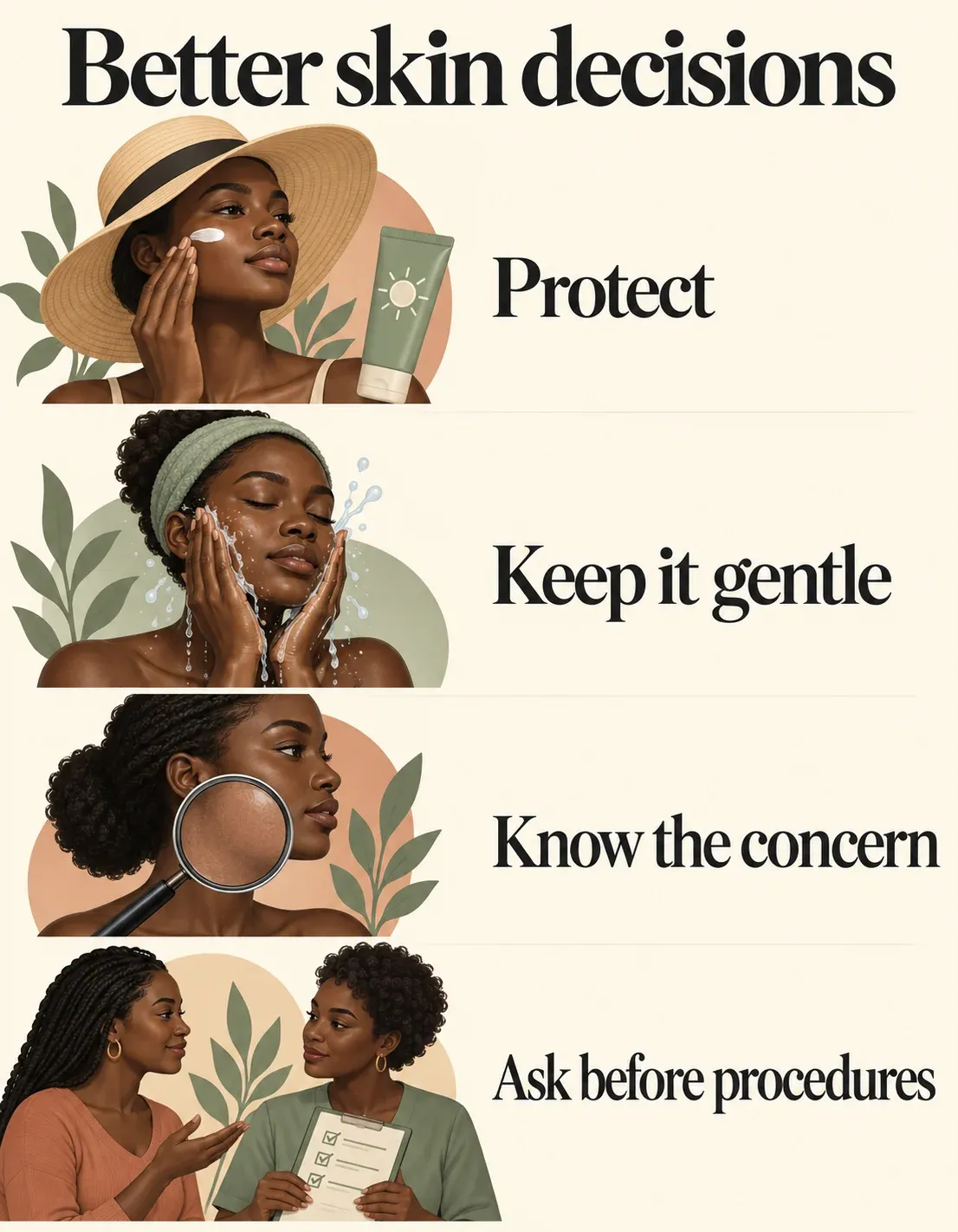
- Protect: choose broad-spectrum SPF 30 or higher; shade and clothing also matter.
- Separate the questions: a flattering sunscreen tint and appropriate protection are different checks.
- Keep it comfortable: burning is not proof that a product works.
- Choose by need: your complexion is not a complete routine prescription.
Editorial note: SkinOptimizer is an editorial skincare resource, not a medical practice. We checked dermatology guidance and product-safety information for this guide; we do not claim personal product testing, a clinical study, or a medical review.
Updated September 14, 2026: substantially rewritten with clearer safety boundaries, decision tables and new explanatory images. Originally published November 19, 2024.
Skincare myths for darker skin tones are most useful to challenge when they change a real decision. Should you replace your sunscreen, add an exfoliant, book a treatment, or simply stop doing something that irritates your face?
Our editorial approach is to ask what each claim leaves out. “Melanin offers protection” leaves out the limits of that protection, while “dark spots can improve” leaves out the cause, the time involved, and the possibility of another condition.
The aim is not to lighten your natural complexion. It is to help you care for comfortable skin without turning every normal variation in color or texture into a problem to fix.
You also do not need to build a routine around someone else's ethnicity-based shopping list. Two people with similar complexions can have different budgets, climates, product preferences, and medical needs.
Use this guide as a filter for advice, not as a diagnosis. The useful question is often “What would make this advice unsuitable for me?” rather than “Which ingredient is the strongest?”
The Skin Insider
Skin tone is not skin type. Tone describes your visible complexion; type describes tendencies such as oiliness or dryness. A concern, such as acne or an unexplained rash, adds another question and may need professional assessment.
Keep those categories separate when shopping. A label aimed at melanin-rich skin does not automatically tell you whether the texture, fragrance, or treatment strength suits your own face.
Skincare myths for darker skin tones: the practical comparison
Use these corrections to choose what to investigate next. The table is a navigation aid, not a way to identify a medical condition from its appearance.
| Myth | What it misses | Better next step |
|---|---|---|
| Melanin replaces SPF | Protection is incomplete | Plan sun protection |
| Any tint will work | Shade and protection differ | Check both separately |
| All dark spots are alike | Causes and depth vary | Identify the concern |
| Stronger means faster | Irritation can backfire | Avoid stacking actives |
| Tone dictates the routine | Type and tolerance matter | Choose by current need |
| Anti-aging is compulsory | Cosmetic goals are personal | Add only useful steps |
| A device guarantees safety | Operator and assessment matter | Ask about individual risk |
| Hydroquinone is simple | Medical and legal context matters | Ask a qualified prescriber |
1. “Darker skin does not need sunscreen”
Fact: more melanin does not make skin immune to sun damage. Sun protection is relevant even when reducing wrinkles is not your personal goal.
The American Academy of Dermatology's sunscreen guidance recommends broad-spectrum protection, SPF 30 or higher, and water resistance. Those label checks are more useful than assuming protection from your complexion.
Build protection around your day: uncovered areas, outdoor time, sweating, swimming, and opportunities to seek shade. Follow application and reapplication directions rather than treating morning application as an unlimited shield.
- Keep sunscreen somewhere that fits your morning routine.
- Include a hat or protective clothing when practical.
- Choose a finish you can comfortably wear in the labeled amount.
Lower risk is also not zero risk. The AAD explains that skin cancer can occur in darker skin tones, including places people may overlook during a skin check.
Do not assume a changing spot is harmless because it is not on a sun-exposed area. Sunscreen does not replace assessment of a new, unusual, bleeding, or changing lesion.
2. “Any tinted sunscreen is right for dark skin”
Fact: tint is not a universal shade match, and a good match does not establish every aspect of protection. Evaluate the sunscreen label and how it looks on your skin as separate questions.
For melasma, the AAD recommends tinted sunscreen containing iron oxide alongside appropriate UV protection. Visible light can worsen melasma, especially in darker skin tones.
That does not mean every beige cream, foundation, or tinted moisturizer is interchangeable. A product can look good while lacking the sunscreen labeling you need; another may have suitable labeling but a poor shade match.
- First: check SPF, broad-spectrum coverage, and directions.
- Then: inspect the tint and finish at the proper application amount.
- For pigment concerns: discuss iron-oxide options when shade matching is difficult.
Do not solve a white cast by deliberately applying too little. It is more useful to look for a different suitable formula than to make the current one disappear by underapplying it.
The words mineral, chemical, and tinted describe different aspects of a formula. Avoid treating one label as a complete answer about comfort, shade range, or visible-light protection.
If a new formula repeatedly stings or causes a rash, stop using that product and seek advice as needed. Protection should not become a reason to ignore a reaction.
3. “Every dark spot needs the same brightening treatment”
Fact: dark spots describe an appearance, not one diagnosis. A mark after acne, a recurring patch, and a changing mole should not automatically enter the same treatment routine.
Post-inflammatory hyperpigmentation, or PIH, is extra pigment remaining after inflammation or injury. Melasma is a different pigment condition; a scar involves a change in texture, although color changes can accompany it.
The AAD's dark-spot guidance emphasizes finding and addressing the cause. Continuing irritation or breakouts can create new marks while older ones gradually fade.
Its timeline example is not a promise: some relatively superficial marks may fade in six to twelve months once the cause stops. Deeper discoloration can take much longer.
- Note whether a mark followed a pimple, rash, injury, or new product.
- Keep track of new marks as well as old ones.
- Ask for assessment when the cause is unclear or a lesion changes.
Our cause-first guide to dark spots on darker skin explores that distinction in more depth. It is a better next stop than adding several unrelated brighteners at once.
When keeping progress photos, use similar lighting and avoid filters. Otherwise, a different window, phone setting, or angle may look like improvement or deterioration when the comparison is simply inconsistent.
4. “More exfoliation will fade marks faster”
Fact: irritation is not a useful progress signal. Adding stronger products to skin that already burns or peels can turn a cosmetic routine into another source of discomfort.
Do not interpret tingling as a measurement of effectiveness. A product can feel dramatic without being appropriate for the concern you are trying to address.
Before adding an exfoliant, check the whole routine. A cleanser, pad, serum, and occasional mask may each contribute an active ingredient even if only one is marketed as an exfoliator.
The Optimizer's Edge
Make one identifiable change. Write down the product, why you added it, and what would make you stop. This makes a reaction easier to discuss than a routine where several new products arrived together.
- Do not push through persistent burning or a worsening rash.
- Keep the packaging and ingredient list if a reaction occurs.
- Ask your prescriber before changing a prescribed treatment plan.
Our guide to routine mistakes that can complicate acne can help you review overlapping steps. Use it to simplify decisions, not to blame yourself for having acne.
If skin is already uncomfortable, buying a stronger treatment is not the only available action. Pausing an optional irritating product and seeking appropriate advice may be the more useful next step.
5. “Everyone with my complexion needs my routine”
Fact: two similar complexions can need different textures and different levels of care. Oiliness, dryness, sensitivity, climate, and existing treatment all affect what is practical.

A useful shopping brief starts with an observable problem: “My cheeks feel tight after cleansing” is more specific than “I need a product for brown skin.” It also makes it easier to judge whether a purchase helped.
For texture choices, see the moisturizer selector for darker skin tones. The point is to match a product to the area and concern, not assume one texture suits every face.
The same principle applies across cultural routines. Our Middle Eastern skincare guide and Indian skincare guide use individual needs rather than treating ethnicity as a diagnosis.
Skincare myths for darker skin tones: turn the label into a question
When a label promises that a formula is made for your complexion, ask what that changes in practice. Does it offer a useful shade range, a comfortable texture, or clear ingredient information?
If the answer is only a slogan, keep comparing. Representation can matter without replacing ordinary checks for suitability, directions, and affordability.
Choose a routine by the problem, not the myth
This table suggests where to begin your thinking. It does not identify disease or replace instructions for products a clinician has prescribed.
| Current concern | Practical first step | When to get help |
|---|---|---|
| Tightness after washing | Review cleansing and moisturizer | Persistent pain, cracking, or rash |
| Uncomfortable sunscreen finish | Compare suitable formulas and shades | Repeated irritation or reactions |
| Marks after breakouts | Address the active trigger | Scarring or ongoing significant acne |
| Unexplained pigment change | Avoid guessing with strong actives | Seek clinical assessment |
Keep a small routine record rather than a complicated tracker. Note the cleanser, moisturizer, sunscreen, and any treatment, including how often you actually use each one.
Record practical problems too: stinging, a shade you dislike, or a bottle that runs out too quickly. Those are useful reasons to reconsider a product even when its marketing sounds convincing.
You can use our AM and PM routine guide to organize the basics. Additional steps should have a clear job rather than exist only because another routine contains them.
6. “Darker skin either never ages or needs an anti-aging arsenal”
Fact: neither extreme is a helpful starting point. Cosmetic goals are personal, and a multi-serum routine is not a requirement for responsible skincare.
If your goal is comfort and sun protection, build around that. If you want to address texture or another specific concern, identify the goal before choosing an optional treatment.
The AAD's retinoid guidance notes that irritation can trigger dark marks in skin of color. It also advises against retinoids during pregnancy.
- Do not add retinol just because an age milestone passed.
- Check whether a current treatment already includes a retinoid.
- Discuss suitability when pregnant, planning pregnancy, or using prescribed skincare.
Price is not a substitute for that assessment. Our guide to skincare cost and results helps separate a useful purchase from an expensive extra step.
There is no obligation to pursue a perfectly uniform, poreless, or unlined face. A routine should serve your goals without turning normal skin into a permanent shopping emergency.
7. “The right laser makes treatment risk-free”
Fact: suitability depends on more than a machine name. Your concern, hair characteristics, skin history, settings, and practitioner experience all belong in the assessment.
The AAD's laser hair-removal guidance warns about burns, scarring, and lasting color changes. A provider should explain risks rather than promise that the chosen device eliminates them.
Hair removal and treatment of pigmentation are different jobs. Do not transfer a claim about a device for one purpose into permission to use it for another.
Questions to ask before booking a procedure
| Ask | Why it matters | Be cautious if |
|---|---|---|
| What are we treating? | Different concerns need different plans | The diagnosis is assumed |
| What is your experience with similar skin? | Assessment and technique matter | Only the machine name is offered |
| What could go wrong for me? | You need individual risk information | Safety is guaranteed |
| What are the aftercare and follow-up arrangements? | Problems need a response plan | Support after payment is unclear |
A test area may be part of the clinician's plan, but it is not a guarantee against every later reaction. Ask how they decide whether treatment is appropriate and when they would postpone it.
Bring a list of products, medicines, past reactions, and previous procedures. Do not stop prescribed medication on your own to qualify for an appointment.
8. “Hydroquinone is either harmless or always forbidden”
Fact: prescription use and buying an unregulated lightening product are not equivalent. The clinical context and the country where a product is sold matter.
The FDA states that hydroquinone skin-lightening products are not approved for over-the-counter sale in the United States. Prescription products may be available through a healthcare provider.
The agency reports harms including rashes, swelling, and ochronosis, a lasting discoloration. This is not an ingredient to self-prescribe from a marketplace listing or a social-media schedule.
- Discuss an unexplained pigment concern before treating it.
- Avoid products with unclear ingredients or missing labeling.
- Ask the prescriber about application, duration, monitoring, and reactions.
Mercury-containing lightening products are not a safer alternative. Nor does replacing hydroquinone with several strong acids automatically create a gentle routine.
If a prescribed product concerns you, bring the actual product and your questions to the clinician. An individualized explanation is more useful than an online rule declaring an ingredient universally safe or universally bad.
Your Clear Skin Checklist
- Name the goal: comfort, protection, or a specific concern—not a lighter natural complexion.
- Check the basics: suitable cleansing, moisturizer, and sun protection.
- Question the shortcut: neither a skin-tone label nor a stronger active guarantees suitability.
- Know your stopping point: persistent irritation or an unexplained change needs attention.
- Ask before procedures: understand the proposed treatment, risks, and follow-up.
Keep the useful advice; leave the myth
The best correction does more than replace “false” with “true.” It tells you what information you need before acting and what would make the advice unsuitable for your skin.
Keep your routine manageable, protect your natural complexion, and ask for help when a concern does not fit a simple cosmetic question. More products are not the measure of better care.
Frequently Asked Questions About Skincare Myths for Darker Skin Tones
Questions about melanin and sunscreen and tinted sunscreen shade matching informed this FAQ. Those discussions identify questions, not evidence; the answers use the authority guidance linked above.
Does natural melanin protection replace sunscreen?
No. More melanin does not provide complete protection from sun damage. Choose appropriate sunscreen and combine it with shade and protective clothing; do not use your complexion as a reason to ignore a changing skin lesion.
Why can tinted sunscreen still look gray on dark skin?
The shade, undertone, or overall formula may not match your complexion. Check the finish using the directed amount rather than applying less to hide it. A flattering tint and appropriate protection are separate requirements.
Do darker skin tones have to use mineral sunscreen?
Skin tone alone does not mandate a mineral formula. Consider the labeled UV protection, tolerance, and finish. For melasma or other pigment concerns, ask about iron-oxide tint rather than assuming the mineral label alone provides the answer.
How long do dark marks take to fade?
It depends on the cause and depth. The AAD gives six to twelve months as an example for some superficial marks once their cause stops; deeper pigment can take longer. An unclear or changing spot needs assessment rather than a countdown.
Is laser hair removal automatically safe for dark skin?
No procedure is automatically risk-free because of a device name. Seek an appropriately qualified, experienced clinician who assesses your skin and explains possible burns, pigment changes, scarring, and aftercare before you decide.
This article is for informational purposes only and does not replace professional dermatological advice.