Does Sleeping on Your Side Cause Wrinkles? What Evidence Shows
Does sleeping on your side cause wrinkles? See what sleep-line research shows and how to reduce morning creases without sacrificing healthy sleep.

In this guide

Sleeping on your side can press and fold facial skin, so it can cause temporary morning creases and may contribute to some persistent “sleep lines” over time. However, current evidence does not prove that side sleeping is a major cause of overall facial aging.
Do not sacrifice comfortable, healthy sleep just to avoid pillow contact. If side sleeping supports your breathing, reflux, pain control, pregnancy comfort, or simply better rest, keep it and focus first on sun protection, a tolerable skincare routine, and small pressure-reducing adjustments.
- What is plausible: repeated compression and shear can create morning marks and may reinforce certain sleep lines.
- What is not proven: that side sleeping is a dominant cause of wrinkles or that back sleeping prevents facial aging.
- What matters more: cumulative UV exposure, smoking, natural collagen loss, facial movement, and a routine you can follow consistently.
- Best practical move: protect sleep quality, reduce direct pressure only when comfortable, and treat silk or satin as a preference rather than a wrinkle cure.
Jump to what the studies can show, the low-risk crease plan, or situations where health should decide your sleep position.
SkinOptimizer is an editorial skincare resource, not a medical provider. We reviewed direct sleep-line research, conflicting human evidence, and clinical sleep-position guidance so that a cosmetic concern does not override safe, restorative sleep.
If you wake with a diagonal line across one cheek or a crease near one eyebrow, your pillow is an obvious suspect. The frustrating part is that the mark can look deeper with age, even when your routine has not changed.
The internet often turns that observation into a rigid rule: sleep on your back or expect one side of your face to age faster. That advice sounds precise, but the research is much less certain.
This guide separates what we can see in the mirror from what studies can actually establish. It also gives you a practical plan that starts with better sleep rather than fear of normal facial lines.
First, Identify the Line You Are Seeing
“Wrinkle” is an umbrella word for several different patterns. A temporary pressure mark, an expression line, a sleep line, and sun-related texture can overlap, but they do not have the same cause or solution.
Look at the line soon after waking and again later in the day under the same lighting. That simple comparison will not diagnose your skin, but it helps you avoid treating a short-lived crease as proof of permanent damage.
| What you notice | Likely contributors | Useful next step |
|---|---|---|
| Line appears on waking and fades | Temporary pressure, fluid shift, surface dryness | Allow time, moisturize if dry, and observe duration |
| Diagonal or vertical line at a pillow-contact point | Repeated compression and shear may contribute | Try a comfortable pressure adjustment for several weeks |
| Line appears with smiling, squinting, or frowning | Repeated facial expression plus normal elasticity loss | Prioritize UV protection; discuss treatment only if it bothers you |
| Fine texture across exposed areas | Photoaging, dryness, intrinsic aging, smoking history | Use broad-spectrum sunscreen and a barrier-supportive routine |
Sleep lines are commonly described as folds created where the face is compressed against bedding. They may run differently from the lines produced by muscle movement, which is why simply relaxing your expression does not remove the pillow-contact pattern.
Still, visible asymmetry is not proof that your favorite side caused every difference. Faces are naturally asymmetric, sun exposure can differ by side, and expression habits, anatomy, dental factors, swelling, and previous procedures can all influence what you see.
Does Sleeping on Your Side Cause Wrinkles? What Studies Show
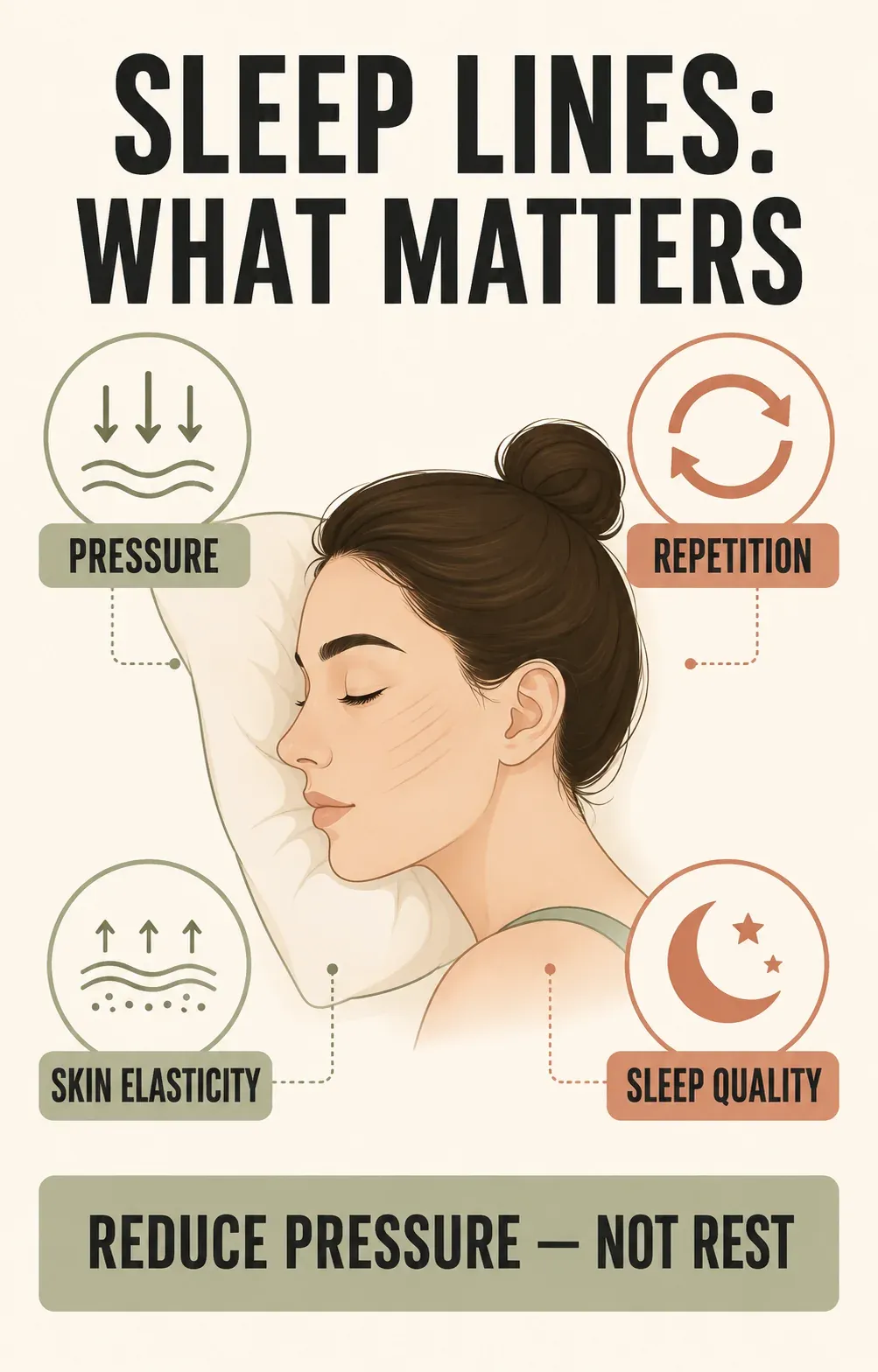
The most frequently cited mechanism comes from a clinical review of sleep wrinkles. Its authors describe compression, tension, and shear forces acting on facial skin during side and stomach sleeping, creating folds in areas that contact the pillow.
That mechanism is reasonable, and it matches the temporary creases many people observe. You can read the review in Aesthetic Surgery Journal via PubMed.
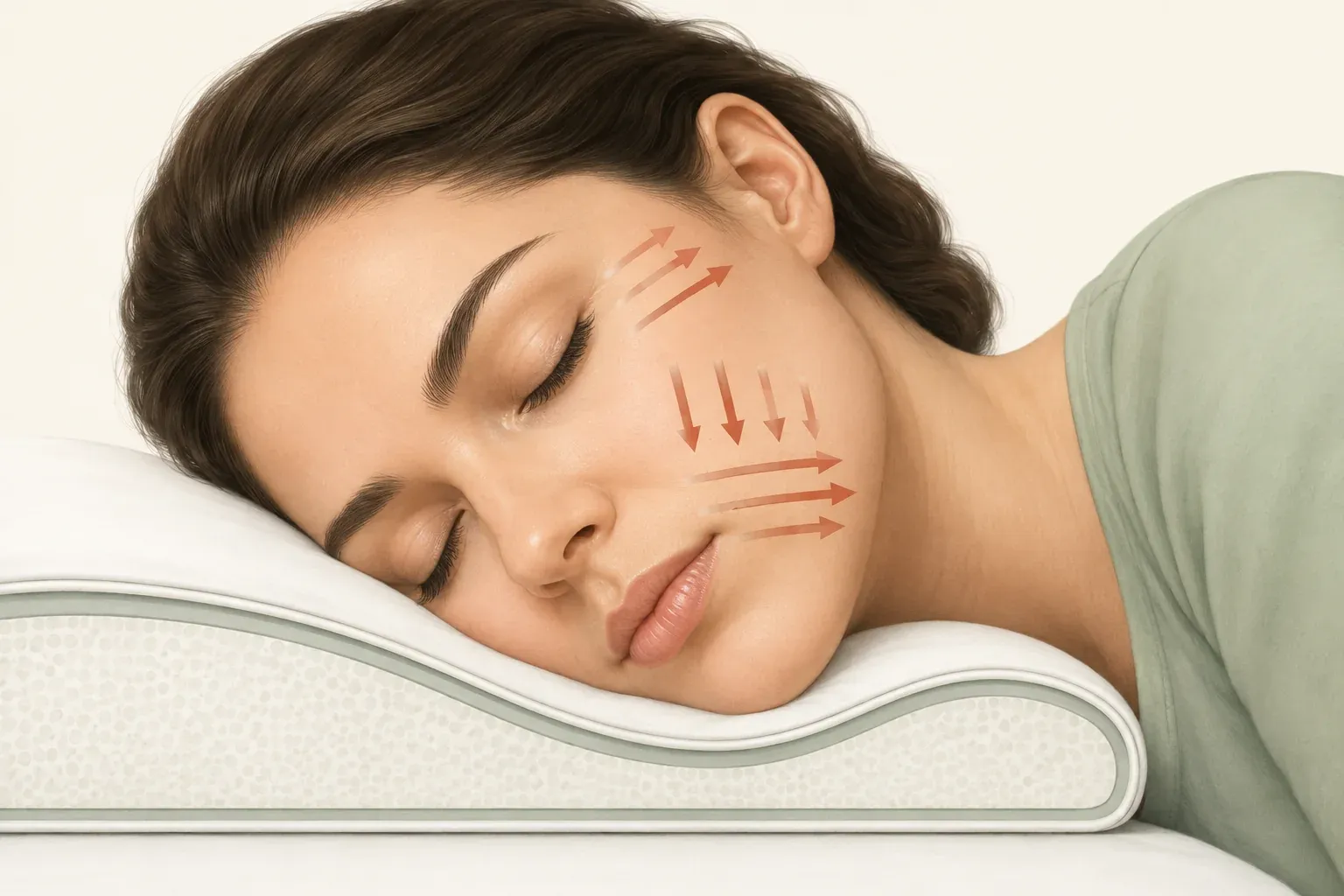
Mechanism is not the same as measured long-term harm. A material can fold skin in one moment without proving how much permanent change that fold creates over years or how it compares with UV exposure, smoking, age, hormones, or genetics.
One study tried to test the side-specific claim directly. In 100 women, researchers compared the preferred sleep side with the side judged to have more wrinkles and facial ptosis, and they found no significant correlation.
The cross-sectional study is available on PubMed. It does not prove that pressure never matters, but it weakens the confident claim that your preferred side reliably predicts which side looks older.
An older clinical report described characteristic sleep-line patterns and considered prone sleeping an important factor. Its observations are useful for recognizing a pattern, yet the design cannot isolate sleep position from the many other processes that change skin over time.
You can review that descriptive report on facial sleep lines. Taken together, the research supports biological plausibility and clinical observation, not a precise risk percentage or a guarantee that changing position will erase established lines.
| Evidence type | What it can support | What it cannot prove |
|---|---|---|
| Mechanical review | Facial skin experiences compression, tension, and shear during pillow contact | How much permanent aging side sleeping causes for an individual |
| Cross-sectional human study | Preferred side did not significantly match the side with more aging signs in that sample | That pressure never contributes or that all sleepers respond alike |
| Descriptive clinical report | Sleep lines can follow recognizable non-expression patterns | Causation, effect size, or prevention by a specific product |
| Personal morning observation | Your face was compressed enough to leave a temporary mark | That the mark will become permanent or that side sleeping is your main aging driver |
The honest conclusion is narrower than social-media advice. Side sleeping can produce pressure marks and may contribute to specific sleep lines, but current evidence is insufficient to call it a major independent cause of facial aging.
Why Morning Creases Can Look Deeper With Age
Younger skin often rebounds quickly after folding because its supporting structures and water balance recover well. With age and cumulative environmental exposure, the same pressure mark may take longer to disappear.
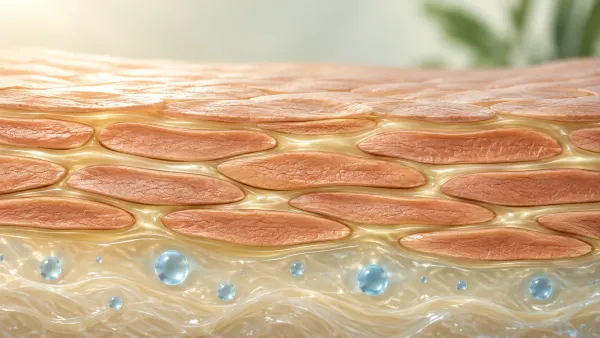
That slower rebound does not mean one night created a wrinkle. It reflects the interaction between repeated mechanics and a skin surface whose elasticity, collagen organization, hydration, and recovery have changed over time.
Dryness can make fine surface lines look sharper, especially after heating, air conditioning, cleansing, or a long night. A moisturizer can improve comfort and temporarily soften that appearance, but it does not prove that dehydration was the only cause.
For a wider prevention strategy, our guide to preventing wrinkles ranks the habits that matter beyond one sleep position. If you want the structural context, see what collagen-boosting skincare can and cannot do.
What Matters More Than Your Pillow Position
UV exposure is a clearer, more actionable cause of premature skin aging than whether your left or right cheek touches a pillow. Daily broad-spectrum sunscreen, shade, clothing, and sensible reapplication have more established roles than forcing a new sleep position.
Smoking also accelerates visible skin aging and harms health far beyond appearance. No pillowcase can offset those exposures, and no sleep hack should distract from them.
Consistent rest matters too. In a controlled study, sleep restriction changed aspects of perceived facial appearance, which is a different question from wrinkles but a useful reminder that losing sleep for cosmetic reasons can be counterproductive.
The sleep-restriction study is available on PubMed. It does not tell you which position to use; it supports keeping sufficient sleep at the center of the decision.
Build the basics with our simple morning and evening routine for aging skin. If you use an active, our retinol guide explains how to start gradually rather than chase fast irritation.
A Low-Risk Plan to Reduce Morning Creases
You do not need to train yourself into a rigid pose. The goal is to reduce avoidable pressure while preserving the position that lets you breathe, relax, and stay asleep.
If you can lie partly on your back without discomfort, a small body pillow or support behind your torso may reduce how fully you roll onto your face. Stop if the setup creates neck, shoulder, hip, or lower-back discomfort.
Pillow height matters because an overly high or low pillow can bend the neck while still pressing the cheek. There is no universal “anti-wrinkle” shape, so comfort and neutral support are better criteria than marketing claims.
A clean pillowcase is sensible for comfort and routine hygiene. Changing it regularly can also remove skincare and hair-product residue, but it should not be framed as a proven wrinkle treatment.
Do Silk or Satin Pillowcases Prevent Wrinkles?
A smooth fabric may feel cooler, reduce friction, and create less hair tangling for some people. Those are reasonable comfort benefits, but they are not the same as clinical proof that a pillowcase prevents facial wrinkles.
Silk describes a fiber, while satin describes a weave that can be made from several fibers. Price, fiber name, and slippery feel do not tell you how much facial pressure remains when the weight of your head still compresses the cheek.
If you enjoy silk or satin and it helps you sleep comfortably, use it. If it is expensive, hot, difficult to wash, or irritating, a smooth clean cotton or other comfortable fabric is a defensible choice.
A specialty pillow may change contact points, but that does not prove long-term wrinkle prevention. Look for a return policy, protect neck comfort, and treat any cosmetic result as an individual observation rather than a guaranteed medical outcome.
Skincare That Supports the Bigger Picture
In the morning, use a moisturizer if your skin feels dry and a broad-spectrum sunscreen that you can apply generously. Sunscreen cannot stop a pillow crease, but it addresses a more established driver of premature aging.
Our real-life sunscreen reapplication guide helps translate the label into normal days. For formula support, compare the routine role of anti-aging moisturizers without expecting hydration alone to rebuild collagen.
At night, gentle cleansing and moisturizer may reduce surface dryness that exaggerates fine texture. If a retinoid is appropriate for you, introduce it slowly and keep the rest of the routine simple enough to distinguish expected dryness from true intolerance.
Established lines can also be discussed with a dermatologist, who can separate sleep lines from expression lines, laxity, volume change, and pigment. Our overview of non-surgical anti-aging treatments explains benefits, limits, and risks without treating every line as a problem that needs a procedure.
| Action | Priority | Important limit |
|---|---|---|
| Preserve sufficient, comfortable sleep | Highest | Cosmetic advice should not override breathing, pain, reflux, or pregnancy needs |
| Use broad-spectrum sunscreen | High | Needs adequate, consistent application; does not remove existing lines |
| Moisturize dry skin | High for comfort | Softens dry surface texture but is not a structural wrinkle cure |
| Try a comfortable pressure adjustment | Optional | Evidence for long-term prevention is limited |
| Buy silk, satin, or a specialty pillow | Preference | Comfort may improve; wrinkle prevention is not established |
When Health Should Decide Your Sleep Position
Back sleeping is not automatically the healthiest position. It may worsen snoring or breathing problems for some people, while side sleeping can be more comfortable in pregnancy or for certain pain and reflux patterns.
Johns Hopkins Medicine's sleep-position guidance emphasizes comfort and specific health needs rather than naming one position as universally best. That is the right hierarchy for a wrinkle decision too.
If you have diagnosed or suspected sleep apnea, loud snoring, gasping, severe reflux, pregnancy-related discomfort, postoperative instructions, or persistent neck and back pain, ask the relevant clinician before changing position. A dermatologist can address the line, while a sleep clinician, obstetric professional, physiotherapist, or other qualified clinician can address the reason you sleep as you do.
Seek prompt medical help for facial drooping, sudden asymmetry, weakness, numbness, severe swelling, or a new change that does not behave like a simple pressure crease. Those signs do not belong in a cosmetic pillow experiment.
The Bottom Line
Side sleeping can create temporary creases, and repeated mechanical folding may contribute to some persistent sleep lines. The leap from that plausible mechanism to “side sleeping causes one side of your face to age” is not supported with the certainty often claimed online.
Use a sleep-first approach. Make small comfort-preserving changes if morning marks bother you, but put stronger evidence-based habits ahead of expensive pillowcase promises or a position that leaves you tired, sore, or short of breath.
Frequently Asked Questions
Are morning pillow lines permanent?
Usually not. A crease that fades after you get up is a temporary pressure mark.
A line that remains through the day may reflect repeated mechanical folding, normal loss of elasticity, expression, sun exposure, or a combination of factors. Track duration rather than assuming every morning mark is permanent damage.
Is sleeping on your back better for wrinkles?
Back sleeping reduces direct facial contact with a pillow, so it may reduce morning compression marks. Evidence does not prove that it prevents overall facial aging, and it is not the best position for everyone.
Do silk or satin pillowcases prevent wrinkles?
A smooth fabric may reduce friction and hair tangling, but there is not strong clinical evidence that silk or satin pillowcases prevent facial wrinkles. Treat the fabric as a comfort preference, not an anti-aging treatment.
Can side sleeping make one side of your face age faster?
It is mechanically plausible that repeated pressure could make sleep lines more visible on one side, but direct human evidence is limited. One cross-sectional study found no significant match between preferred sleep side and the side with more wrinkles or ptosis.
Should I change sleep position if I have sleep apnea, reflux, pain, or pregnancy discomfort?
Do not trade safe, comfortable sleep for a cosmetic goal. Ask a qualified clinician which position fits your breathing, reflux, pain, pregnancy, or recovery needs, and treat wrinkle prevention as secondary.
Method note: This article distinguishes mechanistic reviews, observational human evidence, and clinical sleep guidance. Reddit threads were used only to identify recurring reader questions, never as medical evidence.
This article is for informational purposes only and does not replace professional dermatological advice.