Essential Oils for Skincare: Benefits, Risks and Safer Use
Learn what essential oils for skincare can and cannot do, which risks matter, and how to choose, patch test, and stop using products more safely.
In this guide

Essential oils for skincare are optional, concentrated fragrance-active ingredients—not basic moisturizers and not universal treatments. They may have useful properties in a properly formulated product, but neat oils and improvised mixtures can irritate skin, trigger allergic contact dermatitis, or increase sun sensitivity.
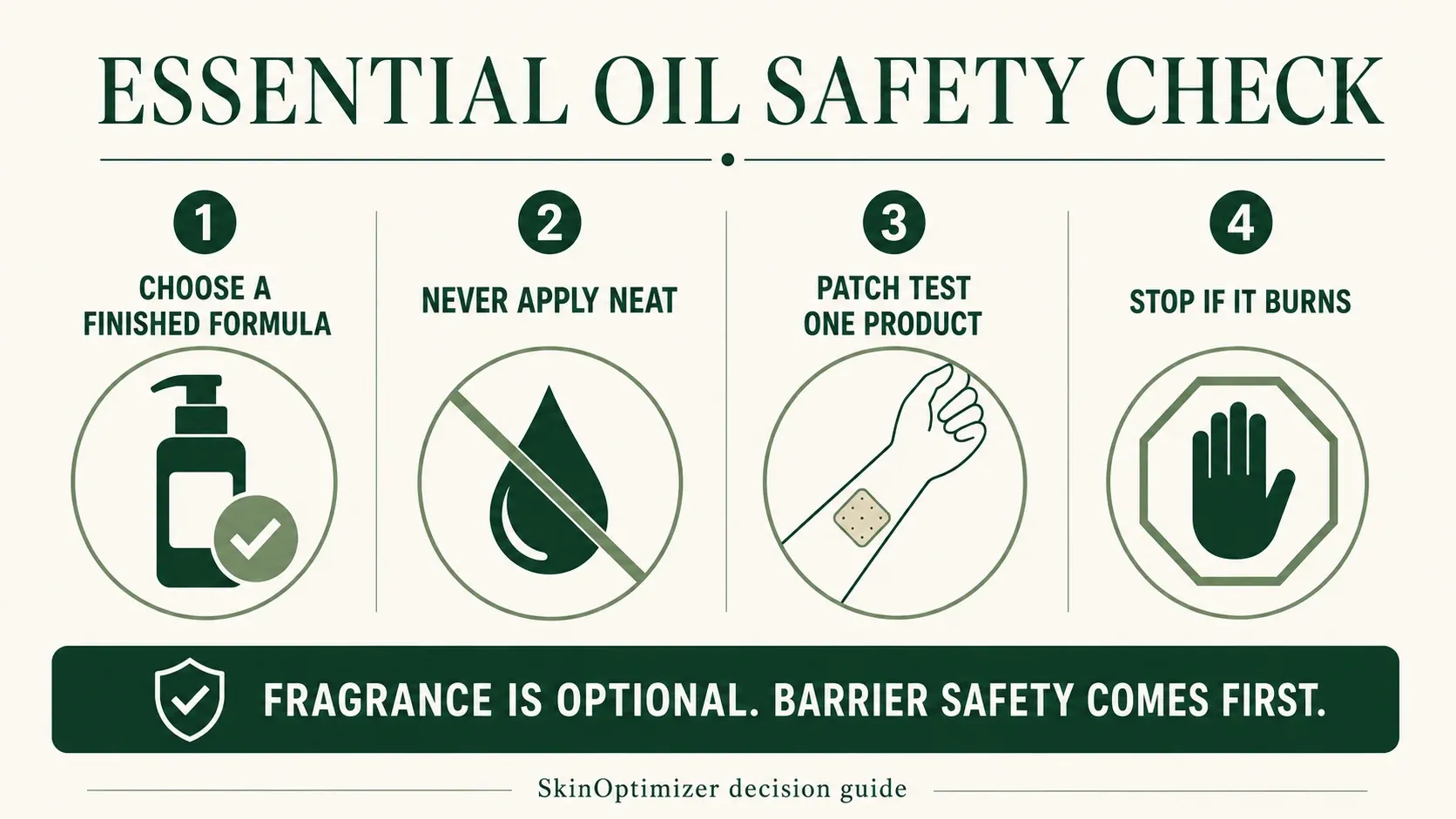
The safest default is to choose a finished cosmetic from a reputable manufacturer, introduce one product at a time, and stop if burning, swelling, blistering, or a spreading rash develops. Sensitive, eczema-prone, or fragrance-allergic skin often does better without essential oils.
- Know the category: tea tree and lavender are essential oils; jojoba, argan, rosehip, and squalane are carrier or face oils.
- Prefer formulation: a tested finished product is more predictable than raw drops mixed at home.
- Read evidence narrowly: research on one concentration and vehicle does not prove that neat oil works.
- Watch the sun: some citrus-derived ingredients can cause phototoxic reactions.
- Respect reactions: tingling and burning are warning signs, not evidence of efficacy.
SkinOptimizer is an educational skincare publication, not a medical clinic. This guide was rechecked in September 2026 using dermatologist-edited guidance, FDA information, clinical research, and a recent evidence review; community discussions were used only to identify practical questions.
Essential oils are easy to misunderstand because the word “oil” covers products that behave very differently. A fragrant, volatile plant extract is not interchangeable with a bland emollient such as squalane or jojoba.
That distinction changes almost every practical decision. It affects whether a product is likely to moisturize, whether it needs careful concentration control, what kind of evidence applies, and how you should respond to irritation.
This guide uses a risk-first approach. Instead of matching a trendy oil to every skin type, it helps you decide whether an essential-oil product adds enough value to justify its fragrance and sensitization risk.
Essential Oil, Carrier Oil, or Finished Skincare?
Essential oils are volatile aromatic extracts obtained from plant material. Their concentrated mixtures may contain dozens of chemical constituents, and their composition can vary with the plant, extraction, storage, and oxidation.
Carrier oils are lipid-rich materials used for emollience or as a vehicle. Jojoba, argan, rosehip, sunflower, and grapeseed are often called facial oils, but they are not essential oils.
A finished skincare product may contain an essential oil at a controlled concentration alongside emulsifiers, preservatives, antioxidants, and other ingredients. That complete formula—not one highlighted ingredient—determines spread, stability, exposure, and tolerance.
| Product type | Main skincare role | Best decision rule |
|---|---|---|
| Essential oil | Concentrated aroma and biologically active volatile compounds | Do not apply neat; avoid treating “natural” as a safety guarantee |
| Carrier or face oil | Emollience and reduced moisture loss | Choose by texture, tolerance, and the rest of the formula |
| Finished cosmetic with essential oil | Formula-specific cosmetic effect plus fragrance | Assess the whole ingredient list, directions, packaging, and skin response |
| Drug or acne treatment | Treatment of a defined condition under drug rules | Use labeled active ingredients or a clinician’s plan rather than substituting raw oil |
For help choosing an emollient rather than a fragrant extract, compare our face oils by skin type and texture. That guide explains when squalane, jojoba, or rosehip may fit without pretending every oil has the same job.

When a label says “oil,” look at the INCI list. Names such as jojoba seed oil and squalane signal emollient oils, while lavender oil, tea tree leaf oil, citrus peel oils, limonene, and linalool point toward fragrance-active exposure.
What the Evidence Actually Supports
Laboratory antimicrobial or antioxidant activity is not the same as a meaningful result on human facial skin. A compound can perform in a dish yet fail to reach a useful concentration in a tolerable cosmetic formula.
Tea tree oil has more clinical attention than most essential oils. A small randomized trial found benefit from a manufactured 5% tea tree oil gel for mild-to-moderate acne, but that result belongs to that concentration, vehicle, schedule, and study population.
The trial does not show that a drop of neat tea tree oil is safer or more effective. It also does not establish tea tree oil as a replacement for broader acne plans built around proven actives and individual severity.
A 2024 scoping review of clinical essential-oil research found tea tree to be the most studied oil for inflammatory skin conditions. The authors also identified inconsistent product-quality verification, small samples, short studies, uncontrolled designs, and a need for better long-term trials.
| Common claim | Evidence-aware reading | Practical choice |
|---|---|---|
| “Tea tree treats acne” | Limited product-specific evidence exists; irritation and allergy remain possible | Prefer a formulated product and compare it with established acne options |
| “Lavender calms sensitive skin” | Scent may feel relaxing, but lavender can also act as a contact allergen | Do not use fragrance as the active plan for redness, eczema, or rosacea |
| “Essential oils hydrate” | Essential oils are not interchangeable with lipid-rich carrier oils or moisturizers | Use humectants, emollients, and occlusives for a hydration goal |
| “Antioxidants prevent aging” | Chemical antioxidant activity does not prove visible anti-aging benefit in a home blend | Prioritize sunscreen, a tolerable routine, and evidence-based actives |
| “Natural means gentler” | Plant-derived chemicals can irritate, sensitize, or react with sunlight | Judge concentration, formulation, exposure, and personal risk |
The tea tree acne trial is a reason for careful interest, not a license for DIY escalation. If breakouts are the real goal, our natural acne care guide separates supportive choices from treatment claims.
For a proven over-the-counter alternative, read how benzoyl peroxide fits by strength and routine. Persistent, scarring, painful, or widespread acne deserves professional assessment rather than repeated experiments with concentrated fragrance.

The Essential-Oil Risk Audit
The main facial-skin risks are irritant contact dermatitis, allergic contact dermatitis, and photocontact reactions. These can overlap, so a reaction is not always easy to diagnose from appearance alone.
Irritation may cause immediate burning, stinging, redness, dryness, or peeling. Allergic contact dermatitis is a delayed immune reaction that can appear after previous tolerated use and may spread beyond the exact contact area.
DermNet’s dermatologist-edited guidance notes that essential oils can cause allergic contact dermatitis and advises against applying neat, undiluted oils. Tea tree, ylang-ylang, lemongrass, sandalwood, clove, jasmine, and other oils have been implicated.
Oxidation matters too. Air, heat, light, and time can alter fragrance chemicals, and some oxidation products are stronger sensitizers than the fresh material.
| Signal or situation | What it may mean | What to do |
|---|---|---|
| Mild tingling that continues | Possible irritation rather than proof of activity | Rinse, stop the product, and keep the recovery routine bland |
| Itchy, scaly, or spreading rash | Possible allergic contact dermatitis | Stop exposure and seek clinician advice if it persists or is significant |
| Blistering after citrus oil plus sun | Possible phototoxic reaction | Avoid further exposure and obtain medical guidance |
| Eye, lip, or airway symptoms | Higher-risk exposure or allergic reaction | Rinse exposed eyes and seek urgent help for breathing difficulty or major swelling |
| New reaction to an old bottle | Formula change, contamination, or oxidation may be involved | Stop using it; do not try to “use it up” on another body area |
The FDA explains that natural or organic origin does not guarantee safety. It specifically notes that some citrus oils used safely in food can be harmful when applied to skin exposed to sun.
Nighttime use is not a universal solution because residue, concentration, and the specific citrus material still matter. Follow the finished product’s directions and warnings rather than relying on a blanket internet rule.
People with eczema, rosacea, a damaged barrier, fragrance allergy, or a history of reactions have less room for error. Our sensitive-skin routine shows how to reduce variables, while the damaged-barrier guide focuses on recovery.
Stop signal: Do not keep applying an oil because discomfort is described as “detox,” “purging,” or proof that microbes are dying. Burning, swelling, blistering, hives, or a worsening rash are reasons to stop.
Patch Testing Helps, but It Is Not a Guarantee
A home patch check may reveal obvious irritation before full-face use, but it cannot guarantee that repeated exposure will remain safe. Allergic sensitization can develop over time, and facial skin may react differently from an arm.
Test the finished product, not a stronger raw ingredient that the formula happens to contain. Follow its directions, use a small area away from the eyes, and avoid testing several new products at once.
If you already have dermatitis or a history of fragrance allergy, a dermatologist’s formal patch testing is more informative than repeated home challenges. Bring the actual products because the relevant allergen may be a component or oxidation product.
A Safer Routine for Essential Oils in Skincare
The lowest-risk route is not to build a raw-oil recipe. It is to decide whether a finished product offers a clear benefit that your current routine lacks.
Start with the goal. If you want moisture, choose a moisturizer or suitable face oil; if you want acne treatment, choose an established active or a professionally formulated tea-tree product; if you want fragrance, accept that scent is the main benefit and a possible tolerance cost.
Do not mix raw essential oil into a moisturizer in your palm. Drop sizes vary, the mixture may not distribute evenly, and adding an ingredient can change spread, preservation, or performance.
Water does not reliably dilute oil. A DIY face mist can create concentrated droplets while also introducing preservation problems, so the old “oil plus water” recipe does not belong in a safety-first facial routine.
Layer a finished essential-oil cosmetic according to its label. If it pills with other products, our guide to stopping skincare pilling helps you change timing and texture without combining formulas in your hand.

Choose the product that solves the goal with the fewest extra variables. For many readers, a fragrance-free moisturizer or established acne active is easier to evaluate than a multi-oil blend with broad “radiance” claims.
Who Should Be Especially Cautious?
Fragrance allergy, atopic dermatitis, rosacea, and an actively damaged barrier raise the practical risk of discomfort or dermatitis. These conditions do not make every essential-oil exposure impossible, but they make experimentation less attractive.
Be cautious during pregnancy or breastfeeding, with infants and children, around pets, and when using medicines that increase photosensitivity. The right decision can depend on the exact oil, route, concentration, body site, and exposure.
Do not use essential oils near the eyes, inside the nose, on lips, on broken skin, or over a fresh procedure unless a qualified clinician specifically directs it. Never ingest an essential oil because a skincare post or label calls it natural.
If redness is persistent rather than a brief cosmetic concern, use the decision points in our redness and rosacea routine. A diagnosis-first approach is safer than rotating through fragranced remedies.
How to Buy and Store an Essential-Oil Product
Choose a product that identifies the manufacturer, provides a complete ingredient list, includes clear directions, and uses packaging suited to its contents. “Therapeutic grade,” “pure,” and “detoxifying” are marketing terms, not proof of facial safety or clinical benefit.
A dark or opaque container may help limit light exposure, but packaging cannot rescue poor formulation. Close the container promptly, store it as directed, and avoid keeping it in a hot bathroom window or car.
Write the opening date on a bottle if you will not remember it. Discard it when the manufacturer’s period-after-opening guidance expires or sooner if the smell, color, texture, or skin response changes.
Do not buy a large raw-oil bottle merely because the unit price is lower. Longer storage creates more opportunity for air, heat, and light exposure, while a small finished product may offer more predictable use.

When Essential Oils Are the Wrong Tool
Essential oils are a poor first choice when the main problem is a damaged barrier, active eczema, unexplained facial burning, a spreading rash, or severe acne. Those situations need fewer variables and sometimes diagnosis or prescription care.
They are also the wrong tool when the desired effect is basic hydration. A well-built moisturizer supplies humectants, emollients, and occlusive support without asking fragrance-active ingredients to perform a job they were not designed to do.
For a simple soothing option, compare evidence and limits in our hypochlorous-acid spray guide. It is still important to assess the finished product, but the decision starts from the skin goal rather than botanical appeal.
- I know whether the product is an essential oil, carrier oil, or finished formula.
- I can name the specific goal and a lower-risk alternative.
- I am not applying neat oil or improvising a water mist.
- I checked sun warnings, storage guidance, and my fragrance history.
- I will stop for burning, swelling, blistering, or a worsening rash.
Frequently Asked Questions About Essential Oils for Skincare
Question-source note: We reviewed recurring uncertainties in a tea-tree formulation discussion, a post-irritation question, and a direct-application question. Community posts identified the questions; dermatologist, FDA, and clinical sources support the answers.
Can I put essential oils directly on my face?
No. Neat essential oils can irritate skin and increase the risk of sensitization, and “one tiny drop” is not a standardized facial dose.
A pre-formulated cosmetic with a disclosed ingredient list is a safer and more predictable choice. Avoid the eyes, lips, mucosa, and broken skin.
Is tea tree oil good or bad for acne-prone skin?
It is neither universally good nor universally bad. Limited evidence applies to specific formulated products, while neat tea tree oil can irritate or trigger allergy.
Do not assume that tingling means antibacterial action or that a raw oil will reproduce a trial result. Compare any tea-tree product with established acne options and stop if tolerance worsens.
Can I dilute an essential oil by mixing it into moisturizer?
Home mixing is not reliably uniform and can change how the moisturizer spreads. Drop size also varies, so a universal “drops per spoonful” recipe creates false precision.
Prefer a professionally formulated product. If a qualified professional recommends a raw material for a specific use, follow product-specific directions rather than a generic internet ratio.
Should I try an essential oil again after it burned or irritated my skin?
Stop the product and let the skin recover; do not treat burning as proof that it worked. A repeat challenge can trigger another or stronger reaction.
Seek medical advice for swelling, blistering, severe pain, eye involvement, breathing symptoms, or a rash that persists or spreads. Bring the product or ingredient list to the appointment.
What is the difference between an essential oil and a face oil?
Essential oils are concentrated volatile aromatic extracts. Face oils are usually carrier oils or formulated blends rich in lipids that soften skin and reduce moisture loss.
Jojoba, squalane, argan, and rosehip are not essential oils. A face oil can still contain fragrance or essential oils, so check the complete ingredient list.
Bottom Line
Essential oils can be optional ingredients in well-designed skincare, but they are not required for healthy skin. Their value is formula-specific, and their risks increase when concentrated oils are applied neat, mixed casually, stored poorly, or used to treat a condition without adequate evidence.
Choose the simplest product that matches the goal. When sensitivity, dermatitis, significant acne, or an unexplained reaction is present, replace experimentation with a bland routine and qualified care.
This article is for informational purposes only and does not replace professional dermatological advice.