Essential Tips on How to Do Skincare for Beginners: Your Complete Guide
Discover essential tips on how to do skincare for beginners, from routines to common mistakes to avoid!

In this guide

Quick Answer
To do skincare as a beginner, start with three jobs: gentle cleansing, comfortable moisturizing, and daytime sun protection. You do not need a toner, serum, scrub or anti-aging treatment to make the routine count.
Keep products you already tolerate, test new basics before full-face use, and change one thing at a time. Use a broad-spectrum, water-resistant sunscreen with SPF 30 or higher, following its directions.
If your skin already hurts, develops a persistent rash, or has deep or scarring breakouts, seek professional advice instead of building a bigger shopping list. The goal is a routine you can repeat without discomfort, not an instant transformation.
Quick Summary
- Morning: cleanse as appropriate, moisturize if needed, then apply sunscreen before outdoor exposure.
- Evening: remove the day's sunscreen and makeup gently, then moisturize.
- First purchase: fill a missing basic step; do not replace everything that already works.
- First troubleshooting move: stop the newest suspected irritant rather than adding another active.
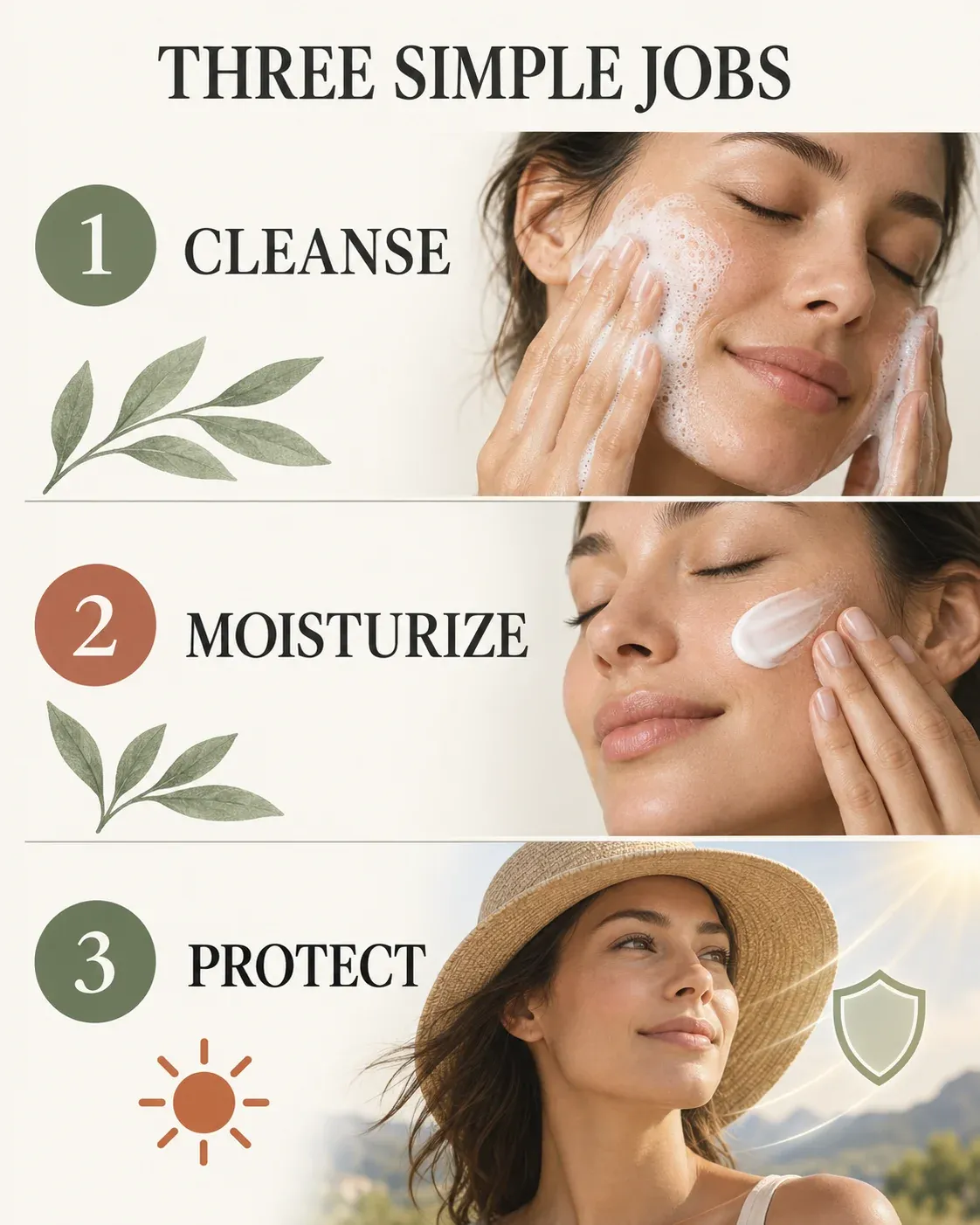
Learning how to do skincare for beginners is mostly a sorting exercise. You are separating everyday care from optional treatments, then finding versions of the basics that fit your skin and your day.
Our approach starts with what you already own. A comfortable moisturizer does not become inadequate because a video recommends a newer one, and an inexpensive cleanser does not need replacing simply because it has plain packaging.
The Cleveland Clinic's beginner advice also emphasizes a simple routine tailored to the individual. Use this guide as a decision aid, not a demand to buy every category mentioned.
A simple morning and evening skincare routine
Give each product one job before deciding its place. In the morning, you are preparing for the day and protecting exposed skin; in the evening, you are removing what accumulated and restoring comfort.
This table is an editorial starting framework for ordinary cosmetic care. A prescribed treatment plan takes priority, and skin conditions may require a different approach.
| When | Starting steps | Adjust for your day |
|---|---|---|
| Morning | Gentle cleanse or suitable rinse; moisturizer if needed; sunscreen | A comfortable SPF moisturizer can combine the last two jobs when used as directed. |
| Evening | Remove makeup and sunscreen; gentle cleanse; moisturizer | Add a separate makeup remover only if your usual cleanser does not remove what you wear. |
| After sweating | Cleanse gently and restore comfort | Reapply sunscreen when needed for continued outdoor exposure. |
How to do skincare for beginners without over-cleansing
A cleanser should remove what needs removing without making a squeaky finish your goal. Use your fingertips rather than treating the face like a surface that needs polishing.
The AAD's face-washing guidance recommends lukewarm water, gentle handling and avoiding scrubbing. It advises limiting washing to twice daily and after sweating, rather than repeatedly washing away every trace of shine.
If a morning wash consistently leaves you uncomfortable, do not force it just to follow a chart. Consider a gentler formula or discuss your cleansing frequency with a dermatologist, especially if dryness or irritation persists.
Double cleansing means using two cleansing products in sequence, not washing harder. It can be useful for stubborn makeup, but it is not a membership requirement for good skincare.
- Makeup comes off easily: keep your existing gentle method.
- Residue remains: consider a suitable remover rather than longer scrubbing.
- Skin feels tight afterward: reassess the formula and handling before adding exfoliation.
For shopping terminology, our cleanser versus face wash guide explains why the label alone does not tell you how a formula will feel.
Moisturizer: choose comfort rather than a skin-type stereotype
Use a moisturizer you can comfortably spread and wear. You do not need separate day and night jars unless one formula cannot meet both needs; see our day versus night moisturizer guide.
A light lotion may suit someone who dislikes residue, while a richer cream may be more comfortable on dry areas. Those are starting preferences, not guarantees based on packaging words such as “gel” or “rich.”
Combination skin does not require two complete routines. You can use the same tolerated moisturizer more generously on dry cheeks and less heavily where a thick layer feels unnecessary.
The AAD's budget skincare guidance supports a cleansing, moisturizing and sun-protection baseline, including moisturizer for oily skin. It also recommends applying moisturizer to damp skin to help retain water.
Sunscreen: the daytime step that is not replaced by a serum
Choose broad-spectrum SPF 30 or higher and water resistance appropriate to your activity. The AAD's sunscreen application guide explains coverage, application before going outdoors and reapplication about every two hours outdoors, including after swimming or sweating.
Follow the amount and use directions on your product. A moisturizer containing SPF can be useful, but applying only a tiny cosmetic dab may not provide the intended coverage.
Keep sunscreen as its own final skincare layer rather than mixing it into another product. Shade, clothing and a hat are useful parts of the same protection plan, not reasons to deliberately underapply sunscreen.
If the finish makes you avoid using it, treat that as a practical selection problem. Our mineral versus chemical sunscreen comparison and sunscreen reapplication guide address the next decisions without expanding your entire routine.
Choose basics by the problem you actually notice
You do not need to diagnose your skin type perfectly before starting. Describe observable patterns instead: where you feel dry, when shine appears, and which products cause discomfort.
A shiny forehead and tight cheeks can coexist. A rash is not simply another skin type, and persistent burning should not be accepted as proof that a product is working.
| What you notice | Useful first choice | What to avoid assuming |
|---|---|---|
| Dryness after washing | A gentler cleansing experience and a comfortable cream | That a new serum will cancel out an irritating cleanser |
| Unwanted greasy finish | A lighter-feeling moisturizer or sunscreen | That all moisturizing is unsuitable for oily skin |
| Dry cheeks, shiny forehead | Adjust application by area with the same basic products | That you must buy separate complete kits |
| Repeated stinging or rash | Stop suspected triggers and seek advice if persistent | That a skin-type quiz can diagnose the cause |
Use ingredient lists to identify known sensitivities and understand a product's category, not to judge whether words are easy to pronounce. A long chemical name is not evidence of harm, and a botanical ingredient is not automatically gentle.
Fragrance-free is a useful selection preference for people trying to reduce fragrance exposure. It is not a guarantee against every possible reaction; “natural,” “clean” and an attractive scent do not establish suitability either.
If you want more detail after narrowing the category, use our moisturizer selection guide. Compare one relevant option with what you already use, not fifteen unrelated products at once.
Introduce new skincare without losing track
Opening three new bottles on the same evening creates a detective problem. If you dislike the result, you cannot easily identify which change mattered.
The AAD's home product-testing instructions suggest testing a small area twice daily for seven to ten days. Wash-off products should be left for the usual instructed contact time, not worn like a leave-on cream.
A small-area test may reveal a reaction; it cannot guarantee future facial tolerance or rule out every allergy. Persistent or unclear reactions may need a dermatologist's assessment and medical patch testing.

For a practical starter plan, keep tolerated products unchanged while introducing the missing basic. This is our organization method, not a medically validated timetable for every person.
- Inventory: list what you use, how often and whether it feels comfortable.
- Choose one change: fill a missing job or replace a clearly unsuitable basic.
- Test and observe: follow suitable product-testing guidance and record any reaction.
- Review: decide whether the new step is useful before adding anything else.
A phone note can be enough: product name, start date, areas used and what happened. Record specifics such as “cheeks felt tight after washing,” rather than scoring your entire face as good or bad.
Do not stop a prescribed treatment simply to make the experiment cleaner. Ask the prescriber how to introduce cosmetics around it; our slow skincare starter guide expands the one-change approach.
What beginners can leave out
A routine is not incomplete because it has no toner, essence, eye cream or device. Each extra step needs a clear purpose, a realistic benefit and a place in your budget.
Our editorial default is to leave exfoliation and retinoids out of the initial shopping list. That is a conservative starting choice, not a claim that nobody benefits from those ingredients.
- Toner: optional when your existing routine already feels comfortable.
- Exfoliant: not required to make cleansing count.
- Retinoid: a separate treatment decision, not an automatic beginner step.
- Device: not necessary to establish daily care.
If a specific concern remains, name it before selecting a treatment. “I want fewer breakouts” is a different question from “I dislike how sunscreen sits under makeup,” and the same purchase will not necessarily solve both.
You do not need a premium kit to build a useful baseline. Spend first on basics you will actually use and replace, rather than a larger routine you cannot maintain.
Troubleshoot one variable, not your whole face
Use this table to choose your next question, not to diagnose a condition. Persistent symptoms, substantial pain or a worsening rash require more than cosmetic trial and error.
| Problem | First practical check | Do not do this |
|---|---|---|
| Products roll into little flakes | Reduce unnecessary layers and let each settle | Scrub the skin or mix sunscreen with moisturizer |
| Tightness after cleansing | Review cleanser, water temperature and friction | Add a peeling product to remove the tight feeling |
| New product causes discomfort | Stop the suspected product and assess symptoms | Push through pain to finish the bottle |
| Routine gets skipped | Keep essentials accessible and remove optional steps | Buy a more complicated kit as motivation |
Product pilling is a formulation or layering problem, not evidence that dead skin must be scrubbed away. Our skincare pilling guide offers a more detailed sequence of checks.
Burning after a new product is also not something to label “purging” automatically. Wash off a suspected irritant and stop using it; if symptoms are severe or persist, get professional advice.
Seek urgent medical help for serious allergic-reaction symptoms such as breathing difficulty or sudden lip or tongue swelling. Do not keep testing products on an active reaction while waiting to see whether a new routine works.
Make the routine easy to repeat
Choose an existing daily cue, such as brushing your teeth, to remember your routine. Keep the essentials together so you do not have to search through a drawer of optional products.
For travel, write down the actual jobs you need to cover instead of packing every open bottle. Check sunscreen storage instructions and expiry, and keep labels available when transferring suitable products into travel containers.
There is no need to compensate for a missed evening with extra washing or a stronger treatment the next day. Resume your normal routine and examine what made the step difficult.
A sustainable budget includes replacing sunscreen and cleanser when they run out. A product that is comfortable but too expensive to replenish regularly may be a poor practical fit, even when its ingredient list looks impressive.
The existing video is retained as optional background. Use the written guide for the updated minimum routine and testing instructions; a video mentioning additional products does not make those steps mandatory.
Keep the basics; add only a reasoned next step
A beginner skincare routine succeeds when it is understandable, comfortable and repeatable. You do not need to graduate into a longer routine to prove that you are taking care of yourself.
Review what actually changed before buying more. Better comfort, easier sunscreen use or simply following the routine consistently can be meaningful improvements without a dramatic before-and-after photograph.
Question selection drew on discussions about starting from scratch, basic routine steps and feeling overwhelmed. Community posts identify questions, not evidence; answers use the dermatology sources and bounded editorial reasoning above.
Frequently Asked Questions About How to Do Skincare for Beginners
Is a cleanser, moisturizer and sunscreen routine enough?
It can be enough for basic daily care. The AAD supports these three jobs as a simple baseline; a persistent condition may need additional assessment or treatment, but extra cosmetic steps are not automatically necessary.
In what order should a beginner apply skincare?
For the basic routine, cleanse first, moisturize as needed, and finish daytime skincare with sunscreen. At night, remove makeup and sunscreen gently, then moisturize; follow any prescribed treatment instructions instead of inserting medication into a generic order.
Do I need toner if my moisturizer already works?
No. Our practical recommendation is to leave it out when your routine already meets your needs; adding another layer without a clear purpose adds cost and makes it harder to identify what helps.
Should I start retinol or exfoliation immediately?
Neither is required to establish basic care. We suggest getting comfortable with the baseline first, then considering a specific treatment only for a defined concern; ask a qualified clinician when symptoms, medication or individual circumstances complicate the decision.
How long should I give a new routine before changing it?
Separate tolerability from treatment results: do not wait through a significant reaction just to reach a deadline. For ordinary routine-building, track one change at a time; there is no universal week when every product or skin concern should visibly improve.
Revision note: Substantially revised in September 2026 with source-linked safety guidance, a simpler starter plan and new explanatory visuals. Originally published on 9 November 2024.
This article is for informational purposes only and does not replace professional dermatological advice.