Recognizing the Signs of a Damaged Skin Barrier
Is your skin dry, itchy, or breaking out? Learn to recognize the 7 signs of a damaged skin barrier and discover effective ways to repair and protect it.

In this guide

Quick Answer
Signs of a damaged skin barrier can include dry, tight or flaky skin, new stinging, itching, roughness and unusual sensitivity. Look for a change from your normal skin, especially after increasing exfoliation or adding products. No single symptom confirms barrier damage.
Acne, eczema, contact allergy and other conditions can overlap with these signs. Start by pausing optional irritating products and keeping care simple, rather than buying a stronger treatment.
A painful, rapidly spreading, blistering or infected-looking rash needs medical attention. Breathing difficulty or swelling of the lips or eyes with a rash requires immediate emergency help.
Quick Summary
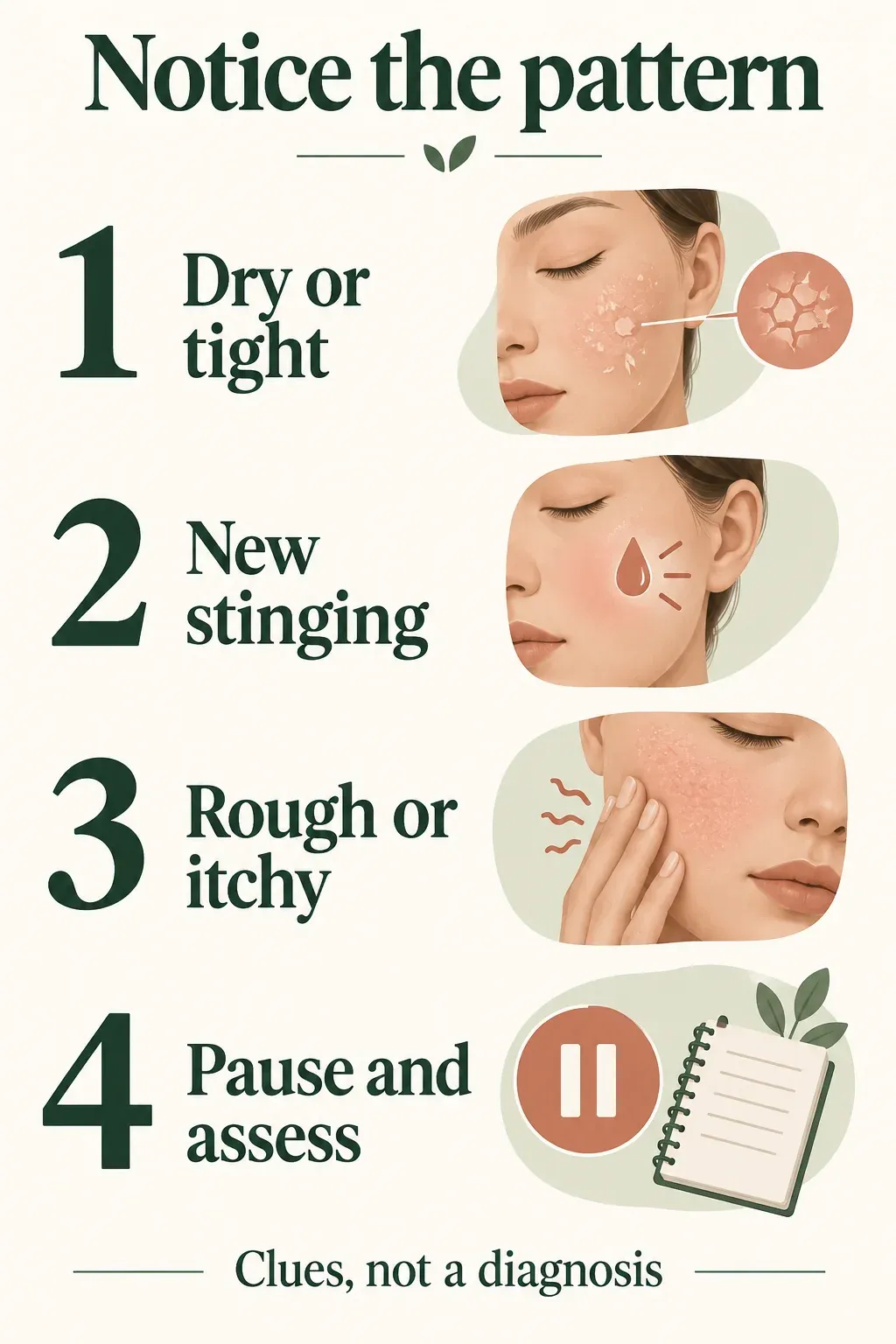
- Notice the pattern: new discomfort matters more than a single dry patch or shiny forehead.
- Do not push through burning: discomfort does not prove that a product is repairing your skin.
- Separate irritation from acne: they can coexist and may need different decisions.
- Track comfort, not perfection: improving tolerance is useful; a photograph cannot measure barrier function.
Editorial Note: SkinOptimizer is an editorial skincare resource, not a medical clinic. We use dermatology guidance to explain practical choices; we have not examined your skin or clinically tested a barrier-repair routine.
A familiar moisturizer suddenly stings. Your cheeks feel tight even though your forehead looks oily. It is tempting to call both problems a damaged barrier and order an entire replacement routine.
A better first question is what changed, where the symptoms occur and whether there are warning signs. Those details are useful even if a clinician later identifies a different cause.
This guide focuses on recognition and next steps, rather than promising a diagnosis from a checklist. You do not need every sign below, and having several does not identify the underlying condition.
The Skin Insider
Your baseline is the comparison that matters. A naturally dry cheek is different from a cheek that becomes sore after a new peel. Record what is new before deciding that every product you own is unsuitable.
Seven signs of a damaged skin barrier: useful clues, not a test
The Cleveland Clinic skin-barrier guide describes dryness, irritation, stinging and sensitivity among possible signs. These are reasons to review your routine, not proof that skincare alone caused the problem.
Open each clue for the distinction that changes the next step. Do not deliberately apply an irritating product to see whether your skin still reacts.
1. Dryness, flaking or tightness that is new
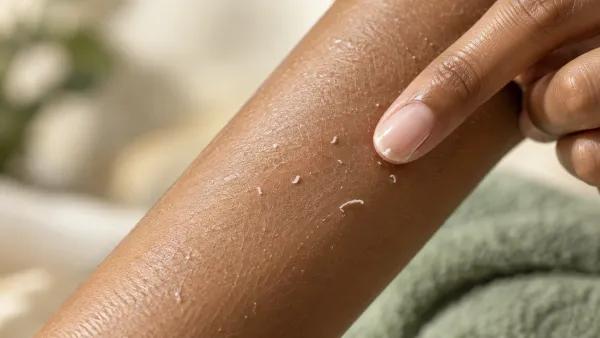
Notice whether discomfort starts after washing, remains between applications of moisturizer or follows a change in weather. Flakes alone do not tell you whether the cause is ordinary dryness, irritation or a skin condition.
Avoid polishing the flakes away. Write down where they occur and whether they hurt, itch or crack; that description is more useful than calling the whole face dehydrated.
2. Stinging from a previously comfortable product
New stinging is a signal to reassess exposure. It does not tell you whether the formula is irritating already sensitive skin or whether you have developed a reaction to a particular ingredient.
Stop the product if it causes a reaction and gently wash it off. Do not keep layering additional serums over burning skin to neutralize the sensation.
3. Increased sensitivity or tenderness
Pay attention when normal cleansing or light contact feels unexpectedly uncomfortable. Repeated rubbing, strong actives and an underlying rash can all complicate the picture.
Use a lighter touch and avoid repeatedly touching the area to check it. Tenderness that is substantial, worsening or accompanied by a rash belongs in the medical assessment category.
4. Itching that accompanies dryness or irritation
Itching is not a unique barrier symptom. Record whether it stays in one patch, affects a wider area or disturbs sleep instead of assuming a richer cream will solve it.
Try to avoid scratching and picking. Persistent itching deserves a cause-based assessment, particularly when routine simplification does not help.
5. Rough texture that feels different from your baseline
Roughness can accompany dry or irritated skin, but bumps are not automatically dead skin that needs exfoliation. Pause before treating an unfamiliar texture with a stronger acid.
Describe the texture separately from any pain or burning. A rough patch and a deep acne bump are different observations, even when they occupy the same cheek.
6. New color changes around an irritated area
Look for changes relative to your own skin tone rather than expecting bright redness. DermNet notes that redness may be harder to see in darker skin, and pigmentation can follow dermatitis.
Color remaining after discomfort settles does not, by itself, prove ongoing barrier damage. Adding an aggressive brightening routine to a still-sensitive area may create a new problem.
7. Breakouts alongside new irritation
Pimples can coexist with impaired barrier function, but a breakout does not diagnose it. Acne is not simply bacteria slipping through a broken surface, and a moisturizer is not a substitute for all acne treatment.
Separate the two concerns in your notes: new bumps versus burning, dryness or rash. If acne is painful, persistent or scarring, seek a treatment plan rather than indefinitely waiting for a barrier reset to fix everything.
What the barrier does—and what it cannot tell you
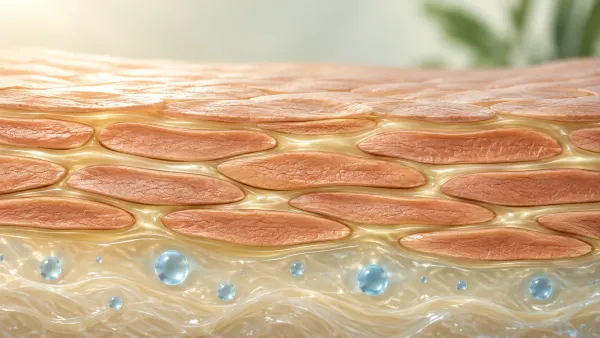
The outer skin layer helps limit water loss and contact with environmental substances. DermNet explains the role of skin cells and surrounding lipids; this is more specific than saying the barrier controls every skin problem.
For a fuller explanation, see how the skin barrier works. Here, the practical point is that surface comfort, appearance and a medical diagnosis are related but different questions.
Oiliness is not a home measurement of water loss. Neither a magnifying mirror nor a skin selfie can establish how well the barrier is functioning.
Likewise, an intact barrier does not replace sunscreen. Keeping skin comfortable and protecting it from ultraviolet exposure remain separate jobs within a sensible routine.
Dryness, irritation or contact allergy: compare the pattern
The following table helps organize a conversation, not choose a diagnosis. Conditions overlap, and a routine change can coincide with a problem it did not cause.
| Observed pattern | What to consider | Useful next step |
|---|---|---|
| Tightness after a new cleanser | The cleansing routine may be too irritating | Stop that exposure and compare comfort with gentle care |
| Itchy rash after a product, including delayed onset | Contact allergy or irritation needs consideration | Keep the ingredient list and seek advice if persistent |
| Usual acne plus new burning | Acne and irritation may coexist | Review treatment tolerance with your prescriber |
| A persistent or recurring patch despite a simpler routine | A skin condition may need targeted treatment | Arrange a clinical assessment instead of more experiments |
Allergic contact dermatitis can appear after a delay, including after products previously tolerated. An immediate versus delayed reaction is useful history, but timing alone cannot reliably separate allergy from irritation.
Keep the packaging or photograph the ingredient list if a product seems linked to a reaction. A brand name alone may not identify the exact formula, especially when different versions share similar packaging.
Also note exposures outside facial skincare: hair products touching the face, repeated mask friction or occupational contact. Describe the location and sequence rather than trying to eliminate every possible ingredient yourself.
When to get medical help instead of trying a reset
Do not use the phrase damaged barrier to explain away a severe rash. The American Academy of Dermatology lists rash warning signs that need medical attention.
- Get prompt medical care: rapidly spreading rash, significant pain, fever, blistering or open sores.
- Check for infection: pus, yellow crust, increasing warmth or swelling, especially with feeling unwell.
- Do not overlook location: a rash involving eyes, lips, mouth or genital skin needs assessment.
- Seek emergency help: trouble breathing or swallowing, or eye or lip swelling with a rash.
Persistent symptoms without these urgent signs still deserve attention. If a simple routine is not helping, the next useful step may be identifying eczema, rosacea, allergy or another cause—not purchasing a more expensive barrier serum.
When contacting a clinician, mention prescription treatments and the timing of new symptoms. Do not stop or redesign a prescribed treatment plan without asking how to manage the reaction.
A simple reset for mild routine-related irritation
For mild symptoms without warning signs, reduce avoidable irritation and monitor comfort. This is a conservative routine review, not a prescribed treatment or a promise that symptoms will resolve within a fixed number of days.
Keep the products already known to be comfortable when possible. Replacing everything at once makes it harder to understand which change helped and which new formula caused trouble.
| Routine step | Practical default | Important limit |
|---|---|---|
| Cleansing | Gentle washing with lukewarm water and a mild cleanser | No scrubbing or repeated cleansing to chase tightness |
| Moisturizing | A comfortable fragrance-free formula | Do not keep using a product that provokes a reaction |
| Optional actives | Pause exfoliants and other irritating extras | Ask the prescriber about prescribed treatments |
| Sun protection | Shade, clothing and tolerated broad-spectrum SPF 30+ | Do not force a burning formula onto irritated skin |
Care tip: cleanse without turning washing into a treatment
A long massage, cleansing brush and repeated rinses are not necessary proof of cleanliness. Keep washing brief and gentle, and pat rather than scrub with a towel.
If your current routine leaves you tight after every wash, review the cleanser and technique before adding another hydration step. Our skin hydration mistakes guide separates product layering from basic routine problems.
Care tip: choose moisturizer by comfort, not the strongest claim
A cream may suit dry skin better than a light lotion, but the whole formula matters. AAD moisturizer guidance favors fragrance-free choices and matching texture to skin needs.
Ceramides are useful ingredients to consider, not a guarantee that any particular product will suit you. See our barrier moisturizer comparison and sensitive-skin moisturizer guide only if you need a replacement.
Care tip: pause exfoliation instead of removing every flake
Leave scrubs, peeling pads and optional exfoliating acids out while skin is irritated. There is no universal once-or-twice-weekly exfoliation schedule that makes a currently painful routine safe.
Household pastes are not a gentler workaround. Our baking soda and skin-barrier review explains why DIY pH experiments are a poor response to irritation.
Care tip: protect skin without adding another active serum
You do not need to add vitamin C or an antioxidant treatment while investigating burning. Keep sun protection practical, including shade and protective clothing.
If a sunscreen repeatedly irritates, stop that formula and ask for help finding a tolerable option. Our sensitive-skin sunscreen guide explains selection trade-offs; no formula is universally reaction-proof.
Care tip: support ordinary habits without blaming yourself
Regular meals, rest and reasonable stress management can support general wellbeing. They do not identify a rash or replace treatment for an underlying condition.
Use the stress and skin flare guide to separate a possible aggravating factor from the cause. Avoid restrictive diets or supplements marketed as a quick barrier fix.
The Optimizer's Edge
Separate two questions: does this product feel comfortable, and does it address my longer-term concern? A moisturizer can pass the first test without treating acne; an effective acne medicine may still need a tolerance adjustment.
Discuss that trade-off with the prescriber. It is more useful than deciding that every active is harmful or that burning must be endured for results.
Use a short observation log, not a daily damage score
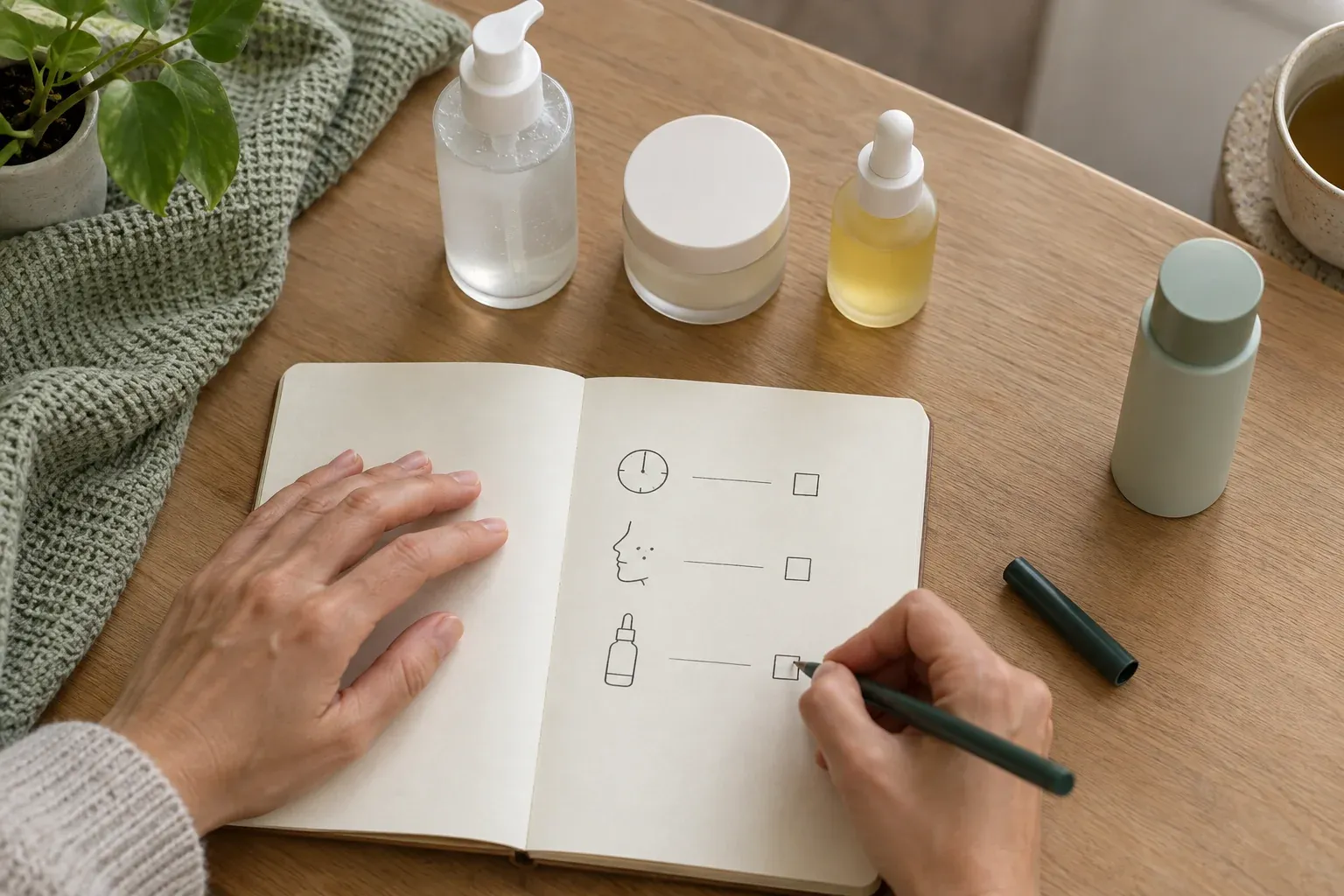
Write a few notes at a consistent time instead of repeatedly examining your face. The aim is to preserve useful details, not assign yourself a medical severity score.
- Exposure: what you used and whether the amount or frequency changed.
- Location: the specific patch, cheek or area affected.
- Comfort: burning, itching, tightness or pain, described in your own words.
- Direction: improving, unchanged or worsening since the previous note.
For example, “cheeks sting after the new cleanser; forehead comfortable” is more useful than “my entire barrier is ruined.” Keep any photographs in similar light, but do not use color differences between cameras as a measure of recovery.
A log is particularly useful when products have similar names. Record the complete version and when you opened it, and bring that information to an appointment if symptoms continue.
How to recognize improvement without a false deadline
Look for less spontaneous discomfort and better tolerance of ordinary gentle care. Improvement in one symptom does not establish that every concern is resolved or that an active can safely return.
A fixed two-week or six-week promise would ignore the cause, repeated exposure and underlying conditions. The right question is whether symptoms are moving in a reassuring direction and whether the remaining problem needs assessment.
| What changes | How to interpret it | Next decision |
|---|---|---|
| Less tightness and less stinging | Encouraging comfort trend, not a diagnostic test | Keep the simple routine stable |
| Less burning, but acne continues | Two concerns may need separate management | Discuss an acne plan rather than more barrier products |
| No improvement or repeated flares | The cause or ongoing exposure may be unresolved | Arrange professional assessment |
| New pain, swelling, crusting or rapid spread | Possible warning signs, not routine healing | Seek medical care promptly |
When skin is comfortable again, introduce only one optional change at a time. Restarting several products together makes any new reaction harder to trace.
The AAD recommends testing new skincare on a small area first. This can help identify a reaction, but it is not the same as medical patch testing and does not guarantee facial tolerance.
Do not deliberately retest a product that caused a significant reaction. Ask a clinician about suspected allergy, and follow the prescriber's instructions when restarting medication rather than adapting a generic online schedule.
Your Clear Skin Checklist
- Describe what changed from your normal skin before naming a cause.
- Check warning signs before starting a home-care experiment.
- Pause optional irritants and keep comfortable basics stable.
- Separate persistent acne or pigmentation from current irritation.
- Keep product details and seek assessment when symptoms persist or worsen.
The practical takeaway
Recognizing possible barrier trouble should make your next decision simpler, not your routine longer. Notice changes, reduce avoidable irritation and use professional help when the pattern is unclear or concerning.
You do not need perfect skin to know that a routine feels more comfortable. You also do not need to prove barrier damage before asking for help with pain, persistent itching or a recurring rash.
Frequently Asked Questions About Signs of a Damaged Skin Barrier
Questions were informed by discussions about moisturizer stinging and breakouts alongside irritation. These threads identify concerns, not medical evidence; dermatology guidance supports the answers.
Should I push through moisturizer stinging?
No. Stinging is not proof of repair or effectiveness. If a product causes a reaction, stop it and gently wash it off; persistent or substantial discomfort needs advice rather than repeated application.
A familiar formula can become uncomfortable for more than one reason. Do not diagnose allergy or barrier damage from the sensation alone.
Can my skin barrier improve while I still have acne?
Yes, reduced irritation and persistent acne can coexist. Comfort and acne control are separate outcomes, so neither ongoing pimples nor improvement after moisturizing establishes a barrier diagnosis.
Seek a specific acne plan if breakouts are persistent, painful or scarring. A richer moisturizer is not automatically the missing treatment.
How long should barrier repair take?
There is no reliable universal deadline for symptoms described as barrier damage. The cause, ongoing exposure and any underlying skin condition matter more than an online countdown.
Track whether gentle care becomes more comfortable. Worsening or persistent symptoms call for assessment, and warning signs should not wait for a reset period to end.
Can I wear makeup while my skin is irritated?
Consider both application and removal. If either worsens discomfort, taking a break is the simpler choice; do not cover an unexplained painful or infected-looking rash instead of seeking care.
If you use makeup, choose a previously tolerated formula and remove it gently. A fragrance-free or non-comedogenic label does not guarantee that your skin will tolerate it.
Should I exfoliate rough or flaky skin?
Not while it is irritated, stinging or sore. Flakes are not an instruction to scrub, and a universal exfoliation frequency cannot account for your current tolerance.
Keep care gentle and investigate persistent patches. Once comfortable, reconsider whether exfoliation is needed at all before adding it back.
This article is for informational purposes only and does not replace professional dermatological advice.