Eye Cream vs Face Cream: Which Should You Use Around Your Eyes?
A concern-first guide to choosing face moisturizer or dedicated eye cream safely around the eye area.
In this guide
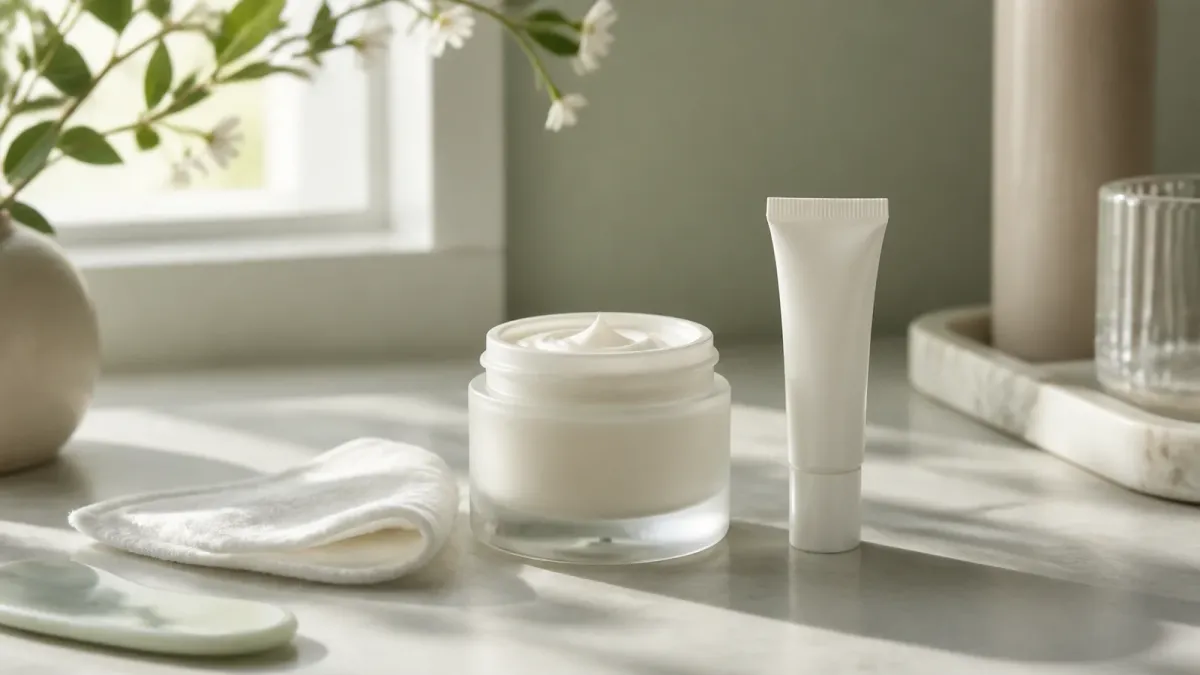
Can you use face cream around your eyes?
Yes—many people can use a gentle face moisturizer around the orbital bone when it is fragrance-free, comfortable and labeled for facial use. A separate eye cream makes sense when you want a distinct texture or targeted ingredient for puffiness, dryness or discoloration.
Neither category guarantees better results. Keep products out of the eye, stop if they sting or cause swelling, and do not use a strong facial retinoid or exfoliating acid on the eyelids unless a clinician specifically directs it.
- Use your face cream when it is bland, non-irritating and comfortable near the eyes.
- Choose eye cream when the smaller dose, lighter texture or targeted formula solves a real problem.
- Avoid fragrance, harsh exfoliants and products that migrate into the eye.
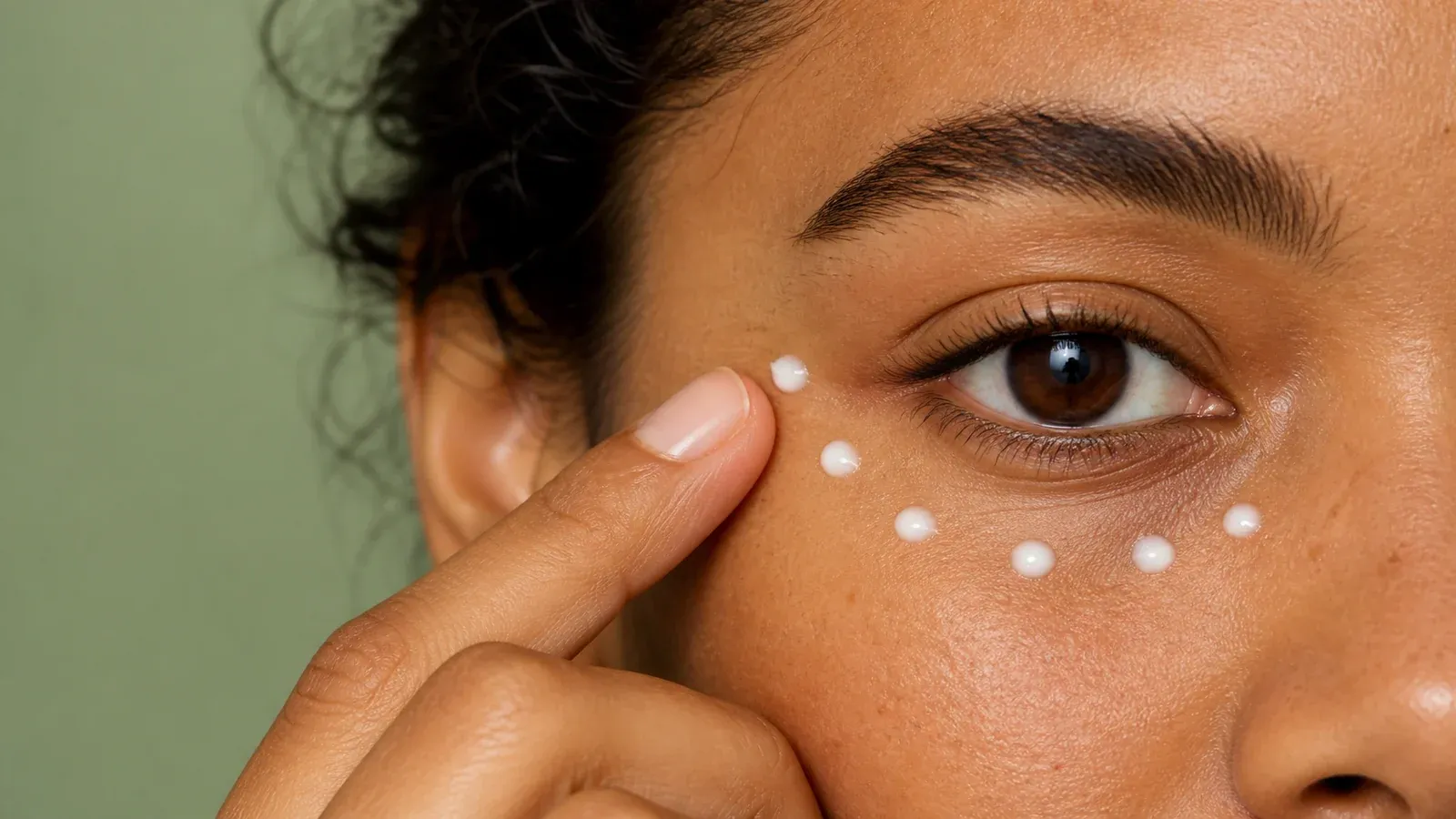
- Apply about a rice-grain amount for both eyes around the orbital bone.
- Daily sunscreen and sleep habits matter more than a premium jar for many concerns.
The label does not decide whether a formula is gentle
“Eye cream” describes where a brand intends a product to be used; it is not a protected performance class. The meaningful comparison is the complete formula, texture, packaging, directions and your tolerance. A simple moisturizer can be perfectly reasonable.
A dedicated eye product can also be useful when it avoids a facial active that is too irritating or delivers a lighter layer under concealer.
This guide was rebuilt by the SkinOptimizer Editorial Team from current safety guidance, formulation principles and reader questions. We did not conduct a controlled product trial and do not claim that a cosmetic can change anatomy, cure eye disease or permanently erase genetic dark circles.
Eye cream vs face cream at a glance
| Question | Gentle face cream | Dedicated eye cream |
|---|---|---|
| Main job | General hydration and barrier support | Targeted texture or concern |
| Best reason to choose | You already tolerate it and want one simple product | Your face cream is too rich, migrates or contains unsuitable actives |
| Common downside | May pill, feel heavy or include fragrance/actives | Smaller size and higher price do not guarantee better results |
| Application | Tiny amount around the orbital bone | Follow the eye-specific label |
A practical decision tree
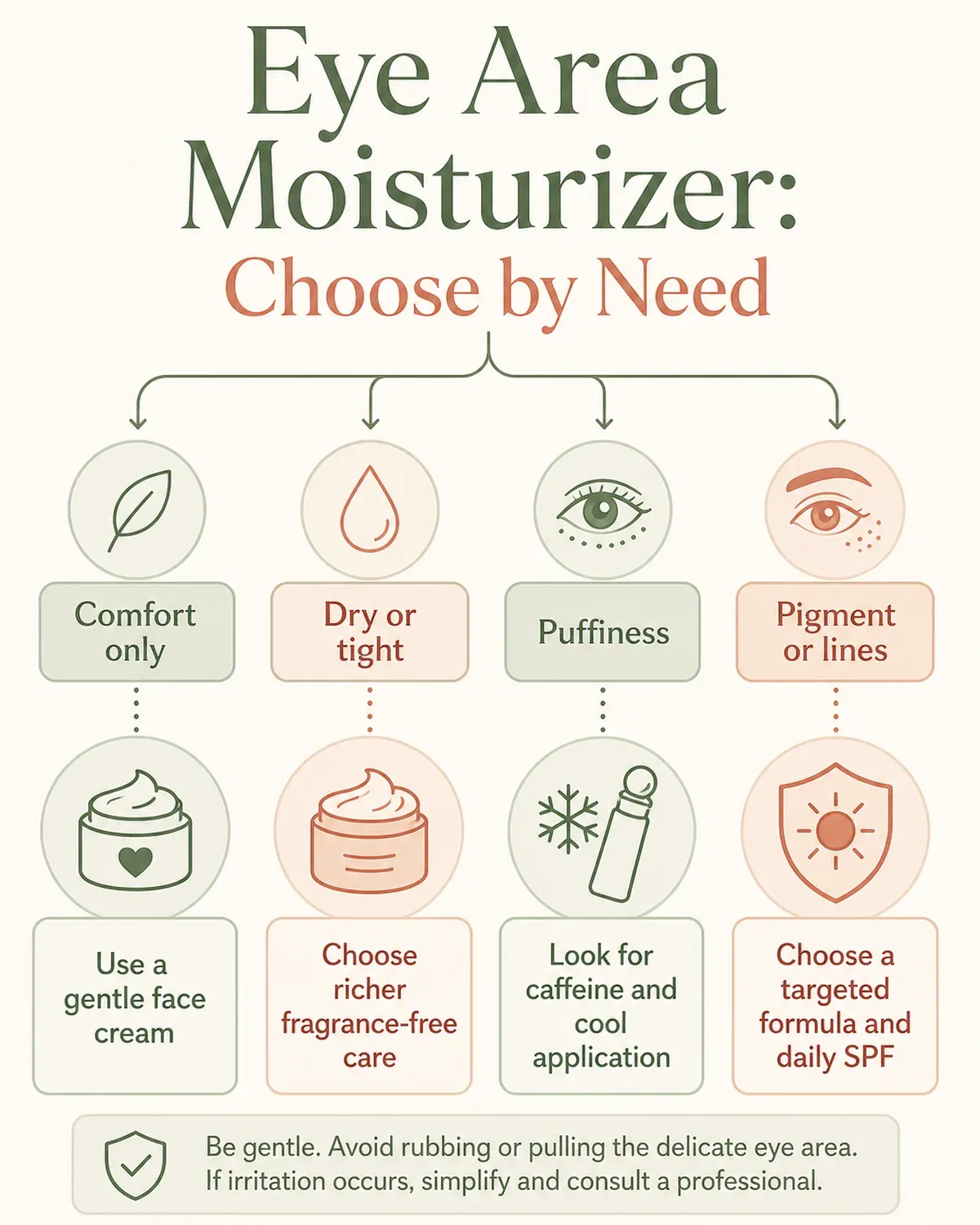
Start by asking what you want the product to do. If the answer is simply “make dry skin feel comfortable,” test a tiny amount of your existing fragrance-free moisturizer.
If it stays comfortable through the day, does not blur vision and does not produce persistent bumps, a separate product may add little.
If the answer is “I need a lighter layer under makeup,” “my face cream migrates,” or “I want a modest caffeine product for temporary puffiness,” a dedicated eye product is easier to justify.
Do not use price as a safety shortcut. Check the exact ingredient list and directions. The U.S. Food and Drug Administration advises keeping eye cosmetics clean, stopping after irritation and avoiding products not intended for the eye area.
Persistent redness, pain, discharge, marked swelling or vision change is not a cosmetic shopping problem; it needs medical attention. See the FDA eye cosmetic safety guidance and a clinician when symptoms are significant.
Match ingredients to the concern
| Concern | Reasonable formula features | Expectation |
|---|---|---|
| Dry or tight skin | Glycerin, ceramides, squalane, dimethicone | Improved comfort and temporary smoothing |
| Morning puffiness | Cool application, caffeine in a tolerable base | Temporary cosmetic improvement, not an anatomical change |
| Fine dehydration lines | Humectants plus emollients | Plumper appearance while hydrated |
| Uneven pigment | Daily sun protection; gentle brightening ingredients | Gradual change; many dark circles are structural or genetic |
| Sensitivity | Fragrance-free, short routine, patch test | Lower exposure, not a guarantee against reaction |
Retinoids can improve fine lines over time, but the eye area is easy to irritate. A facial retinoid is not automatically an eyelid product. Acids, benzoyl peroxide and strong vitamin C formulas can also migrate.
If you already use active skincare, our layering guide, sensitive-skin retinol guide and barrier repair guide explain how to reduce unnecessary overlap.

What dark circles can—and cannot—tell you
Dark under-eyes can reflect pigment, visible blood vessels through thin skin, shadow from tear-trough anatomy, allergies, rubbing, sleep patterns or a combination. That is why one cream can look helpful for one person and irrelevant for another. Hydration may soften texture.
Caffeine may temporarily change the look of puffiness. Pigment-focused ingredients can help some discoloration. None of those can refill a deep hollow or diagnose allergy, anemia or eye disease.
Cleveland Clinic's overview of eye-cream selection similarly separates ingredients by concern and encourages realistic expectations. Read it as general education, not a prescription: how to pick an eye cream.
For related routines, compare our guides to caffeine eye creams, eye-mask order and gentle eye products for teens.
Run a one-side, one-week tolerance test
Apply the candidate product to one outer eye contour for several nights while keeping the rest of the routine stable. Compare comfort, pilling and morning puffiness—not microscopic differences in every line. Stop immediately for burning, swelling or rash.
This is a tolerance check, not a clinical efficacy trial.
Two practical product fits
These are examples, not universal winners. The first is a rich face-and-body cream that may suit a dry outer eye contour in a tiny amount. The second is a dedicated eye cream with a smaller-dose format.
Both should be introduced carefully, and neither needs to be purchased if your current moisturizer already works.
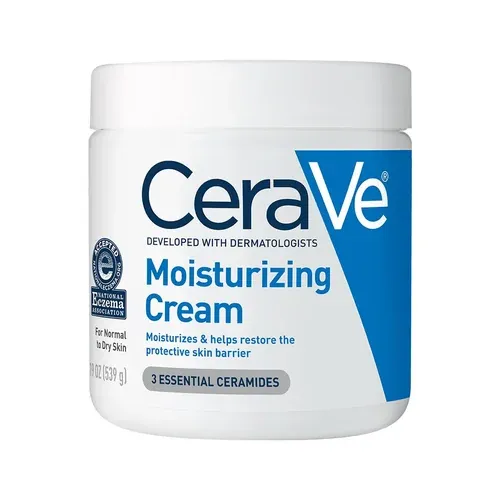
CeraVe Moisturizing Cream
Best for: dry skin that already tolerates a rich fragrance-free cream
Why it fits: Ceramides, glycerin and an occlusive cream base can support comfort. Use only a tiny amount around the outer eye contour.
Before you buy: It may feel heavy, migrate or contribute to milia-like bumps for some users. Do not place it in the eye.
Check current price on AmazonAs an Amazon Associate, SkinOptimizer may earn from qualifying purchases.
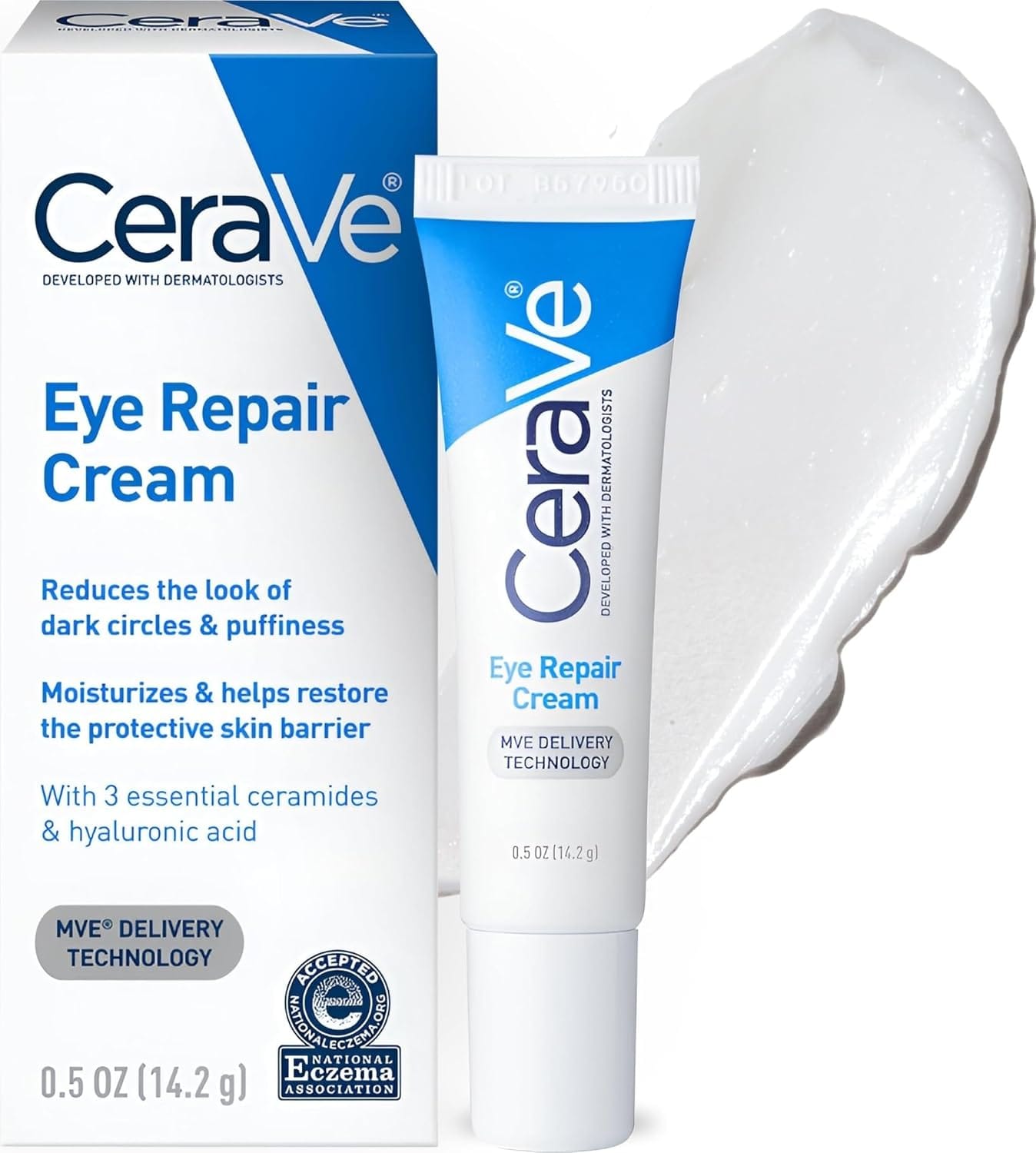
CeraVe Eye Repair Cream
Best for: users wanting a smaller-dose eye cream with ceramides and niacinamide
Why it fits: The eye-specific format makes conservative dosing straightforward and avoids stronger anti-aging actives.
Before you buy: Niacinamide and botanical components can still irritate. Patch test and verify the current ingredient list.
Check current price on AmazonAs an Amazon Associate, SkinOptimizer may earn from qualifying purchases.
Product formulas, sizes, packaging, sellers and availability can change. Verify the current label and seller before purchase.
Before applying anything near the eyes
- The label permits facial or eye-area use.
- The formula does not contain a strong active you have not tolerated there.
- Hands are clean and the package is not contaminated or expired.
- You use a tiny amount and keep it outside the lash line.
- You stop for burning, swelling, rash, discharge or visual symptoms.
The Truth About Eye Cream vs. Face Cream Around Eyes comes down to one thing: the skin under your eyes plays by different rules, but you don’t need a 27-step routine to win.
If you want brighter, smoother, less puffy eyes—without irritation or wasted spend—this guide is your playbook.
TL;DR (read this if you’re busy)
- Yes, eye creams are different from face creams—mainly in texture, migration control, and how they handle irritants near your eyeballs.
- Can you use face cream around eyes? Sometimes—but only if it passes a quick 5-point “Eye-Safe” Litmus Test below.
- If you have dark circles, puffiness, or lines, a targeted eye formula usually outperforms a basic face moisturizer.
- Most results come from ingredients + consistency, not fancy jars.
- Keep this post as a decision tool—not a medical claim. For safety around eyes, see the FDA’s guidance on eye cosmetic safety and the AAD’s smart buying tips.
Why the eye area is a different game (without the jargon)
What makes eye skin… eye skin?
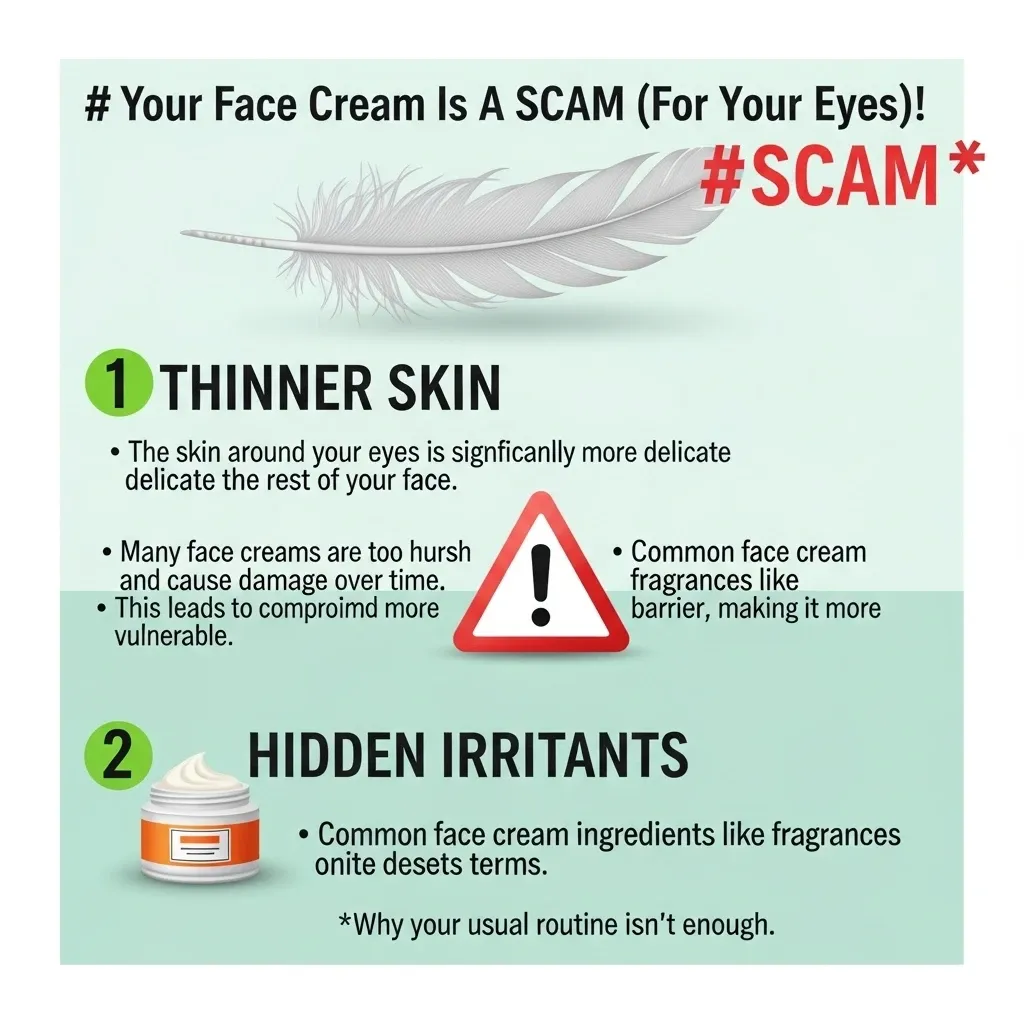
- Thinner & drier: Fewer oil glands = dries out faster.
- Always moving: You blink, smile, squint—thousands of micro-movements a day.
- Closer to the eyeball: If a product “runs,” it can sting and water.
That’s why many eye products are designed to stay put, avoid common irritants, and use gentler versions of actives near the lash line.
See also Harvard Health’s clear take on when a separate eye cream helps: Do you need a separate eye cream?
Eye cream vs. face cream: the head-to-head
Use this table to see how they’re usually built:
| Feature | Eye Cream (Specialized) | Face Cream (General) |
|---|---|---|
| Ingredient strength | Gentler levels near eyes; low-migration textures | Often stronger acids/retinoids suited to cheeks/forehead |
| Targeted concerns | Puffiness (caffeine), dark circles (pigment/vascular support), fine lines (peptides) | Hydration, anti-aging or acne for the whole face |
| Texture & migration | Designed not to creep into eyes | Can spread or run with heat/sweat |
| Irritants avoided | Often fragrance-free and essential-oil-free | Fragrance is common; can irritate near eyes |
| Testing | Often ophthalmologist-tested | Typically dermatologist-tested for general use |
Bottom line: targeting + tolerability is the difference. The eye zone needs both.
The 5-Point “Eye-Safe” Litmus Test for your face moisturizer
Grab your current face cream and score it. If it fails any of these, keep it off the eye area.
- Fragrance check: Any “Fragrance/Parfum” or essential oils (citrus, lavender, mint)? Fail.
- Strong actives: Medium/high levels of glycolic, pure L-ascorbic acid at high %, high-dose retinoids, or salicylic acid? Fail.
- Ophthalmologist-tested: Does the brand explicitly say this? If not, proceed with caution.
- Heavy occlusives up top: Petrolatum/mineral oil high on the list? Can trap keratin and create milia on some people. Risky.
- Migration test: Dot on the back of your hand. After 60 seconds of warmth, does it slide? If yes, not for eyelids.
If it passes all five: you might use a thin layer along the orbital bone (not the lash line). But if you want targeted benefits like de-puffing or brightening, a purpose-built eye formula still wins.
“Do I actually need an eye cream?” Use this decision tree.
Start here:
- I see puffiness in the morning.
Choose an eye cream with caffeine and a stay-put gel/cream. Want the full playbook on caffeine and timing? Read Caffeine Eye Creams: Do They Actually Work? - I’ve got dark circles.
First, identify the type (shadowing, pigment, or vascular). Then go targeted. This practical walkthrough helps: 7 Essential Steps to Banish Dark Circles - Fine lines are creeping in.
Consider gentle eye-safe retinoids/retinal or peptide blends. If you’re curious about using retinoids near eyes, here’s a safe, step-by-step guide: Retinol for Eyes—Use It Safely - I’ve tried creams and I’m still stuck.
Eyes age from multiple angles (sleep, salt, screen time, muscle movement). This piece shows what to add beyond cream: Eye Wrinkles That Go Way Beyond Eye Cream - New to eye care and don’t want to waste money.
Start with fundamentals, ingredients that actually move the needle, and a tight order of operations: The Eye Care Guide—Stop Wasting Money
The money talk: is eye cream “just a tiny, pricey moisturizer”?
Let’s do the math.
- Typical eye cream size: 15 ml
- Use: ~0.25 ml (pea-size) for both eyes, 2× daily
- Days per tube: 15 ml ÷ (0.5 ml/day) ≈ 30 days (conservative)
With lighter application, many stretch 90–120 days.
Cost per day examples:
- €40 eye cream over 90 days → €0.44/day
- €60 eye cream over 120 days → €0.50/day
If that buys you less puffiness by 8 a.m., smoother concealer by 8:30, and fewer “you look tired” comments by noon… it’s not outrageous. The key is buying the right formula (next section) and using it consistently.
The ingredient cheat sheet (keep this simple)
- Puffiness: Caffeine, cold application, and non-migrating gels/creams.
- Fine lines/texture: Peptides, retinal/retinol (eye-safe), hyaluronic acid.
- Dark circles (vascular): Caffeine, niacinamide, peptides; patience required.
- Dark circles (pigment): Gentle brighteners; daily SPF around the eye contour (avoid stinging filters).
- Dehydration: Humectants (HA, glycerin) + light occlusion that won’t cause milia for you.
If you wear base or concealer, read this quick helper on SPF + makeup layering: Does SPF Makeup Work?
How to apply (the 60-second method)
- Use half a pea per eye (too much = migration).
- Tap with ring finger along orbital bone—not the lashes.
- Day: de-puffing gel or light cream under sunscreen.
- Night: repair-focused cream (peptides/retinal) after moisturizer.
- Wait 1 minute before makeup.
Pro move: Keep your morning eye gel in the fridge. Cold + caffeine = visible de-puffing boost.
Geo note: optimize for European living (Berlin to Barcelona)
You don’t live in a lab—you live in Europe. Small tweaks make a big difference:
- Hard water cities (Berlin, London, Paris): If your eye area feels tight post-wash, buffer with a pH-balanced, fragrance-free hydrating layer before eye cream.
- Long winters, indoor heat: Air gets dry. Switch to a richer night eye cream with ceramides and glycerin from November to March.
- Summer holidays & city sun: Sunglasses with UV protection + hats reduce squinting (wrinkle insurance). Re-apply a non-stinging SPF near the orbital bone when outdoors.
- Allergy/pollen seasons: Choose non-fragranced formulas. Rubbing itchy eyes breaks collagen like a bad habit.
When face cream around eyes makes sense (rare, but real)
Use your face moisturizer near eyes only if:
- Fragrance-free & essential-oil-free
- No strong exfoliating acids or high retinoid levels
- Passes the migration test
- You have zero puffiness/dark circle goals (you’re just hydrating)
- You apply along the orbital bone only
Even then, you’re probably leaving results on the table (de-puffing, brightening, firming) that a dedicated eye formula could give you.
What about using eye cream on your face?
It’s safe, but not smart economically. Eye creams are engineered to be gentle + efficient in tiny doses. Spreading that all over your cheeks is like using a silk blouse as a gym towel.
You can, but why?
Common myths—debunked quickly
- “Eye cream is just marketing.”
If your concerns are puffiness or circles, ingredient targeting matters. Also, migration control is real. - “If a face cream doesn’t sting, it’s fine by my eyes.”
Irritation can be slow burn. Think milia, dryness, and creeping redness. - “Stronger is better.”
Not near the lash line. Near eyes, consistency beats intensity. - “Natural = safe.”
Citrus, mint, and floral oils can irritate eyes. Choose fragrance-free.
For practical, expert guidance on safe product use around eyes, keep the FDA’s eye cosmetic page and the AAD’s buying guide handy.
Sample mini-routines you can copy
Goal: De-puff fast (busy mornings)
- Splash cool water → Pat dry
- Caffeine gel (thin layer)
- Hydrating sunscreen around orbital bone
- Sunglasses on commute
Goal: Smooth concealer (no creasing)
- Tiny amount of hydrating eye cream → wait 60s
- Lightweight, non-greasy SPF
- Cream concealer, tapped on (don’t rub)
Goal: Night repair (lines + dryness)
- Gentle cleanse → hydrating toner/essence (optional)
- Eye cream with peptides or low-irritation retinal
- Face moisturizer to seal
Quick buyer’s checklist (keep on your phone)
- Fragrance-free
- Ophthalmologist-tested (bonus)
- Non-migrating texture
- Ingredient match for your goal: caffeine (puff), peptides/retinal (lines), brighteners + SPF (circles)
- Packaging: tube or pump > jar (stays fresher)
Want deeper dives before you buy? These guides are short, tactical reads:
- Eye Care Guide—Stop Wasting Money
- Caffeine Eye Creams: Do They Actually Work?
- Retinol for Eyes—Use It Safely
- Eye Wrinkles Beyond Eye Cream
- 7 Steps to Banish Dark Circles
Takeaway
If you want real pay-off in the mirror, design for the terrain. The eye area is thin, busy, and sensitive. A targeted product built to stay put, avoid irritants, and match your goal will beat a generic face cream most days of the week.
Be consistent. Keep it simple. And choose smart:
- Use the 5-point Litmus Test before bringing a face cream anywhere near lashes.
- Match ingredients to goals (caffeine, peptides, retinal, humectants).
- Consider Europe’s seasons and lifestyle when picking textures.
If you want a fast next step, start with one focused goal (puffiness, circles, or lines), pick a gentle, fragrance-free eye cream that targets it, and stick with it for 8–12 weeks. That’s how you win.
Frequently asked questions
Is face moisturizer safe under the eyes?
It can be when the formula is gentle, fragrance-free, comfortable and used outside the lash line. “Safe for one person” does not guarantee tolerance for another, so test a tiny amount.
Is eye cream just expensive moisturizer?
Sometimes the formulas are very similar, but an eye product may use a lighter texture, smaller dose, different packaging or targeted ingredients. Judge the exact formula rather than the category.
Can I put retinol face cream around my eyes?
Not automatically. Use only as the label directs. The eyelids and eye contour irritate easily, and migration can cause burning or dryness.
Why does moisturizer make my eyes water?
The formula may be migrating into the eye, fragrance or another ingredient may irritate, or too much may have been applied. Stop, rinse if needed and seek care for persistent pain, redness or vision changes.
How much eye cream should I use?
A rice-grain amount for both eyes is a practical starting point unless the label says otherwise. More is not more effective and can increase pilling or migration.
Final verdict
A gentle face cream is enough for many people who only need hydration. Buy a dedicated eye cream when it solves a clear texture, dosing or ingredient problem—not because the jar implies superior science.
Protect the area from sun, avoid rubbing and keep expectations tied to the actual cause of the concern.
This article is for informational purposes only and does not replace professional dermatological advice.