Non-Surgical Anti-Aging Treatments: Benefits, Limits and Risks
Compare non-surgical anti-aging treatments by concern, expected change, downtime and risk before choosing injectables, lasers, peels or RF.

In this guide

The best non-surgical anti-aging treatment depends on what is actually changing. Botulinum toxin targets muscle-driven lines, fillers replace selected volume, lasers and peels address surface damage, and energy devices aim for modest tightening. None is a universal facelift substitute.
Start with the concern, not a trending device. A qualified dermatologist or plastic surgeon should explain the expected degree of change, downtime, maintenance, alternatives, and serious risks before treatment.
- Dynamic forehead or frown lines: discuss botulinum toxin.
- Volume loss or deeper folds: fillers may fit, but vascular complications can be serious.
- Sun damage, texture, or selected scars: compare laser, light, peel, and microneedling options.
- Mild laxity: radiofrequency or ultrasound may offer gradual, modest change.
- Substantial sagging: non-surgical treatments cannot reproduce a surgical lift.
Non-surgical anti-aging treatments can soften a specific sign of aging without an operation, but the category covers very different medical procedures. An injection, controlled peel, laser, needle device, and heat-based treatment do not work on the same tissue or carry the same risk.
The useful question is not “Which treatment is strongest?” It is “What is causing the change I want to address, and what is the least aggressive option that can realistically help?”
Normal aging includes muscle-driven lines, collagen change, pigment, visible vessels, volume loss, bone remodeling, and laxity. One device cannot reverse all of those processes, so packages marketed as a complete “non-surgical facelift” deserve careful scrutiny.
Choose a Treatment by Concern, Not by Trend
A consultation should begin with a diagnosis of the visible concern. The American Academy of Dermatology's wrinkle guidance separates options such as botulinum toxin and fillers rather than treating every line the same way.
The table below is a starting map, not a prescription. Skin tone, medical history, medicines, prior procedures, healing pattern, budget, and tolerance for downtime can change the decision.
| Main concern | Options commonly discussed | Important limit |
|---|---|---|
| Lines that deepen with expression | Botulinum toxin | Does not restore volume or treat pigment |
| Hollowing or selected deeper folds | Dermal filler or fat transfer discussion | Filler cannot tighten all loose tissue |
| Sun spots, uneven tone, redness | Laser, IPL, peel, or targeted medical treatment | The lesion and pigment pattern need diagnosis first |
| Rough texture or selected acne scars | Fractional laser, microneedling, peel, or scar-directed combination | Scar type determines the tool and depth |
| Mild early laxity | Radiofrequency or microfocused ultrasound | Improvement is usually gradual and modest |
| Substantial jowling or tissue descent | Surgical consultation may be more honest | Energy devices cannot remove or reposition significant tissue |
Build the Daily Baseline Before Paying for a Procedure
Procedures do not replace daily sun protection, a tolerable routine, and treatment of active skin disease. Ongoing ultraviolet exposure can undermine pigment and collagen goals while increasing the chance of post-procedure discoloration.
Start with the aging-skin routine guide and the anti-aging sunscreen guide. Appropriate users can also discuss retinoids after reading our retinol guide.
Active acne, dermatitis, infection, suspicious lesions, or an impaired barrier may need treatment before an elective procedure. A calmer baseline also makes it easier to judge whether the procedure created a meaningful change.
Botulinum Toxin for Dynamic Expression Lines
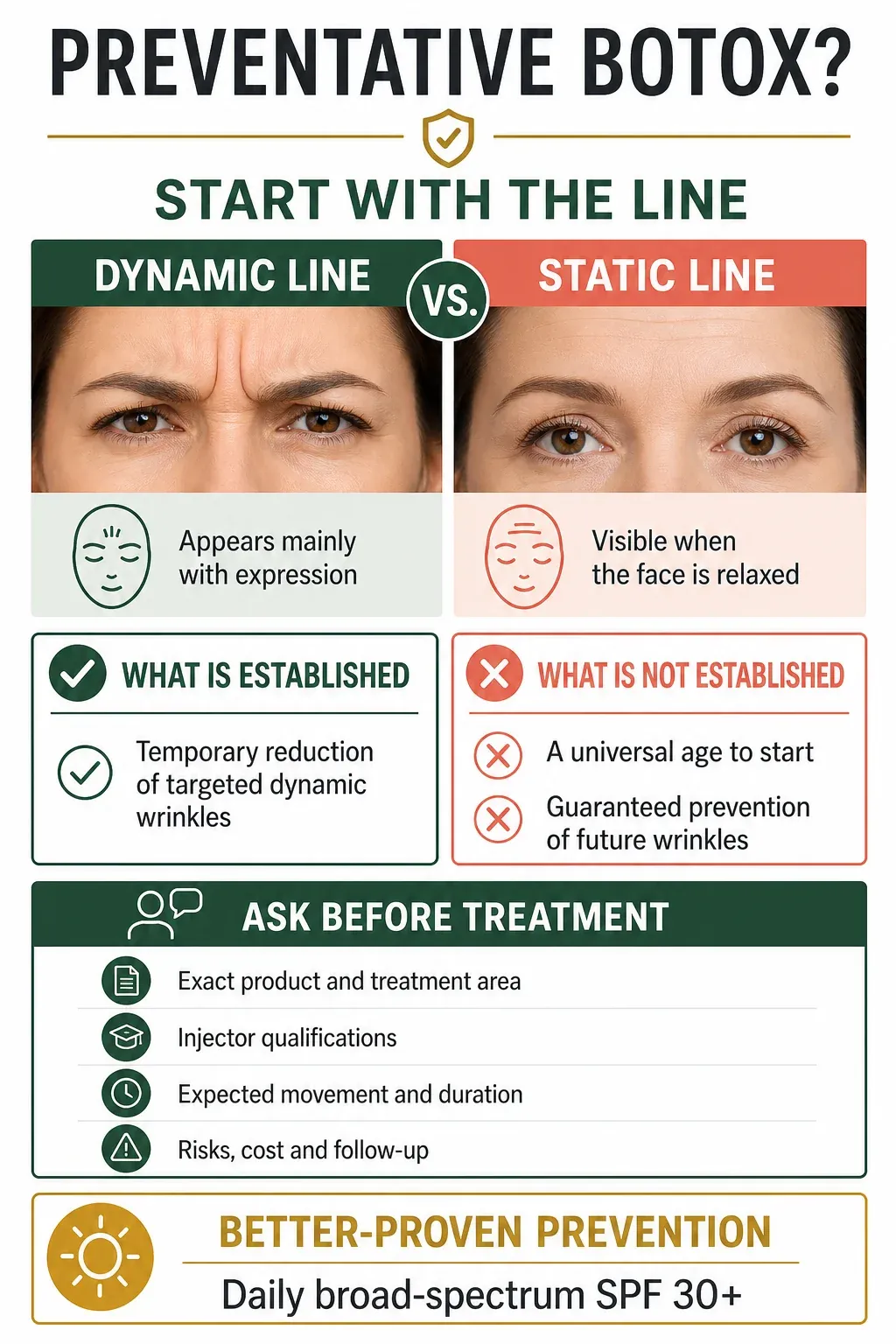
Botulinum toxin temporarily reduces signaling to selected muscles. It is best known for expression-driven lines such as frown lines, forehead lines, and crow's feet, depending on the authorized product and treatment area.
It does not fill a hollow, remove pigment, rebuild a scar, or tighten the whole lower face. Static lines may soften when repeated folding decreases, but an established crease can remain.
Results are temporary, and repeated treatment creates an ongoing cost. Product units are not automatically interchangeable, and dose should follow anatomy, desired movement, product labeling, and clinician judgment.
Our preventative Botox guide explains why there is no universal age to start. It also covers provider questions and symptoms that require urgent medical attention.
Dermal Fillers for Selected Volume Loss
Dermal fillers add material beneath or within tissue to change contour or replace selected volume. They may be discussed for cheeks, lips, chin, hands, or particular folds, depending on the product's authorization and the patient's anatomy.
A filler cannot recreate the ligament repositioning or tissue removal of surgery. Adding volume to every area that appears lower can create heaviness without correcting the underlying structural change.
The most serious filler risk is accidental injection into a blood vessel. The FDA warns that vascular injection can cause tissue death, stroke, or blindness, and some complications can be permanent.
Ask for the exact product, intended tissue plane, amount, reversibility, emergency protocol, and injector's experience with that area. Read our dermal filler decision guide before comparing price per syringe.
Laser and Light Treatments for Pigment, Vessels, and Texture
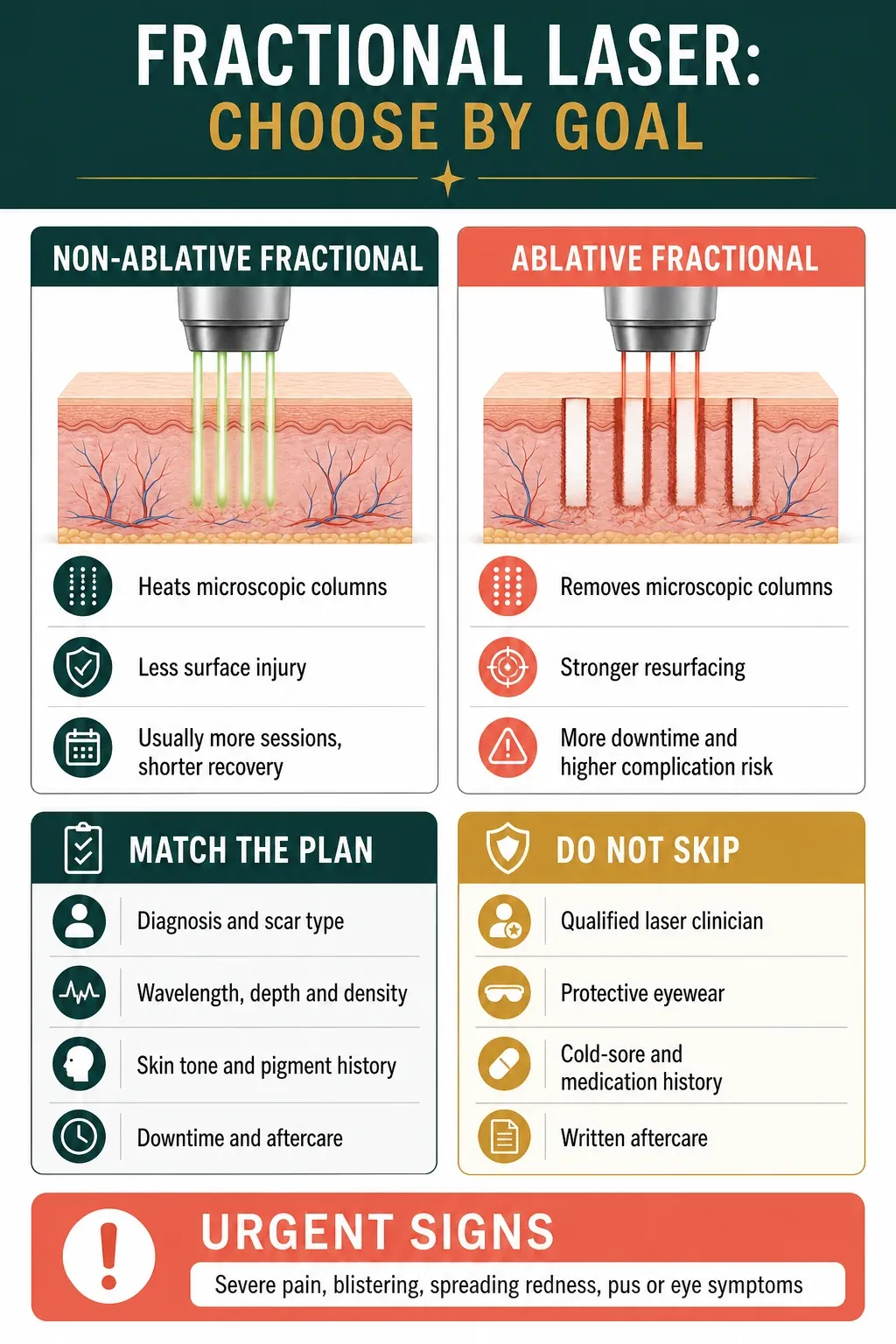
“Laser” is not one treatment. Wavelength, pulse duration, energy, spot size, cooling, and whether the procedure is ablative or non-ablative determine what tissue is targeted and how the skin heals.
Fractional resurfacing treats microscopic columns while leaving intervening skin untreated. Ablative approaches remove tissue and generally require more recovery, while non-ablative approaches heat below the surface and often produce subtler change across a series.
Intense pulsed light is not a laser. It can target selected brown and red concerns, but a changing pigmented lesion needs medical assessment rather than cosmetic light treatment.
The Mayo Clinic overview of wrinkle treatments describes ablative and non-ablative resurfacing as different approaches. Our fractional laser guide goes deeper into wavelength, skin tone, downtime, and provider selection.
Chemical Peels and Surface Resurfacing
Chemical peels create a controlled injury at a chosen depth. Superficial peels may address brightness and mild unevenness, while medium or deep peels have greater recovery and complication risk.
The percentage on the bottle does not define the full strength. Acid type, pH, formulation, number of layers, application time, skin preparation, and neutralization can change the effect.
Do not perform a professional-strength peel at home because a social video makes the process look simple. Review our chemical peel preparation guide and disclose retinoids, recent procedures, cold sores, pigment history, and healing problems.
Microdermabrasion is a more superficial mechanical exfoliation and cannot reproduce deep resurfacing. Dermabrasion is a substantially more invasive medical procedure despite the similar name.
Microneedling for Texture and Selected Scars
Microneedling devices create controlled punctures to support remodeling. The FDA has authorized specific devices for limited indications, including selected facial wrinkles and scars in adults, but not every device or combination is reviewed for every use.
Medical microneedling is not equivalent to a shallow cosmetic roller. Needle depth, cartridge sterility, device authorization, skin preparation, and aftercare affect both benefit and risk.
The FDA states that microneedling devices are not authorized to deliver cosmetics, topical drugs, vitamin solutions, or blood products into the skin. A fashionable add-on does not become proven merely because it is applied after needling.
Infection, pigment change, prolonged irritation, cold-sore reactivation, and an unwanted cosmetic result are possible. Our microneedling guide explains candidacy, recovery, and safer provider questions.
RF Microneedling Needs a Current Safety Conversation
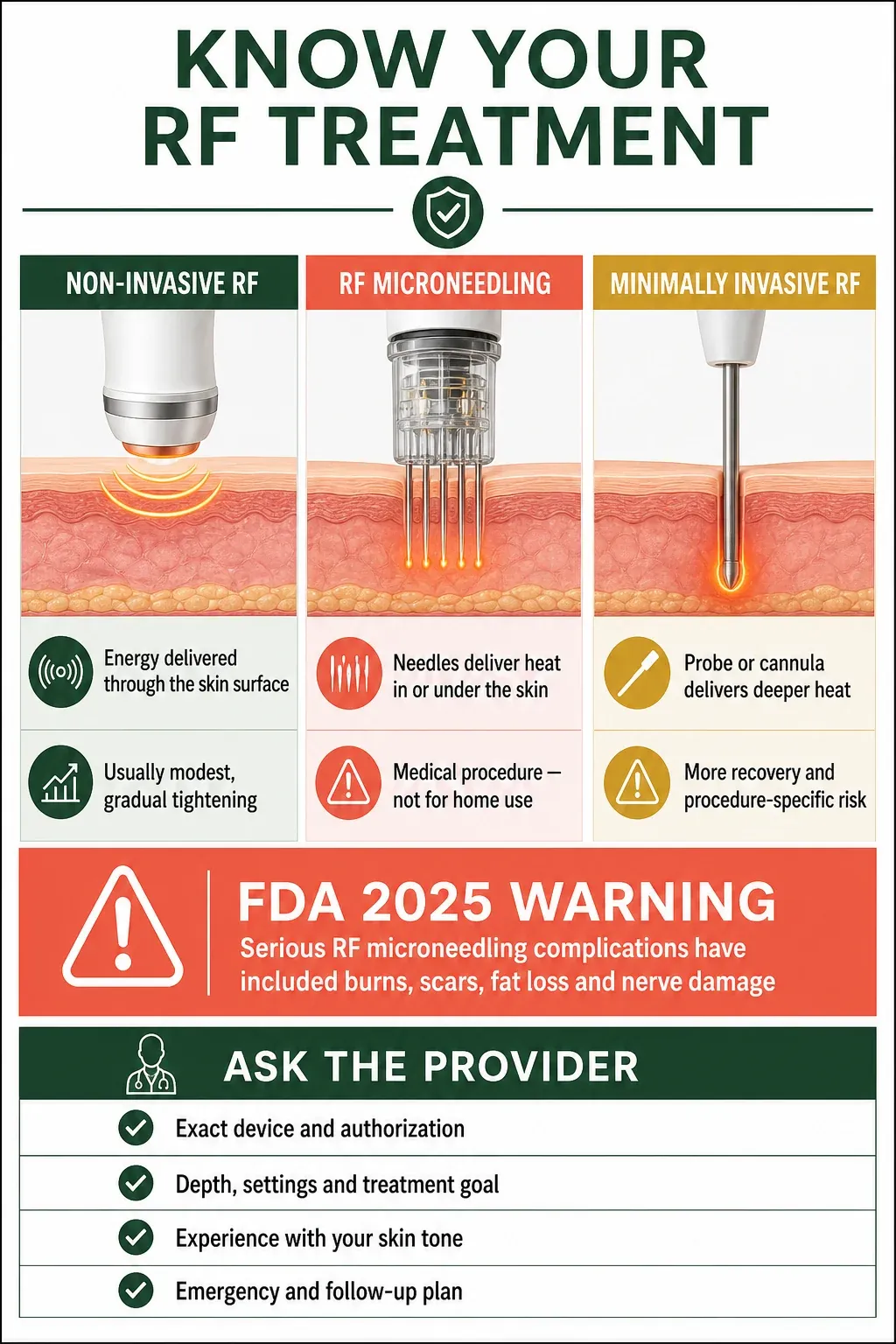
RF microneedling adds radiofrequency heat at needle depth, so it is not simply “stronger microneedling.” Device type, insulated or non-insulated needles, depth, energy, pulse duration, passes, and facial anatomy all matter.
In October 2025, the FDA warned about reported burns, scarring, fat loss, disfigurement, and nerve damage with certain aesthetic uses. The agency describes RF microneedling as a medical procedure that should not be performed at home.
Ask the provider for the exact device, cartridge, treatment depths, energy plan, and experience with your facial area and skin tone. “Collagen stimulation” is not a complete explanation of where the heat will travel.
Radiofrequency and Ultrasound for Mild Laxity
Non-invasive radiofrequency and microfocused ultrasound aim to heat selected tissue layers without a surgical incision. Some patients may see gradual tightening, but the degree of lift is usually modest and varies by device, anatomy, settings, and baseline laxity.
These treatments do not remove loose skin or reposition deeper facial structures. If the consultation promises a surgical result without surgery, ask the clinician to define the expected change in millimeters, standardized photographs, or another measurable endpoint.
Energy near nerves, fat, the thyroid region, eyes, implants, or thin facial areas requires specific knowledge. Our radiofrequency tightening guide separates surface RF from needle and minimally invasive systems.
LED, PRP, Biostimulators, and Newer “Regenerative” Options
Low-level light devices, platelet-rich plasma, biostimulatory injectables, polynucleotides, exosomes, and other regenerative claims are often grouped together. They differ in regulation, evidence, invasiveness, and what is actually placed into tissue.
Do not treat a clinic menu or influencer result as proof that combinations outperform a single well-chosen treatment. Ask which part of the plan has evidence for your diagnosis and whether the combination increases infection, inflammation, pigment, or cost.
PRP uses a preparation from the patient's blood, while a biostimulatory injectable places a manufactured product. Exosome marketing can imply cell-level rejuvenation without establishing the exact product, purity, dose, authorization, or clinical outcome.
LED may offer a lower-downtime option for selected goals, but device wavelength, irradiance, dose, treatment distance, and schedule matter. Home and clinic devices should not be assumed equivalent.
| Treatment family | Typical trade-off | Maintenance reality |
|---|---|---|
| Botulinum toxin | Fast, targeted change in muscle-driven lines; injection risks | Temporary and commonly repeated |
| Dermal filler | Immediate contour or volume change; rare severe vascular risk | Duration varies by product and area |
| Laser or peel | Surface and pigment improvement; healing and pigment risk rise with intensity | A series or later maintenance may be needed |
| Microneedling | Gradual texture remodeling; puncture, infection, and pigment risks | Often performed as a planned series |
| RF or ultrasound | Modest gradual tightening; device- and depth-specific risk | Change is not equivalent to surgery and may fade |
Skin Tone, Melasma, and Pigment History Change the Plan
Darker skin can receive many cosmetic procedures, but the device, wavelength, depth, energy, cooling, and pre- and post-treatment plan require pigment-aware experience. Excluding someone solely by skin tone is not good care, and ignoring pigment risk is not good care either.
Post-inflammatory hyperpigmentation can follow heat, needles, peels, or aggressive resurfacing. Melasma may flare after inflammation or heat, so a “brightening” procedure can worsen the concern when diagnosis and settings are wrong.
Ask for unedited results in patients with a similar skin tone and diagnosis. Our anti-aging guide for melanin-rich skin explains how daily care and pigment prevention support a procedure plan.
A test spot can inform selected decisions, but it cannot guarantee the response of a larger treatment area. Sun exposure, recent tanning, active inflammation, and inconsistent aftercare can still alter healing.
How to Choose a Qualified Provider
A license alone does not prove experience with the exact procedure, device, facial area, and skin tone. Verify who diagnoses the concern, who performs the treatment, who supervises, and who manages complications after hours.
Ask whether the proposed use is authorized, cleared, approved, or off-label for the exact device or product. Those terms are not interchangeable, and regulatory status does not guarantee that the treatment fits you.
Before-and-after photographs should use similar lighting, angle, expression, camera distance, and timing. Makeup, swelling, a different facial expression, or combined procedures can exaggerate the apparent result.
| Ask this | A useful answer includes | Pause when you hear |
|---|---|---|
| What exactly are we treating? | A diagnosis and one measurable priority | “Full-face rejuvenation” without a defined target |
| What product or device will you use? | Exact name, authorization, depth, dose, or settings | Only a branded package name |
| What change is realistic? | Degree, timing, limits, and alternatives | Guaranteed lift, pore removal, or permanent result |
| What can go seriously wrong? | Specific warning signs and an emergency plan | “There is no downtime, so there is no risk” |
| What is the total commitment? | Number of sessions, recovery, follow-up, and maintenance cost | A deposit before medical assessment |
Budget for the Series, Downtime, and Corrections
The advertised session price is not the full cost. Include consultation, anesthesia, prescriptions, dressings, follow-up, time away from work, transport, maintenance, and the possibility of managing a complication.
A subtle procedure repeated several times can cost more than a single aggressive session. The safer choice is not automatically the cheapest or most expensive; it is the plan with a clear job and an acceptable benefit-to-risk trade-off.
Do not stack treatments simply to share one recovery period. Combining heat, needles, peels, injectables, or resurfacing can make it harder to identify the cause of a reaction and may increase cumulative injury.
Build a staged plan. Complete one treatment, allow the proper assessment interval, compare standardized photographs, and then decide whether another modality has a separate job.
Frequently Asked Questions About Non-Surgical Anti-Aging Treatments
Which non-surgical anti-aging treatment gives the most noticeable result?
There is no single winner because treatments solve different problems. Botulinum toxin can create a noticeable change in dynamic lines, filler can change selected volume immediately, and aggressive resurfacing may create a larger texture change with more downtime.
Choose the treatment whose mechanism matches the concern. A powerful laser cannot replace lost volume, and filler cannot remove sun damage.
Are lasers comparable to Botox?
No. Botulinum toxin reduces selected muscle movement, while lasers target water, pigment, vessels, or controlled tissue heating depending on the system.
A person may need one, the other, neither, or a staged combination. The decision should follow line type and skin diagnosis rather than a general anti-aging goal.
What can I choose if I do not want Botox or fillers?
For texture, selected scars, pigment, or mild photoaging, discuss laser, IPL, chemical peels, or microneedling. For mild laxity, selected radiofrequency or ultrasound devices may offer modest gradual change.
These options do not recreate the muscle effect of botulinum toxin or the volume effect of filler. Substantial loose skin may require a surgical consultation for an honest comparison.
How many sessions will I need?
The answer depends on the diagnosis, device or product, treatment intensity, response, and acceptable downtime. Some injectables show a change after one visit, while many device and resurfacing plans use a series.
Ask for a reassessment point rather than buying an open-ended package. Additional sessions should follow measured response, not an automatic calendar.
How do I know whether an aesthetic clinic is safe?
Verify the treating professional's license, training, and experience with the exact procedure, area, and skin tone. Request the exact product or device, regulatory status, emergency plan, and after-hours contact before paying.
Leave if the clinic guarantees results, minimizes serious risks, hides who performs the procedure, or pressures you to combine treatments without a diagnosis.
The Bottom Line
Non-surgical anti-aging treatments work best when one procedure has one defined job. Match dynamic lines, volume loss, pigment, texture, scars, or mild laxity to the correct mechanism and accept that meaningful structural sagging may need surgery.
Prioritize a qualified medical assessment, realistic outcome, conservative plan, and clear complication pathway. More sessions, more heat, deeper needles, or a higher price do not automatically produce a better result.
This article is for informational purposes only and does not replace professional dermatological advice.