Chemical Peels for Acne Scars: What They Can and Cannot Fix
Chemical peels for acne scars: learn which scar types may improve, when another procedure fits better, and how to reduce burn and pigment risks safely.

In this guide

Chemical peels can improve some post-acne discoloration and selected shallow atrophic scars, but they do not erase every acne scar. A superficial field peel mainly works near the skin surface, while deep ice-pick, rolling, boxcar, raised, or tethered scars often need a different procedure or a combination plan.
The safest first step is a scar-type assessment by a dermatologist or another licensed clinician trained in chemical peels. Do not use a high-strength TCA, glycolic, salicylic, or lactic acid peel at home. The FDA warns that unsupervised products can cause severe burns, infection, pigment changes, and additional scarring.
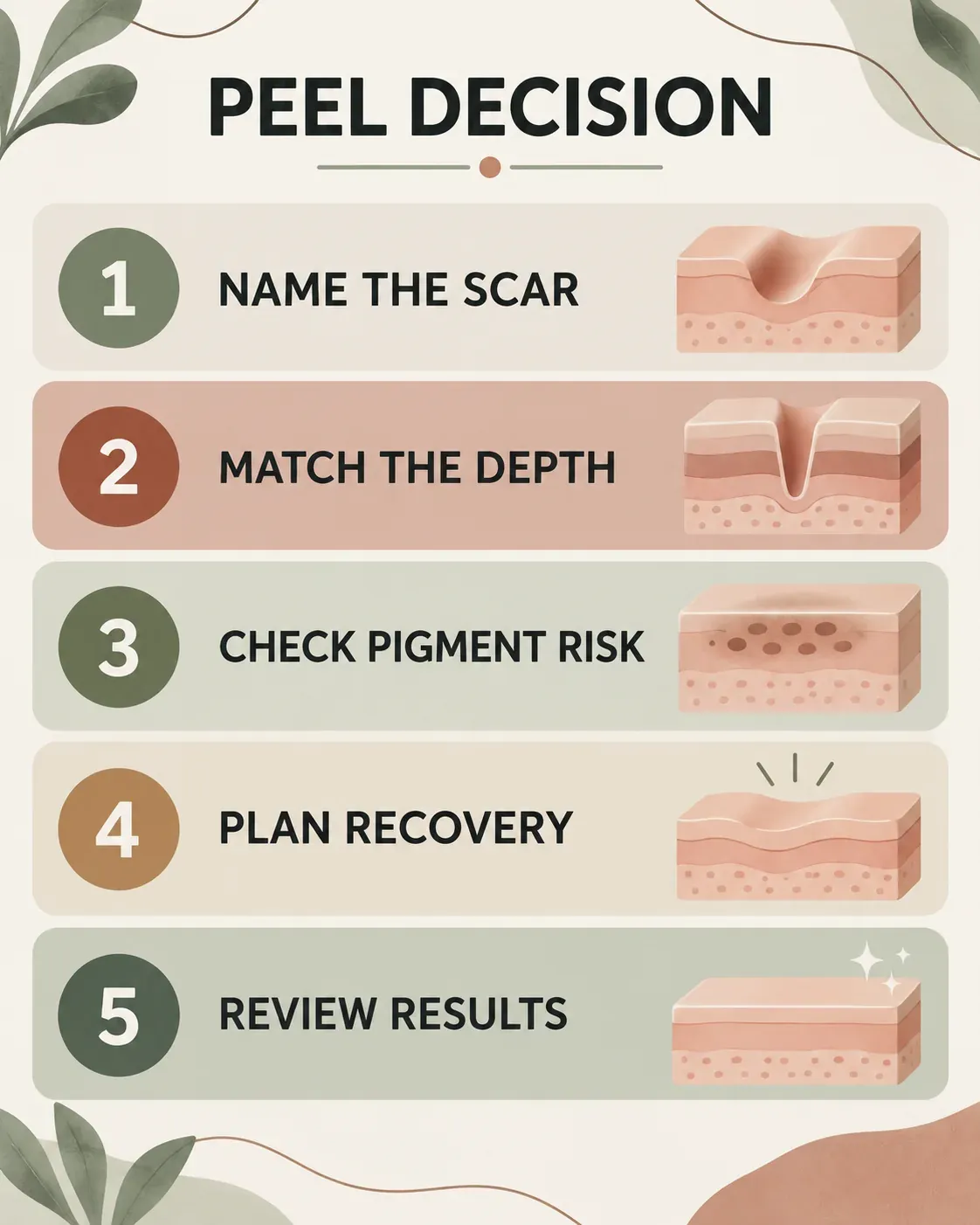
- Name the problem first: a brown or red post-acne mark is not the same as a dented or raised scar.
- Match depth to depth: superficial peels can help surface color and texture; deeper structural scars often need another technique.
- Expect a series: mild and medium peels commonly require more than one session.
- Protect pigment: darker skin tones can have peels, but provider experience, conservative selection, preparation, and aftercare matter.
- Skip DIY strength chasing: a stronger acid is not a shortcut to a safer or better result.
Find the decision you need
Check your scar pattern, compare peel approaches, or jump to the recovery plan.
SkinOptimizer is an independent skincare publication, not a medical provider. We reviewed current dermatology guidance, the FDA safety alert, and systematic-review evidence. We use Reddit discussions only to identify recurring reader questions, never as proof that a treatment works or is safe.
Chemical peels for acne scars are useful only when the peel matches the problem. That sounds obvious, yet many people are sold a package before anyone separates discoloration from damaged skin structure. A brown mark, a red mark, a shallow depression, a narrow ice-pick scar, and a raised keloid can all remain after acne, but they do not respond to the same intervention.
We rebuilt this guide around that distinction. Instead of promising “radiant” or “transformed” skin, it shows what a peel can reasonably target, what it usually cannot reach, which questions to ask before paying for a series, and when another procedure may be a better first move.
A peel creates a controlled injury at a chosen depth. That makes concentration only one part of the plan. The acid, skin preparation, number of coats, contact time, application technique, skin tone, current medications, healing history, and aftercare all influence the result and risk.
Start With the Scar Type, Not the Acid
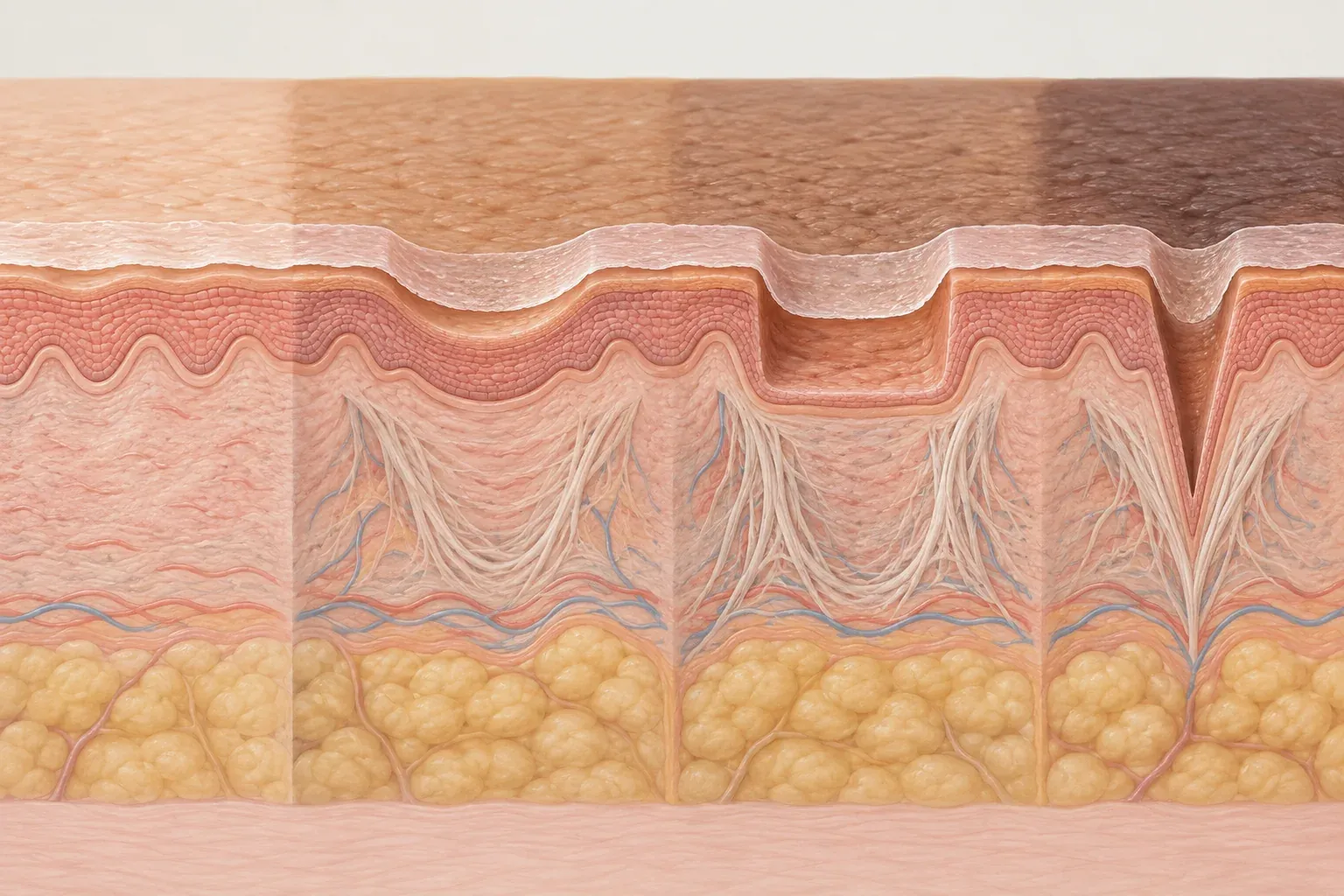
Post-acne marks are changes in color after inflammation. Post-inflammatory hyperpigmentation can look brown, dark brown, gray-brown, or purple-brown.
Post-inflammatory erythema is more red or pink. Neither is the same as a true atrophic scar, although one area can have both color and texture.
Atrophic scars sit below the surrounding surface. Rolling scars have broad slopes and may be tethered below.
Boxcar scars have more defined edges and can be shallow or deep. Ice-pick scars are narrow at the opening but extend deeper into the skin.
Hypertrophic scars and keloids are raised because excess scar tissue formed. A peel is not a standard answer for these scars and may add injury. A changing, bleeding, painful, ulcerated, or diagnostically uncertain spot also needs medical assessment rather than a cosmetic peel.
| What you see | Can a peel fit? | Better first question |
|---|---|---|
| Flat brown post-acne marks | A superficial professional peel may help uneven pigment when active acne is controlled. | Could a topical pigment routine be tried before a procedure? |
| Flat red or pink marks | A pigment-focused peel may not address the vascular component. | Is this erythema rather than hyperpigmentation? |
| Shallow boxcar or surface texture | A series may soften the appearance, often as part of a combined plan. | How much change is realistic from the peel alone? |
| Rolling or tethered scars | A surface peel cannot release deep attachments. | Would subcision, microneedling, or another structural treatment fit better? |
| Narrow ice-pick scars | Selected scars may be considered for clinician-applied focal TCA CROSS. | Is focal CROSS appropriate, and what is the pigment-risk plan? |
| Raised hypertrophic scar or keloid | A peel is generally not the right first treatment. | Which scar-specific medical treatment is safer? |
The acne-scar treatment map by scar type and skin tone compares these categories in more detail. If the area is flat and only the color remains, our cause-first dark-spot plan for darker skin is the more relevant starting point.
What a Chemical Peel Actually Does
A chemical peeling solution produces controlled exfoliation and injury at a planned depth. During healing, the outer skin renews and selected treatments can stimulate remodeling. The treatment may improve superficial pigment, roughness, active comedonal acne, and some shallow textural irregularity.
The American Academy of Dermatology's acne-scar guidance includes chemical peels among options for depressed scars. It also explains that mild and medium peels often need multiple sessions and that dermatologists commonly combine treatments when one method cannot address every scar.
A full-face or field peel treats a broad area. TCA CROSS is different: a trained clinician places high-concentration trichloroacetic acid precisely inside selected narrow scars to create focal remodeling. That is not the same as painting a strong TCA solution over the whole face, and it is not a home technique.
Compare Peel Approaches by Their Job
The labels “light,” “medium,” and “deep” describe the intended tissue depth, not a guaranteed result. A superficial peel has shorter recovery and usually lower risk, but it also has less ability to change structural scars. A deeper injury can create more remodeling and more downtime, while increasing the stakes if healing or pigment response goes wrong.
| Approach | Where it may fit | Main limit or risk |
|---|---|---|
| Superficial field peel | Post-acne discoloration, active comedonal acne, roughness, and selected shallow texture | Usually modest for true pits; a series may be needed |
| Medium-depth peel | Selected texture and pigment concerns under experienced medical supervision | More recovery, inflammation, and pigment-change risk |
| Deep peel | Rarely selected for acne scarring and highly dependent on patient and provider factors | Long recovery and substantially higher complication burden |
| Focal TCA CROSS | Selected ice-pick or narrow deep scars treated one by one | Not a full-face peel; pigment change and scarring remain possible |
| Peel plus another modality | Mixed color and texture or several scar types | More variables, cost, and recovery require careful sequencing |
A 2026 systematic review comparing microneedling with chemical peels found no clear difference in clinically significant improvement for atrophic scars. Microneedling was more likely to produce at least some improvement, while other continuous outcomes did not show a consistent winner.
This does not mean the procedures are interchangeable. Rolling scars may need release of tethering, narrow ice-pick scars may suit focal methods, and mixed patterns may need staged treatment. The review also noted inconsistent satisfaction and adverse-event reporting, which limits confident promises.
What Chemical Peels Usually Cannot Fix Alone
A surface treatment cannot mechanically release a tethered rolling scar. It cannot replace missing volume under a broad depression, flatten a keloid, or fully rebuild a deep ice-pick tract. A peel may soften the surface around these scars, but that cosmetic blending is different from correcting the main structure.
The evidence base is also less certain than marketing pages imply. A Cochrane-derived review of acne-scar interventions described limited support for chemical peeling and generally low or very low certainty across small, varied studies. In one small comparison, 6 of 12 people in the TCA CROSS group developed post-inflammatory hyperpigmentation.
Combination treatment may still be reasonable, but “combined” does not automatically mean “better for you.” It means the clinician is assigning different jobs to different tools. Subcision may release tethering, microneedling may support collagen remodeling, a laser may target selected texture, and a peel may address surface pigment or blend edges.
Use our fractional laser guide to compare ablative and non-ablative tradeoffs. If microneedling is being proposed, the broader microneedling overview helps you ask about device depth, sterile technique, skin-tone experience, and recovery.
Peels for Darker Skin: Possible, but Not Casual
People with darker skin tones can have chemical peels. The critical issue is not a blanket ban; it is preventing excessive inflammation that can leave post-inflammatory hyperpigmentation or, less commonly, loss of pigment. Provider experience with your skin tone matters because acid choice, depth, priming, and aftercare may need adjustment.
Ask how often the clinician treats people with your skin coloring and which complications they see. Request unedited examples from comparable patients, while remembering that another person's outcome cannot predict yours. A patch or test area may be considered in some plans, but it cannot eliminate all risk.
Active eczema, dermatitis, open lesions, a damaged barrier, recent tanning, or uncontrolled acne can make recovery less predictable. A provider may delay treatment, simplify the routine, or choose a different method. Our post-acne redness guide can help you recognize when the main concern may be vascular color rather than brown pigment.

Why High-Strength Home Peels Are Not a Shortcut
The FDA warns against buying or using high-strength chemical peel products without professional supervision. Serious chemical burns, pain, swelling, infection, skin-color changes, and disfiguring scars can occur.
Online strength charts make a peel look like a recipe: choose a percentage, set a timer, and neutralize. Real penetration is not that predictable. Product pH, formulation, skin degreasing, prior exfoliation, pressure, coats, contact time, anatomical area, and individual healing can change the injury.
Do not copy a clinician's TCA CROSS technique from a video. Focal high-strength application requires correct scar selection and control of where the acid touches. A spill outside the scar or an overly aggressive application can create a larger mark or scar than the one being treated.
At-home exfoliating products with lower acid levels are not the same as an office peel. They may support acne or uneven tone when used according to the label, but they should not be used as a do-it-yourself attempt to reconstruct deep scars. More peeling is not evidence of more collagen or a better final result.
Build a Safer Consultation Plan
Bring a complete list of prescription medicines, over-the-counter products, supplements, and recent procedures. Tell the clinician about current or prior isotretinoin, retinoids, antibiotics, cold sores, poor wound healing, keloids, allergies, pregnancy or breastfeeding, and any history of pigment change after injury.
Do not apply a universal internet stop schedule to your routine. The provider should give exact written instructions for retinoids, acids, benzoyl peroxide, hair removal, shaving, sunscreen, makeup, and other products. Some ingredients may be paused, while prescribed acne control may need a different transition plan.
The chemical peel preparation checklist provides a fuller two-to-four-week planning framework. If new acne is still forming, work through a stable simple acne-prone skincare routine before repeatedly treating scars that are still being created.
Plan Recovery Before the Procedure
Recovery depends on depth and individual response. A superficial peel may cause tightness, redness, dryness, or light flaking for several days.
A medium-depth peel can involve more swelling, darkening, crusting, and peeling over roughly one to two weeks. Deep procedures can require a much longer medical recovery.
Those ranges are planning estimates, not a schedule to self-manage. Your provider's instructions control cleansing, ointment or moisturizer, antiviral use when indicated, sunscreen, makeup, exercise, heat exposure, and the timing of active ingredients.
| Stage | Usually sensible | Contact the provider for |
|---|---|---|
| First hours | Use only the written post-peel products; avoid rubbing, picking, and unapproved actives | Severe pain, rapidly increasing swelling, breathing difficulty, or unexpected blistering |
| Early peeling | Cleanse gently, moisturize as directed, and let flakes release on their own | Pus, spreading warmth, fever, grouped blisters, or worsening tenderness |
| Sun protection | Use shade, a hat, and the provider-approved broad-spectrum sunscreen when the skin is ready | New gray, white, or rapidly darkening patches |
| Return to actives | Restart one product at a time only on the clinician's schedule | Persistent burning, rash, cracking, or renewed inflammation |
| Result review | Compare standardized photos after healing and before buying the next session | Scarring that looks deeper, raised tissue, or pigment that keeps worsening |
Picking flakes does not speed recovery. It exposes immature skin, increases inflammation, and can raise the chance of infection or pigment change. Scrubs, brushes, waxing, depilatories, retinoids, strong acids, and fragranced products may also be restricted until the provider clears them.
Sunscreen is essential after a peel, but a freshly treated barrier may react to products that were comfortable before. Use the exact sunscreen type and start time your clinician recommends. The following product is an optional shopping example for readers whose provider approves a tinted mineral facial sunscreen after healing has reached the appropriate stage.
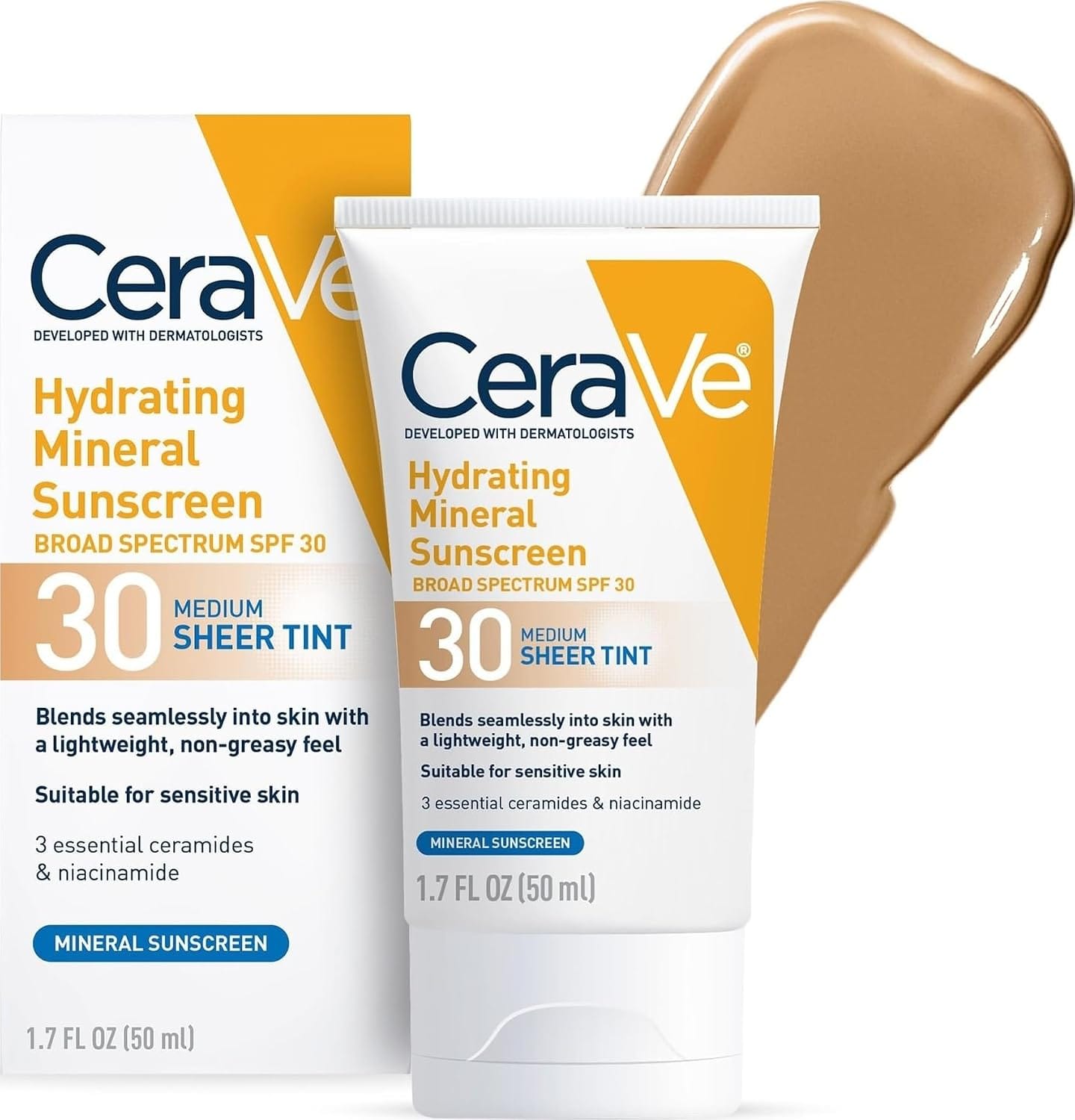
Buy it if: your provider has cleared sunscreen use and a tinted mineral SPF 30 suits your skin tone, texture preference, and aftercare plan.
Skip it if: the single tint does not match your complexion, the formula stings, or your clinician wants a different product during early recovery.
This exact product uses zinc oxide and titanium dioxide with a sheer tint. The tint can reduce visible cast, but it is not universal and this is not a hands-on SkinOptimizer test or a promise of post-peel tolerance.
Check current Amazon optionsAs an Amazon Associate, we earn from qualifying purchases.
Product facts should be checked against the current package and the official CeraVe product information. Formulas, packaging, availability, and prices can change.
How to Decide Whether Another Session Is Worth It
Do not judge the final result while skin is still red, dry, swollen, or peeling. Wait for the clinician's review point and compare photos taken with the same light, angle, camera distance, and facial expression. Side lighting often makes textural change easier to assess than a bright front-facing selfie.
Track the planned target. If the goal was fewer brown marks, compare pigment.
If the goal was softer shallow boxcar edges, compare texture. A temporary glow, swelling, or fresh exfoliation can make skin look smoother before the long-term result is clear.
Ask three questions before paying for another session: Did the intended target improve? Was recovery within the agreed range? Is the next session expected to add meaningful benefit, or would a different modality address the remaining scar better?
If new breakouts continue, scar prevention may be the higher-value step. Use the evidence-based acne prevention plan and discuss prescription care for persistent or scarring acne. Treating old scars while new ones form can turn a finite procedure plan into a costly loop.
The Bottom Line
Chemical peels can be useful for post-acne discoloration, active comedonal acne, surface roughness, and selected shallow atrophic scars. They are not a universal scar eraser. The deeper or more tethered the scar, the more important it becomes to compare peels with subcision, microneedling, laser, fillers, or a staged combination plan.
The safest decision is scar-type first and acid second. Choose a provider who can explain what the peel is meant to change, what it cannot change, how pigment risk will be reduced, and what happens if healing falls outside the expected range.
Community question note: We reviewed discussions about peels and darker skin, pigment changes after peels, peels for pitted scars, and whether a peel series is worth the cost. These threads identified recurring questions only; dermatology, regulatory, and research sources support the answers.
Frequently Asked Questions About Chemical Peels for Acne Scars
Can a chemical peel remove pitted acne scars?
A peel may soften shallow texture or the edges of selected atrophic scars, but it rarely removes pitted scars completely. Rolling, deep boxcar, and ice-pick scars often need another procedure or a combination plan matched to the scar structure.
Are chemical peels safe for darker skin tones?
They can be performed on darker skin, but post-inflammatory hyperpigmentation and uneven pigment are important risks. Choose a trained clinician with substantial experience treating your skin tone and ask for a conservative depth, preparation plan, and clear follow-up.
Is TCA CROSS the same as a chemical peel?
TCA CROSS uses a high concentration of trichloroacetic acid placed precisely inside selected narrow scars. It is a focal professional technique, not the same as a full-face peel and not a method to copy at home.
How many chemical peel sessions are needed for acne scars?
Mild and medium peels often require a series, and the number depends on scar type, depth, acid, tolerance, and the amount of change sought. Ask for a planned review point instead of buying an open-ended package before the first response is known.
Is microneedling better than a chemical peel for acne scars?
A 2026 systematic review found no clear overall winner for clinically significant atrophic-scar improvement. Microneedling may fit broader textural remodeling, while a peel may better fit surface pigment or selected scars; the best choice depends on scar structure, skin tone, risk, and clinician experience.
This article is for informational purposes only and does not replace professional dermatological advice.