Exfoliation for Darker Skin: Prevent Irritation and Dark Marks
Effective exfoliation for darker skin should not burn or darken the skin. Use one controlled mechanism, slow frequency and daily sun protection.

In this guide

For darker skin, choose one exfoliating mechanism for one concern, patch test and start once weekly on calm intact skin. Increase only when there is no persistent burning, rawness, swelling or new darkening, because irritation can trigger post-inflammatory hyperpigmentation. Moisturize, use broad-spectrum SPF 30+ and seek an experienced clinician for strong peels, scars or widespread pigment concerns.
Quick Summary
- Skin tone does not require stronger acids or daily exfoliation.
- Choose one AHA, BHA or retinoid mechanism and count routine overlap.
- Monitor darkening as well as smoothness because irritation can create PIH.
- Use sunscreen daily and leave strong peels to experienced clinicians.
Exfoliation advice for darker skin often swings between unnecessary fear and aggressive glow routines. This guide uses a third approach: controlled dose, clear concern matching and active monitoring for post-inflammatory hyperpigmentation, with a separate lane for professional peels.
Why Exfoliation Needs More Control in Darker Skin
Melanin-rich skin does not need less effective care, but irritation can leave post-inflammatory hyperpigmentation that lasts longer than the original problem. The goal is controlled cell-shedding support without creating new inflammation. Burning, rawness and visible darkening are stop signals.
A 2024 systematic review of PIH treatment in skin of color found limited robust evidence and reports of worsening after some procedures. Prevention of new inflammation remains central. A peel is not automatically safer because it is marketed for glow.
Skin tone is not skin type. Dry, oily, acne-prone and sensitive patterns need different exfoliation choices. Existing eczema, acne treatment, shaving and recent procedures also change tolerance.
| Main concern | Possible first option | Avoid at the start |
|---|---|---|
| Clogged pores | Low-strength salicylic acid | Scrub plus acid toner |
| Surface roughness | Mild lactic or glycolic acid | Daily high-strength peel |
| Post-acne dark marks | Trigger control, SPF and targeted care | Aggressive exfoliation |
| Sensitive or eczema-prone | No separate exfoliant until stable | Fragrance and multiple acids |
| Deep acne or scars | Dermatology treatment | Home peel kits |
Choose One Mechanism
Physical exfoliation uses friction from scrubs, brushes or cloths. Chemical exfoliation uses acids or enzymes, while retinoids normalize cell turnover but are treatments rather than simple exfoliants. Count every mechanism in the routine.
Salicylic acid is oil-soluble and may fit clogged pores. Lactic acid is an AHA with humectant properties, while glycolic acid penetrates efficiently and can be more irritating at higher exposure. Percentage alone does not describe pH or free-acid strength.
The AHA and BHA guide compares these roles. Choose one product for one concern. Do not start acid cleanser, toner and serum together.
A Slow Starting Schedule
Patch test for seven to ten days, then use once weekly at night on calm intact skin. Follow the product contact time and rinse directions. Apply a fragrance-free moisturizer afterward.
Hold the rest of the routine stable for at least two weeks. Increase to twice weekly only when there is no persistent stinging, flaking or darkening. Daily use is not a default target.
The slow skincare guide helps isolate reactions. Photographs in the same lighting can reveal a trend more reliably than checking immediately after application.
Exfoliation and Hyperpigmentation
Dark spots must be classified before treatment. Post-inflammatory hyperpigmentation, melasma and scar texture are different concerns. Exfoliation cannot erase deep pigment or structural scars quickly.
The AAD advises treating the cause of inflammation and using gentle skincare. Its dark-spot guidance notes that irritating products can create new marks. Broad-spectrum sunscreen is essential.
Use the hyperpigmentation routine for pigment-focused choices. A tinted sunscreen with iron oxides may help when visible light worsens melasma or persistent marks.
Physical Scrubs, Brushes and Microtears
"Microtears" is often used vaguely, but friction can clearly worsen inflamed acne and eczema. Coarse particles are hard to dose evenly. Immediate smoothness does not prove long-term benefit.
A soft cloth with light pressure can be enough for loose surface scale on comfortable body skin, but it is optional. Avoid scrubbing acne lesions, picked areas and active rash. Do not use a brush to force off retinoid flakes.
If ashiness is the concern, apply cream on damp skin before reaching for exfoliation. The melanin-rich skin moisturizer guide addresses the underlying dryness.
Retinoids, Acids and Acne Treatment
Retinoids already influence cell turnover and can cause an adjustment period. Adding AHA or BHA immediately increases irritation risk. Separate nights and establish one product first.
Benzoyl peroxide treats inflammatory acne but can dry the barrier. Salicylic acid may overlap with an acid cleanser or spot product. Read all active labels before building a schedule.
The controlled exfoliation guide provides a mechanism count that applies beyond teenagers. Painful acne, scars or recurring nodules need professional care rather than more exfoliation.
Exfoliation After Shaving, Waxing or Hair Removal
Hair removal creates friction and can leave small barrier disruptions. Do not apply a strong acid immediately afterward. Wait until skin is calm and follow the product or clinician instructions.
Ingrown hairs may respond to carefully timed exfoliation, but active folliculitis and infection need diagnosis. Avoid picking because trauma can leave long-lasting marks. Use clean tools and reduce repeated passes.
For beard and body areas, begin with a wash-off or low-frequency product. Do not use facial peel strength on underarms or bikini areas without specific guidance. Occlusion and friction change exposure.
Professional Chemical Peels in Skin of Color
Professional peels can treat selected acne, pigment and texture concerns, but depth, agent, pH, preparation and aftercare matter. A review of chemical peeling in ethnic skin highlights the risk of post-inflammatory dyschromia and abnormal scarring.
Choose a clinician experienced with a range of skin tones and the exact condition. Ask about test spots, pre-treatment, expected downtime, antiviral history and management of complications. Do not judge competence from before-and-after photos alone.
Home peel kits are not miniature clinic procedures. Do not layer products or extend contact time to imitate professional depth. Neutralize and rinse only as the product directs.
Sunscreen Is Part of Exfoliation Safety
Use broad-spectrum SPF 30+ every morning and reapply during outdoor exposure. Exfoliation does not make sunscreen optional on cloudy days. UV and visible light can prolong pigment concerns.
Choose a wearable formula that does not leave an unacceptable cast. Tint can improve blend and add iron oxides. Do not mix pigment drops or oil into sunscreen unless designed for it.
The sunscreen ingredient guide helps distinguish allergy from online fear. The best sunscreen is one that can be applied in an adequate amount.
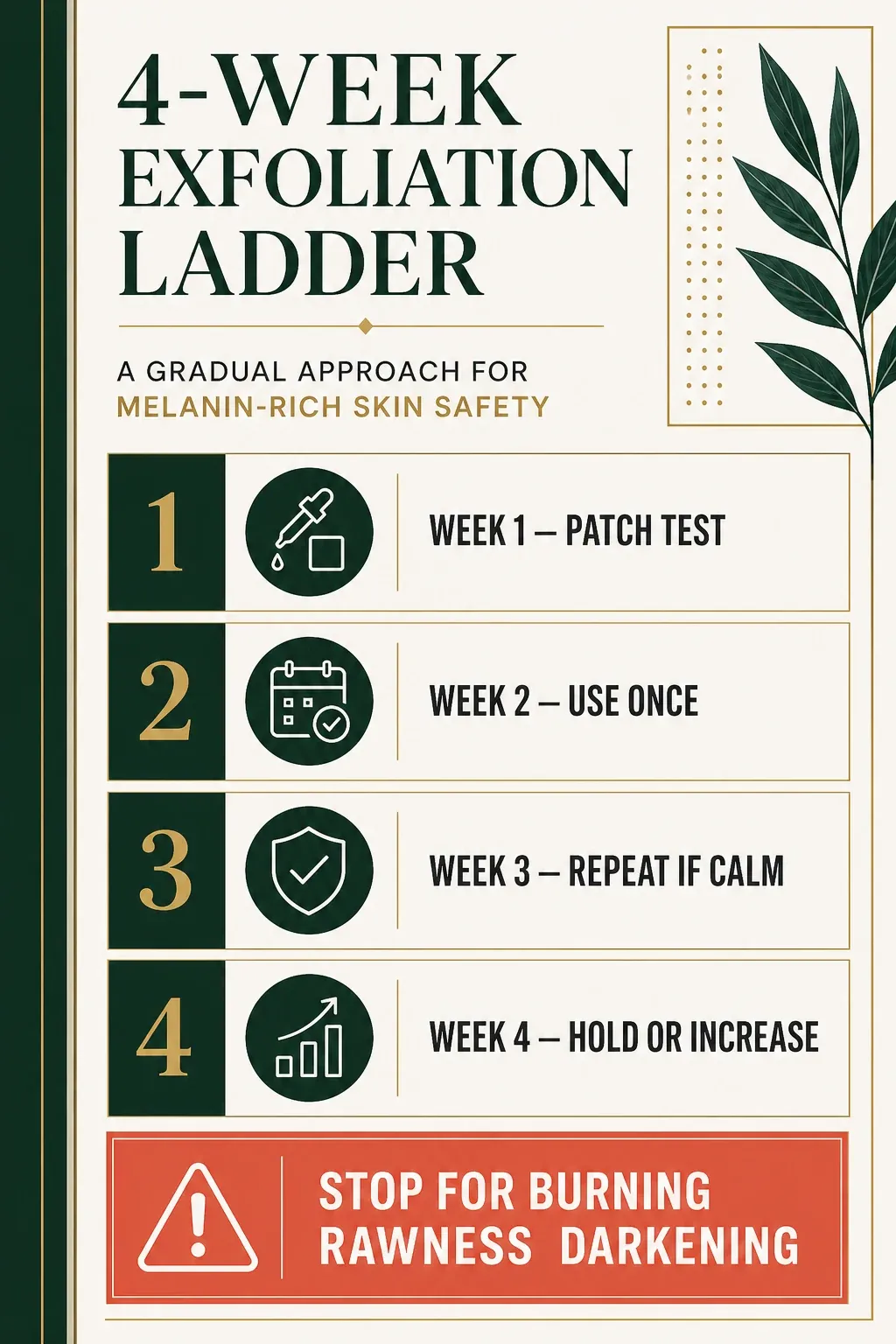
A Four-Week Exfoliation Ladder
| Week | Frequency | Decision signal |
|---|---|---|
| 1 | Patch test only | No itch, swelling or delayed rash |
| 2 | One evening use | No persistent burning or rawness |
| 3 | Repeat once | No rising flakes or darker patches |
| 4 | Maintain or increase to twice weekly | Clear benefit with stable comfort |
| Any time | Pause and simplify | Required for pain, rash or pigment worsening |
Signs of Over-Exfoliation
Persistent stinging, shiny-raw texture, widespread flakes, swelling and burning with water or moisturizer indicate barrier injury. New diffuse darkening can follow irritation. Stop acids, scrubs and optional actives.
Use a gentle cleanser, fragrance-free moisturizer and sunscreen until comfort returns. Do not exfoliate away flakes. The damaged barrier signs guide gives a structured reset.
Seek care for blistering, severe swelling, crusting, eye involvement or breathing symptoms. Persistent pigment change or scarring also deserves professional assessment. Keep the product and timing details.
Common Exfoliation Myths
- Darker skin is thicker: skin tone does not prescribe stronger acids.
- Peeling means it works: visible injury can create PIH.
- Scrubs remove dark spots: friction can prolong them.
- Natural enzymes are always gentle: botanical formulas can irritate and vary.
- Higher percentage works faster: pH, contact time and tolerance matter.
- Daily use is the goal: the lowest effective frequency is often better.
When to See a Dermatologist
Seek care for melasma, deep acne, scars, widespread PIH or a history of keloids before using strong peels. A clinician can identify whether the problem is pigment, redness, texture or active disease. The treatment plan changes accordingly.
A review of PIH in skin of color emphasizes early treatment of the inflammatory cause plus photoprotection. Procedures can help selected resistant cases but are not universal first steps.
Do not continue a product that repeatedly burns or darkens the skin. Earlier correction limits another pigment cycle. Bring the complete routine to the appointment.
Understanding Acid Percentage, pH and Contact Time
A ten-percent acid is not fully described by percentage. pH and buffering affect free-acid availability, while contact time and vehicle change exposure. Comparing percentages across brands can be misleading.
Rinse-off cleansers have shorter contact than leave-on serums. A weekly mask can still be strong. Follow the exact label rather than transferring directions from another product.
Do not neutralize a home acid with baking soda unless the product specifically provides and instructs a neutralizer. Improvised chemistry can create heat, uneven pH and more irritation. Rinse as directed and seek advice for a significant burn.
Lactic, Glycolic, Mandelic and Salicylic Acid
Lactic acid is an AHA that can support surface texture and has humectant properties. Glycolic acid has a smaller molecule and can be effective but irritating at higher exposure. Mandelic acid is larger and often marketed as gentler, though formula still matters.
Salicylic acid is oil-soluble and can fit clogged pores. It is not automatically the best choice for dry roughness. Avoid duplicating it across cleanser, toner and spot treatment.
Choose a known concentration from a reputable manufacturer and start at the lowest practical frequency. The ingredient-label guide illustrates why the complete formula and allergy history matter beyond a hero active.
Body Exfoliation and Dark Marks
Elbows, knees and heels tolerate different products from underarms, neck and bikini areas. Friction, shaving and occlusion make folds more reactive. Do not use a strong facial or foot peel on a sensitive fold.
Darkened neck or folds can have medical causes, including acanthosis nigricans, and should not be scrubbed aggressively. Seek evaluation when thick velvety change develops. Bleaching does not treat the cause.
For keratosis pilaris, lactic acid, salicylic acid or urea may help selected people, but consistency and moisturizer matter. Stop when burning or darker patches appear. Body results still require sunscreen on exposed areas.
Post-Peel Aftercare
After an exfoliating product, use a gentle cleanser, fragrance-free moisturizer and sunscreen. Avoid waxing, scrubs, retinoids and additional acids until the skin is fully comfortable. Do not pick peeling sheets.
Temporary mild dryness can occur, but severe pain, blistering, swelling or sharply worsening pigment is not routine aftercare. Contact the treating clinician or seek urgent advice depending on severity. Keep the product strength and timing.
Professional procedures should include written aftercare and a contact plan for complications. Ask who manages a burn or pigment flare before treatment. A low price does not offset inadequate follow-up.
Exfoliation in Pregnancy and During Medication
Pregnancy changes which acne and pigment treatments are appropriate. Do not infer safety from an over-the-counter label or a natural-acid claim. Review salicylic acid area, concentration and retinoid avoidance with a clinician.
Isotretinoin and prescription retinoids can greatly change tolerance and procedure timing. Tell a clinician about all medications before a peel. Do not hide supplement or topical use.
When uncertain, prioritize cleanser, moisturizer and sunscreen until professional guidance is available. Delaying an optional exfoliant is safer than creating a burn. Pregnancy-related melasma needs pigment-aware sun protection.
How to Assess Results at Eight Weeks
Track texture, clogged pores, inflammatory lesions, dark marks and comfort as separate outcomes. Use photographs in the same lighting every two weeks. Immediate shine after application is not a long-term result.
Keep the schedule stable unless irritation appears. If texture improves but pigment worsens, the product has failed the full goal. Reduce frequency or stop.
No improvement after a consistent tolerated trial suggests a mismatch in concern or mechanism. Seek diagnosis for scars, melasma or active acne. Adding strength without clarity increases risk.
Maintaining Results Without Escalation
Once the lowest effective frequency is found, keep it rather than increasing automatically. Seasonal dryness, medication and procedures may require a temporary reduction. A maintenance routine should remain comfortable.
Use sunscreen and moisturizer every day even when exfoliation is paused. Texture does not rebound because an acid was skipped for one week. Barrier recovery protects long-term pigment results and supports safer future treatment decisions.
The Bottom Line
Safe exfoliation for darker skin is controlled, not weak. Choose one mechanism, start once weekly, support the barrier and monitor pigment as well as texture. Burning and darkening are reasons to stop.
For post-inflammatory hyperpigmentation, prevent new inflammation and use sunscreen before escalating acids. Professional peels require an experienced clinician because depth and complication management matter.
Frequently Asked Questions About Exfoliation for Darker Skin
How often should darker skin be exfoliated?
Start once weekly after patch testing. Increase to twice weekly only when the skin remains comfortable and there is a clear benefit without new darkening.
Which exfoliant is best for melanin-rich skin?
Choose by concern: salicylic acid for clogged pores, a mild AHA for surface roughness or a clinician-guided retinoid for acne and photoaging. There is no universal best.
Can exfoliation make dark spots worse?
Yes. Burning, friction and barrier injury can trigger post-inflammatory hyperpigmentation. Stop for rawness, swelling or new darkening.
Are chemical peels safe for darker skin?
Selected peels can be used by clinicians experienced with skin of color, but agent, depth, preparation and aftercare matter. Strong home peels add avoidable risk.
Should I scrub ashy skin?
Usually start with gentler washing and a cream on damp skin. Scrubbing dry scales can increase irritation without fixing the barrier.
This article is for informational purposes only and does not replace professional dermatological advice.